President Milei of Argentina, Who Called for 'Anti-China, Anti-Communism'
Requested Extension by Sending Letter but Was Rejected
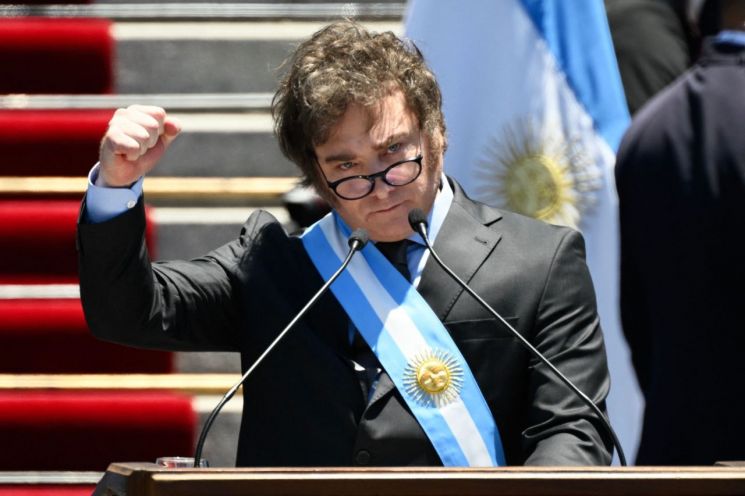
China has suspended a currency swap agreement worth $6.5 billion (approximately 8.48 trillion KRW) with Argentina. This decision came just 10 days after Argentine President Javier Milei, who had fiercely criticized China and called for severing ties throughout his election campaign, took office.
On the 21st, Hong Kong's South China Morning Post (SCMP), citing local Argentine media reports, stated, "China has suspended the $6.5 billion currency swap agreement," adding, "China will suspend the currency swap agreement until President Milei clearly expresses his willingness to cooperate with China."
The Chinese Embassy in Argentina did not respond to inquiries about the veracity of the reports, according to SCMP. Wang Wenbin, spokesperson for the Chinese Ministry of Foreign Affairs, also did not confirm the facts during a briefing the previous day, only stating, "China will cooperate with Argentina based on equality and mutual benefit."
The two countries had renewed the currency swap annually since 2009. For Argentina, whose dollar reserves are in negative territory and is effectively in a state of international debt default, the currency swap with China has been regarded as one of the few credit options among South American countries.
In October, China had promised to extend the currency swap with Sergio Massa, then Argentina’s Minister of Economy, but he lost the presidential election last month to Milei by a margin of 11.3 percentage points. Throughout his campaign, Milei shouted "anti-China and anti-communism." He declared, "We will not do business with communist countries, and therefore will sever relations with China," adding, "We will do business with civilized places." However, after his election, he reportedly changed his stance and sent a letter to the Chinese government requesting a renewal of the currency swap worth $5 billion.
According to Argentine media outlet Infobae, China’s suspension of the currency swap is also believed to be influenced by Argentina’s purchase of used fighter jets (F-16) made in the United States. Before Milei’s election, Argentina was reportedly negotiating to purchase Chinese jets (JF-17 Thunder). Infobae predicted that for China to resume the currency swap, Argentina would need to demonstrate a "clear goodwill or friendly attitude."
Argentina now faces the situation of having to find funding sources through debt renegotiations with the International Monetary Fund (IMF), but SCMP forecasted that it would be difficult without the "buffer" of a currency swap with China.
© The Asia Business Daily(www.asiae.co.kr). All rights reserved.
![Clutching a Stolen Dior Bag, Saying "I Hate Being Poor but Real"... The Grotesque Con of a "Human Knockoff" [Slate]](https://cwcontent.asiae.co.kr/asiaresize/183/2026021902243444107_1771435474.jpg)















