'Yeongwol Bundeokjae Cave' Widely Distributed with Flowstones and Stalactites
Thin Flowstones Extending Like Threads Confirmed for the First Time
A cave discovered during the construction of the Bundeokjae Tunnel on Island Road No. 9 will be designated as a natural monument. It is the 'Yeongwol Bundeokjae Cave,' the fourth longest limestone cave in South Korea. The Cultural Heritage Administration announced on the 21st that it will collect opinions from various sectors for a month and finalize the designation through a review by the Cultural Heritage Committee. If designated, various academic materials containing the cave's value will be secured, and a systematic preservation management plan will be established based on this.
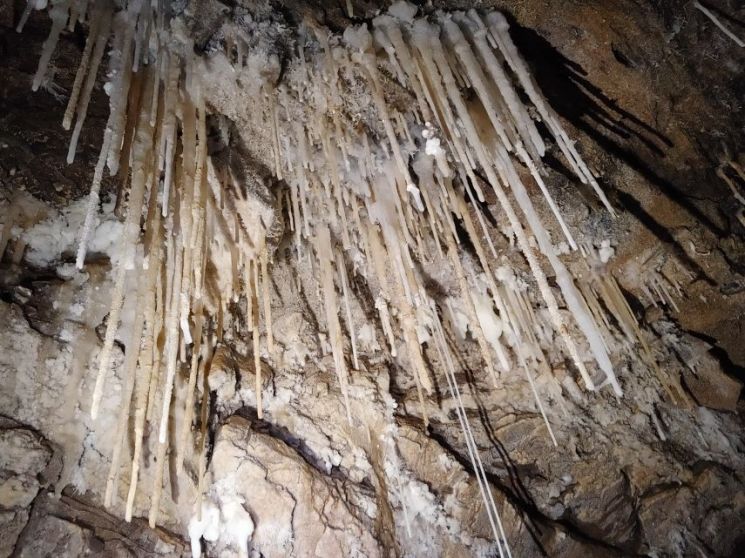
Yeongwol Bundeokjae Cave is a natural cave discovered in 2020 during the construction of the Bundeokjae Tunnel at the boundary between Yeongwol-eup and Buk-myeon. Immediate protective measures were taken, resulting in an excellent state of preservation. According to the preliminary survey report, the cave is 1,810 meters long. Flowstones, calcite formations, stalactites, and other features are widely distributed in various sizes and shapes.
Flowstones generally extend like thin threads in various directions. They are also found in various shapes such as ‘ㄱ’ (L-shape), ‘ㄴ’ (reverse L-shape), and ‘stairs.’ The Cultural Heritage Administration explained that this is a "form discovered for the first time in South Korea." Stalactites are straw-shaped, formed by water droplets falling from the ceiling, and can reach lengths of up to 3 meters. Stalagmites are scattered throughout the cave. All of these were formed as calcite materials in water droplets grew upward from the floor.
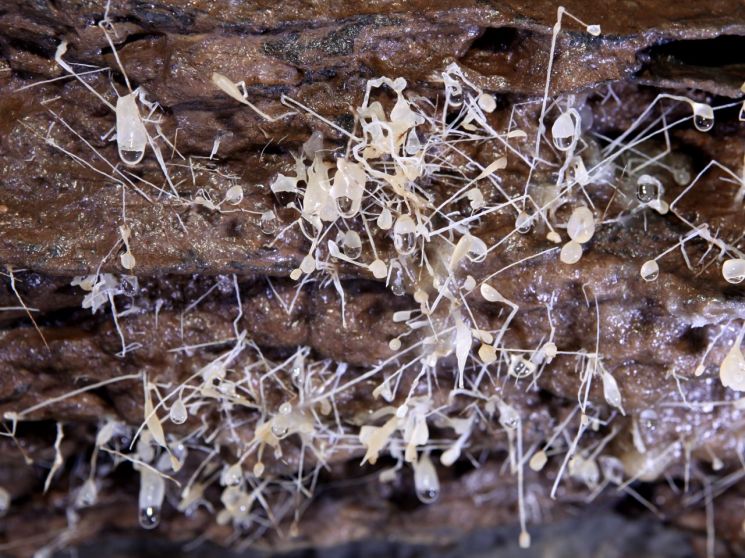
In addition, Yeongwol Bundeokjae Cave contains speleothems such as columns (stone pillars) and stalagmites, as well as solutional holes (bell-shaped holes formed by the dissolution action of groundwater seeping into the cave), potholes (holes formed by pebbles rotating and grinding the riverbed in concave parts along the riverbed), and desiccation cracks (irregular polygonal sedimentary structures). These small-scale and subtle topographic features are evaluated as having excellent academic and educational value.
This cave is also the largest among those found in the Machari Formation. The Machari Formation is a Paleozoic early geological layer formed by alternating deposits of limestone and black shale (clay sedimentary rock). Paleozoic fossils are frequently found here. The Cultural Heritage Administration added, "The cave passage walls, with severe irregularities caused by erosion and dissolution, clearly show the characteristics of the Machari Formation."
© The Asia Business Daily(www.asiae.co.kr). All rights reserved.
![Clutching a Stolen Dior Bag, Saying "I Hate Being Poor but Real"... The Grotesque Con of a "Human Knockoff" [Slate]](https://cwcontent.asiae.co.kr/asiaresize/183/2026021902243444107_1771435474.jpg)
















