Ministry of Science and ICT Promotes Policy to Ease Communication Cost Burden
The Ministry of Science and ICT announced a plan to alleviate the burden of communication fees as a follow-up measure to the 'Measures to Promote Competition in the Telecommunications Market' announced in July and the 'Measures to Alleviate the Burden of Communication Fees' announced in November.
The Ministry of Science and ICT stated that to expand the choice of telecommunications service users, it plans to implement ▲the phased abolition of restrictions on subscription to mobile phone plans based on device types by the three major mobile carriers, ▲exemption from cancellation penalties for wired communication and broadcasting services for residents affected in disaster areas, and ▲the introduction of a pre-reservation system for the mobile phone selection discount (25% discount on fees).

Following SK Telecom's abolition of restrictions on subscription to plans based on device types on the 23rd of last month, KT and LG Uplus also reported amendments to their terms of use with the same content. From the 22nd, existing and new KT subscribers will be able to freely subscribe to 5G and LTE plans regardless of the device type such as 5G or LTE. LG Uplus plans to abolish subscription restrictions after completing preparation procedures such as system work, starting from January 19 next year.
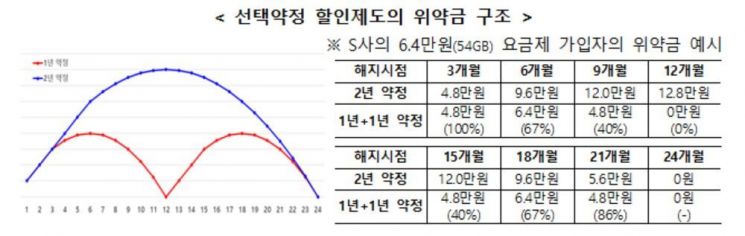
A 'Pre-Reservation System for the 25% Selection Discount' has also been prepared to alleviate the inconvenience experienced by users receiving the selection discount. Article 6 of the 'Act on the Improvement of Distribution Structure of Mobile Communication Devices' (the Mobile Device Act) stipulates that users who subscribe to mobile communication services without receiving device subsidies should be provided with a 25% selection discount on fees. Currently, the discount rate for 1-year and 2-year contracts is the same at 25%, and the cancellation penalty (discount refund) is lower when choosing a 1-year contract; however, a significant number of users choose a 2-year contract. This appears to be because re-contracting after the contract expires is cumbersome and awareness of the penalty structure is low.
Accordingly, the Ministry of Science and ICT, in consultation with the three major mobile carriers, decided to introduce a 'Pre-Reservation System for the 25% Selection Discount' that allows subscribers choosing a 1-year contract to pre-reserve an additional 1-year contract extension. After preparation such as system development by each carrier, this will be implemented from March 29 next year. Along with the existing 1-year and 2-year contracts, users will be able to choose a '1-year + 1-year (pre-reservation)' contract, and subscribers under this contract will have their contract automatically extended for one year after the initial 1-year contract expires.
Additionally, each company will improve their subscription application forms and websites to strengthen explanations about the penalty structure, and include URLs for immediate re-contract application in notification messages sent at contract expiration points (twice before expiration, on the day of expiration, and once after expiration) to enhance convenience for re-contract applications.
The Ministry of Science and ICT stated, "We will significantly reduce the switching costs for users to move to carriers that offer plans suitable for them, allowing them to enjoy real benefits of reduced fee burdens. We expect that more users will receive the 25% selection discount by alleviating the inconvenience experienced during the re-contract application process after contract expiration."
Cancellation penalties for wired communication and broadcasting services will be waived for residents affected in disaster areas. Opinions have been raised that users whose homes have been damaged to the point of being uninhabitable due to heavy rain, landslides, etc., should be able to cancel their service contracts without penalty since they can no longer use wired communication and broadcasting services at the affected location. Under current terms of use, only service suspension or transfer installation to a new residence is possible.
Accordingly, the Ministry of Science and ICT has agreed with the four major telecommunications companies, cable TV companies, Internet TV (IPTV) companies, and satellite broadcasting companies to allow users whose residential facilities have been destroyed, partially destroyed, or severely damaged by disasters to cancel their service contracts without penalty. From February next year, users wishing to cancel services due to residential facility damage can submit a damage confirmation certificate issued by the local government head according to relevant laws within six months from the disaster date to the telecommunications company, and will be exempt from contract discount refunds, equipment rental fee refunds, and compensation for equipment loss or damage.
The Ministry of Science and ICT is actively promoting policies to alleviate the burden of communication fees to ease the economic burden on people's livelihoods, which has been exacerbated by prolonged high inflation and high interest rates.
First, in the first half of this year, through consultations with telecommunications companies, the 5G plan tiers were subdivided, and new plans for youth, seniors, online users, and budget phone users with expanded data allowances and additional benefits were introduced, significantly expanding plan choices and enabling users to select plans closer to their actual usage.
In the second half of the year, to alleviate the burden of using ultra-high-speed internet services mainly bundled with mobile phones and to improve ease of switching providers, the penalty (discount refund) structure was improved to significantly reduce cancellation burdens in the latter part of contracts.
As a result of these policy efforts, the average monthly total household consumption expenditure in the third quarter of this year increased by about 3.9% compared to the same period last year (2,702,000 KRW → 2,808,000 KRW), but the average monthly household communication expenditure decreased by about 1% (131,000 KRW → 130,000 KRW). In October this year, the overall consumer price index rose by about 3.8% year-on-year (109.21 → 113.37), but the communication price index remained relatively stable (100.68 → 101.01).
Furthermore, the Ministry announced a comprehensive implementation plan to expand user choice and reduce communication fee burdens and is carrying out follow-up measures. To alleviate device cost burdens, as a result of consultations with manufacturers, two mid-to-low priced devices priced between 400,000 and 800,000 KRW (Galaxy Jump 3 on November 10 and Galaxy S23 FE on December 8) were released. Three to four additional models are planned to be released in the first half of next year.
The wholesale provision obligation system, which is the institutional foundation of budget phones (a system requiring dominant mobile operators to wholesale their networks to budget phone providers), has been made permanent, providing a stable growth base for budget phones to launch more affordable and diverse plans.
The Ministry of Science and ICT stated, "We will continue to identify and improve user inconveniences, and faithfully implement the 'Measures to Alleviate the Burden of Communication Fees,' including the introduction of 30,000 KRW-level 5G plans, expansion of mid-to-low priced device releases, and inducement of budget phone plan launches."
© The Asia Business Daily(www.asiae.co.kr). All rights reserved.
![Clutching a Stolen Dior Bag, Saying "I Hate Being Poor but Real"... The Grotesque Con of a "Human Knockoff" [Slate]](https://cwcontent.asiae.co.kr/asiaresize/183/2026021902243444107_1771435474.jpg)















