Seo Ji-hyun, former deputy chief prosecutor of the Seongnam branch of the Suwon District Prosecutors' Office (age 50, Judicial Research and Training Institute class 33), ultimately lost a civil lawsuit claiming that former Ministry of Justice Prosecutor General Ahn Tae-geun (class 20) forcibly molested her and gave her unfavorable personnel treatment.
The Supreme Court's 2nd Division (Presiding Justice Kwon Young-joon) on the 21st upheld the lower court ruling that dismissed Seo's appeal in the lawsuit seeking 100 million won in damages against former Director Ahn and the state.
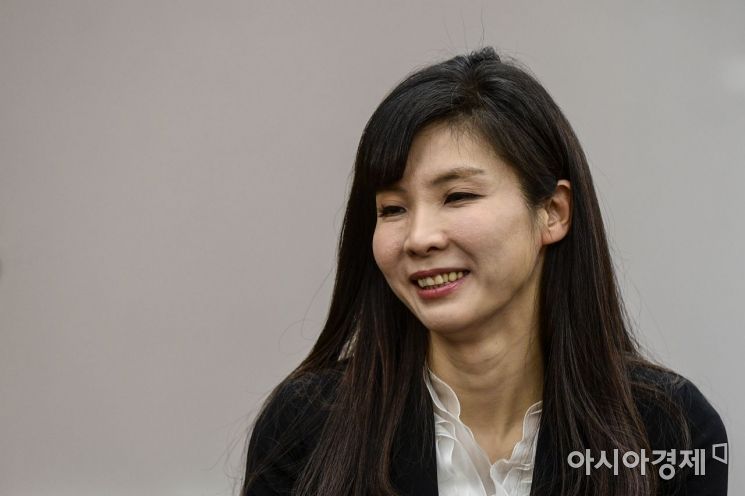 In January 2018, Seo Ji-hyun, deputy chief prosecutor at the Suwon District Prosecutors' Office Seongnam Branch, who came forward with a 'Me Too' allegation against former Prosecutor General Ahn Tae-geun, is seen smiling brightly after concluding a press conference announcing her position on January 24, 2019, at the Seoul Bar Association building in Seocho-gu, Seoul. Photo by Kang Jin-hyung aymsdream@
The court explained the reason for dismissing the appeal, stating, "There is no error affecting the judgment such as failure to conduct necessary hearings for the lower court's decision, violation of the rules of logic and experience beyond the limits of free evaluation of evidence, misunderstanding of legal principles regarding the starting point of the statute of limitations, abuse of rights, contradictory reasoning, or omission of judgment."
Seo claimed that in 2010, at the funeral of a female prosecutor's father, former Director Ahn forcibly molested her, and when she raised the issue, Ahn, who was in charge of personnel at the prosecution in 2015, retaliated against her with unfavorable personnel transfers.
Within the prosecution, in branch offices without a chief prosecutor or deputy chief prosecutor, where branch chiefs and deputy prosecutors are assigned, the workload is relatively heavier than in district prosecutors' offices with a chief prosecutor or branch offices with a deputy chief prosecutor. Therefore, a 'Career Prosecutor Branch Office Assignment System' was operated to allow career prosecutors to be preferentially assigned to their desired posts in the next personnel reshuffle. Seo argued that her transfer from the Suwon District Prosecutors' Office Yeoju branch, a branch office, to the Changwon District Prosecutors' Office Tongyeong branch, another branch office, in the second half of 2015 personnel reshuffle on August 20, was problematic.
However, both the first and second trials rejected Seo's claims.
The first trial court ruled that even if the fact of forced molestation was recognized, the claim for damages was not admissible because the statute of limitations of three years had passed since Seo became aware of both the victimization and the perpetrator.
The court also dismissed Seo's claim that former Director Ahn ordered the preparation of unfavorable personnel plans, stating that personnel matters are subject to the discretion of the personnel authority or the practical staff assisting them, and there was insufficient evidence to prove that Ahn abused or exceeded his discretion.
The court stated, "Personnel transfers fall within the authority of the personnel officer, who has considerable discretion unless restricted by law. Practical staff who assist or support the execution of personnel duties under the direction or delegation of the personnel officer also have certain authority and roles within that scope and thus possess discretion."
Regarding the Career Prosecutor Branch Office Assignment System, which Seo cited as the basis for retaliatory personnel action, the court said, "Even if the system was maintained as one of the personnel standards or considerations at the time of preparing the personnel plan in this case, it merely means that career prosecutors working at branch offices are given consideration in the next transfer. It is one of several personnel standards or considerations and cannot be regarded as a mandatory or absolute standard that personnel officers must follow when preparing transfer plans, nor is there evidence that it holds unilateral superiority over other personnel standards or considerations."
The court concluded that since former Director Ahn's illegal acts were not recognized, the state's liability for damages based on that premise could not be acknowledged.
The second trial court reached the same conclusion.
Seo revealed the forced molestation by former Director Ahn in January 2018, which became a catalyst for spreading the 'Me too' movement across various sectors of society.
Meanwhile, Ahn, who was indicted on charges of abuse of authority related to retaliatory personnel actions, was sentenced to two years in prison in the first and second criminal trials. However, after the Supreme Court overturned the conviction and remanded the case, the retrial acquitted him, and since the prosecution did not appeal, the acquittal became final.
© The Asia Business Daily(www.asiae.co.kr). All rights reserved.

















