Cleaning of a 70s Resident Suspected of Hoarding in Dong-gu, Busan
Over 20 Volunteers Participated in Organizing for Two Days
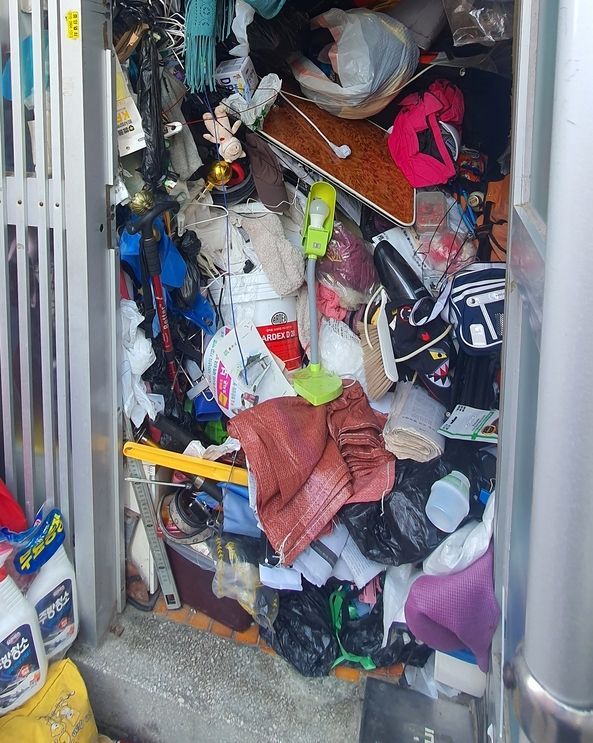 The waste found inside Mr. A's house amounts to a total of 13 tons, equivalent to 10 trucks of 1-ton capacity.
 [Photo by Dong-gu Office, Busan]
Nearly 13 tons of items piled up in the home of a person in their 70s suspected of hoarding disorder were cleared after almost a year of persuasion by local government authorities. The items were stacked to the point of mostly blocking the entrance, making access difficult.
According to Dong-gu, Busan on the 19th, the Dong-gu Senior Welfare Center has been monitoring Mr. A since early this year and visited his home. Mr. A's two-story detached house in the district was filled with waste. Various items, from furniture and home appliances to plastic bags, were piled up inside Mr. A's home.
 A 70-year-old's house, suspected of hoarding disorder, was cleared of 13 tons of accumulated items after nearly a year of persuasion by the local government. The items were piled up to the extent that they mostly blocked the entrance, making access difficult.
 [Photo by Dong-gu Office, Busan]
A Dong-gu official explained, "Items were stacked so much that one could barely climb to the second floor by holding onto a rope hanging on the stairs."
At first, Dong-gu staff provided Mr. A with garbage bags to encourage him to clean up by himself. They repeatedly checked whether the trash was being taken out on time and persuaded him.
However, Mr. A only responded, "I will clean up myself," but did not follow through. Then, last summer, when a foul odor began to permeate the house, the district staff and Mr. A agreed on a date to "clean up the items," and Mr. A even signed a pledge to cooperate with the district office if he failed to do so.
In the end, even after the agreed date passed, the trash was not disposed of, so the Dong-gu Office took direct action to clean up. The enormous amount of waste they first encountered was not easy to remove.
Above all, since Mr. A is not a basic livelihood security recipient, a separate budget was needed for cleaning and waste disposal, and due to the large volume of trash, many volunteers were required.
A Dong-gu official said, "After recruiting about 20 volunteers, the cleaning was carried out over two days last month," adding, "The district office partially supported the costs, and Mr. A and his family agreed to bear the rest."
The waste removed from Mr. A's home amounted to 13 tons, equivalent to ten 1-ton trucks.
The Dong-gu official said, "It appears that hoarding symptoms emerged due to a combination of family discord and financial difficulties," and added, "Just as we cleaned Mr. A's home after nearly a year of persuasion, we will continue to identify and systematically manage households suspected of hoarding disorder."
'Hoarding Disorder' is Three Times More Common Among the Elderly Than the Young
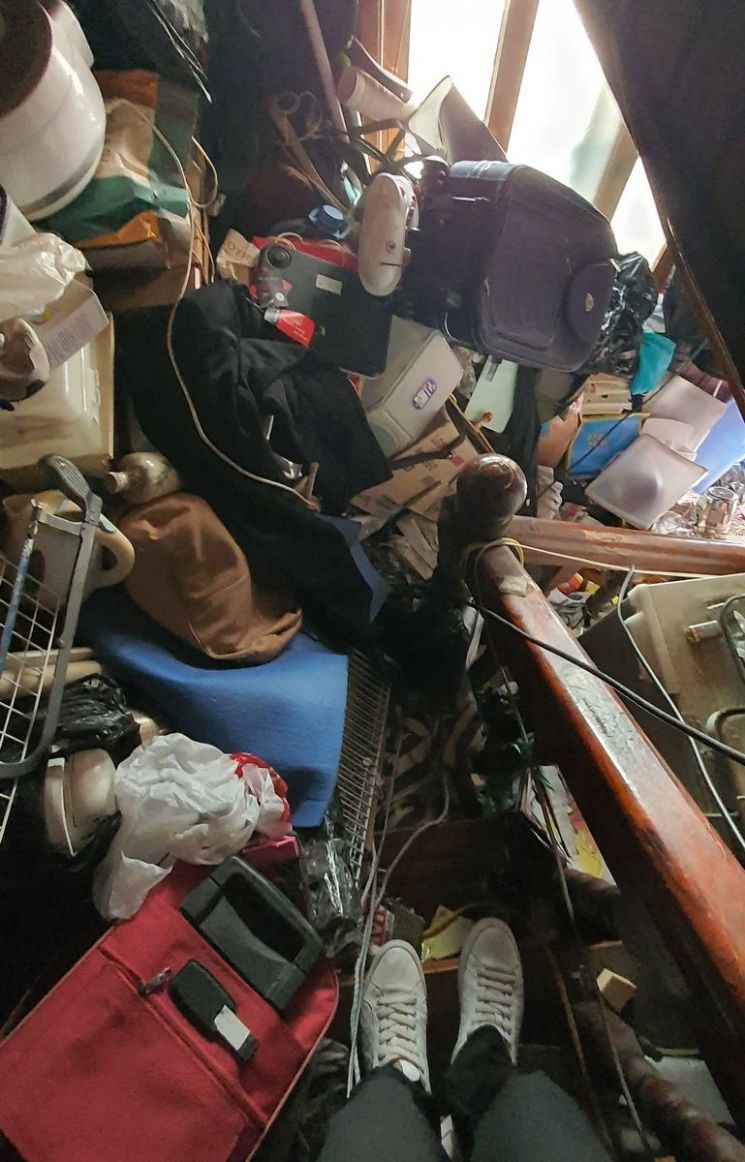 'Storage obsession,' the inability to throw away items and accumulating them, refers to the worry or anxiety that items, although currently useless, might be needed later.
 [Photo by Dong-gu, Busan]
'Hoarding' refers to the inability to discard items and the accumulation of possessions due to worries or anxiety about possibly needing them later, even if they are currently useless.
If this worry intensifies, it can worsen into 'hoarding disorder,' where a person cannot throw anything away and compulsively collects items. Hoarding disorder is a type of obsessive-compulsive disorder and is also known as compulsive hoarding or hoarding syndrome. Regardless of whether items are used, individuals collect them, and if they cannot hoard, they experience anxiety and unpleasant feelings. The elderly are about three times more likely to suffer from this than younger people.
Hoarding disorder occurs when the frontal lobe fails to perform functions such as decision-making and planning behavior. Because they cannot judge the necessity of items, they cannot discard them and instead store them.
Due to impaired brain function, the ability to categorize items decreases, and traits such as indecisiveness, avoidance, interpersonal problems, and distractibility often accompany the disorder. Symptoms typically first appear between ages 11 and 15, such as an inability to discard old newspapers, magazines, or clothes. It often develops into a chronic condition.
Since hoarding disorder symptoms worsen over time, active treatment should be sought at an appropriate stage. If symptoms deteriorate, individuals may accumulate items until their homes are filled with trash without discarding anything. This can increase the risk of respiratory infections, skin diseases, and other health problems.
Patients with hoarding disorder often do not recognize their symptoms as a disease, even when severe odors and unsanitary conditions make daily life impossible. Moreover, the boundary of the disorder is unclear, so many patients do not realize their symptoms and do not receive treatment. Even when treated, it is generally more difficult to treat than other obsessive-compulsive disorders.
Accordingly, the American Psychiatric Association classifies hoarding disorder as a mental illness requiring treatment and estimates that 2-5% of the U.S. population suffers from it. However, in South Korea, there are no proper statistics or surveys yet, so even when some local governments want to provide assistance, they often cannot do so in practice.
© The Asia Business Daily(www.asiae.co.kr). All rights reserved.
![Clutching a Stolen Dior Bag, Saying "I Hate Being Poor but Real"... The Grotesque Con of a "Human Knockoff" [Slate]](https://cwcontent.asiae.co.kr/asiaresize/183/2026021902243444107_1771435474.jpg)


















