Yoon: "We Must Strive for Economic Performance That Citizens Can Feel"
Orders on Regulating Platform Company Monopolies and Managing Supply Chain Risks
President Yoon Suk-yeol stated on the 19th, in response to a foreign news article reporting that South Korea ranked second in economic performance among OECD countries, that this achievement is "the result of the entire nation's endurance through pain and efforts to turn crisis into opportunity amid the complex global economic challenges."
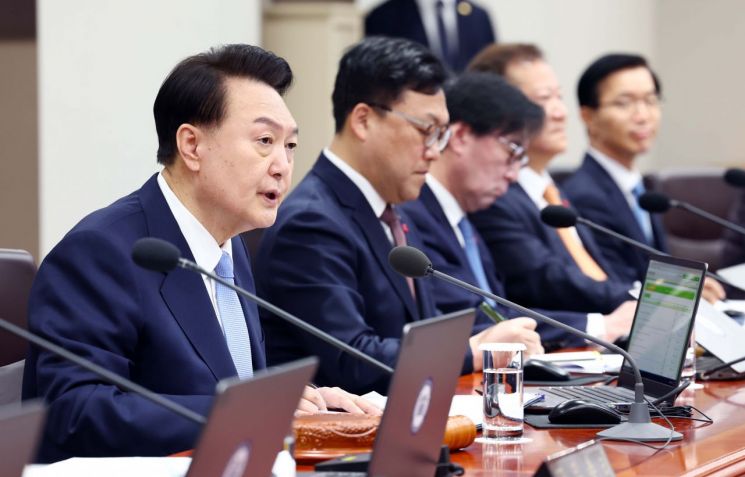
President Yoon made these remarks during his opening address at the 54th Cabinet meeting held in the State Council Meeting Room at the Yongsan Presidential Office on the same morning, citing a report from the British weekly magazine The Economist.
He said, "I believe this evaluation reflects the efforts to restore a private sector-led, market-centered economy under the sound fiscal policy stance that our government has maintained so far," and emphasized, "Next year, let us work harder so that the people can tangibly feel these economic achievements."
President Yoon also mentioned, "This year, our economy is expected to achieve a current account surplus of 30 billion dollars," adding, "Next year, macroeconomic indicators such as current account, growth, employment, and inflation will improve further."
Earlier, The Economist reported on the 17th that South Korea ranked second in a composite score calculated from five economic and financial indicators?core inflation rate, inflation diffusion level, gross domestic product (GDP) growth rate, employment growth rate, and stock price increase rate?covering 35 OECD countries from October last year to September this year.
Greece, which experienced a sovereign debt crisis over a decade ago and received multiple bailouts, but has recently shown high economic growth rates for several years through market-friendly policies, ranked first for the second consecutive year in The Economist’s evaluation.
Greece’s core inflation index, excluding items with prices highly affected by external factors such as energy and agricultural products, was 3.4%, and its stock price increase rate reflecting inflation reached 43.8%.
South Korea recorded a core inflation index of 3.2%, GDP growth rate of 1.6%, and stock return rate of 7.2%, securing second place. The inflation diffusion level, which indicates the proportion of items with an annual price increase rate of over 2%, also dropped by 13 percentage points compared to the same period last year, reaching 60%.
Among the top ranks excluding South Korea, many countries from the Americas such as the United States (3rd), Canada (6th), and Chile (7th) were included. European countries like Germany (27th), the United Kingdom (30th), Sweden (31st), and Finland (35th) recorded relatively lower rankings.
Meanwhile, the report also pointed out the need for bold reforms regarding the current economic situation, including regulation of monopolies by platform companies and management of supply chain risks. President Yoon criticized, "If monopolistic structures become entrenched, small business owners and consumers will have no alternative services to switch to," adding, "They will lose freedom of choice, and the birth of new platform startups will be restricted, preventing dynamic innovation from taking root."
He particularly urged related ministries such as the Fair Trade Commission to unite in responding to unfair discriminatory practices against small business owners within platforms and monopolistic profit-seeking behaviors, and called for the establishment of institutional measures to regulate monopolistic abuse.
Regarding the increasing risks to supply chains directly linked to people’s livelihoods, such as the supply of diesel exhaust fluid, President Yoon explained, "The government has prepared response plans including the extension of tariff quotas, support for maritime transportation costs, and utilization of reserves, and companies are also discovering alternative import sources to cope without major disruption," adding, "We will also jointly seek fundamental measures such as establishing a domestic production system for essential items."
© The Asia Business Daily(www.asiae.co.kr). All rights reserved.

















