The number of foreigners employed in South Korea reached a record high of 923,000. This increase was influenced by the endemic situation, which led to a rise in non-professional employment (E-9) and international students. Among them, more than half were aged 30 or younger, and half of the wage workers earned between 2 million and 3 million KRW.
On the 18th, Statistics Korea and the Ministry of Justice announced the results of the "2023 Immigrant Residency Status and Employment Survey" containing these details.
As of May, the number of foreign residents (aged 15 and above) in South Korea was 1.43 million, an increase of 9.9% (129,000) compared to the previous year. Among them, the number of employed foreigners rose by 9.5% (80,000) to 923,000. Both the total number of foreigners and employed foreigners were the highest since related statistics began in 2012.
Im Kyung-eun, Director of Employment Statistics at Statistics Korea, explained, "This is due to a significant increase in non-professional employment and international students under the endemic conditions."
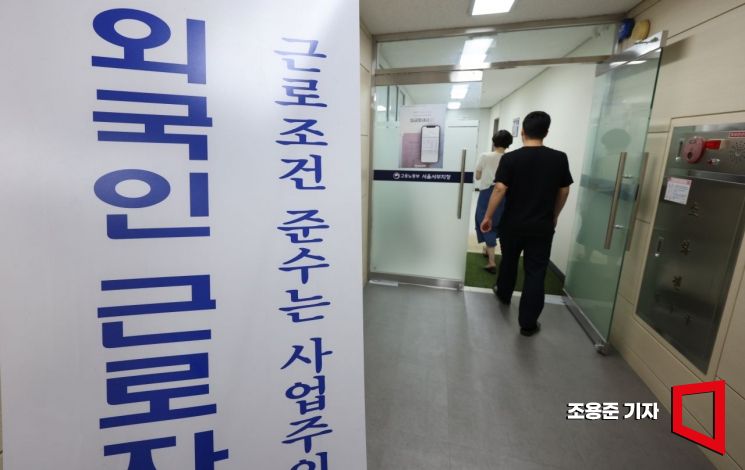 On the 11th, a notice regarding the employment of foreign workers was posted at the Western Branch of the Ministry of Employment and Labor in Mapo-gu, Seoul. Photo by Jo Yongjun
By age group, those in their 30s increased by 30,000 from the previous year to 308,000, accounting for 33.3% of the total. Those aged 15 to 29 also increased by 41,000 to 214,000, making up 23.2%. Thus, those aged 15 to 39 accounted for 56.5%. Those in their 40s and 50s accounted for 18.5% and 15.7%, respectively.
By nationality, Korean-Chinese made up the largest share at 35.3%, followed by Vietnamese (11.3%) and Chinese (4.9%). Other Asian countries accounted for 39.8%.
By industry, mining and manufacturing accounted for 44.6%, wholesale, retail, accommodation, and food services 18.4%, and business, personal, and public services 15.5%.
The number of foreign wage workers was 873,000, representing 94.5% of all employed foreigners. Among wage workers, the largest group earned between 2 million and less than 3 million KRW, totaling 442,000 (50.6%), followed by those earning 3 million KRW or more at 313,000 (35.8%). Those earning between 1 million and less than 2 million KRW and less than 1 million KRW accounted for 9.9% and 3.7%, respectively.
Regarding foreigners' income, 32.8% had an average monthly total income between 2 million and less than 3 million KRW, and 24.4% earned 3 million KRW or more. Foreigners reporting no income over the past year accounted for 29.8%. Foreigners spent 39.4% of their total income on living expenses, with remittances (23.2%), savings (15.7%), and housing costs (11.8%) following.
Looking at housing types, 59.2% lived in rented housing (jeonse or wolse), while only 15.2% lived in their own homes. Those living in 'free' housing types such as dormitories, non-residential places, or vinyl greenhouses accounted for 25.6%.
The number of foreign international students was 188,000, an increase of 14.1% (25,000) from the previous year. By nationality, Vietnamese accounted for 38.3%, Chinese 27.7%, and Uzbek 6.4%. The most common reason for studying abroad was "because the educational program is excellent" at 30.0%, followed by "because the major matches my field of interest well" (21.9%), and "because a Korean degree helps with employment" (10.6%). The main majors were social sciences, media, information studies, business, administration, and law (28.8%), Korean studies (19.6%), and education, arts, and humanities (17.2%).
© The Asia Business Daily(www.asiae.co.kr). All rights reserved.
![Clutching a Stolen Dior Bag, Saying "I Hate Being Poor but Real"... The Grotesque Con of a "Human Knockoff" [Slate]](https://cwcontent.asiae.co.kr/asiaresize/183/2026021902243444107_1771435474.jpg)















