18th 4th Economic Security Diplomacy Forum
Economic Security Expands as a National Sovereignty Issue
Strategies Arise Weaponizing Interdependence
Need Two-Track Approach to Defend Predatory Supply Chains and Protect Domestic High-Tech Industries
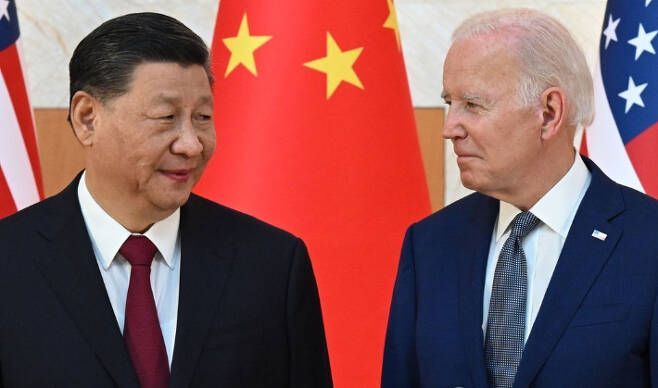
There is an assessment that a two-track strategy of defense (threat detection capability) and offense (fostering domestic advanced industries) is necessary for national interests, as ‘protectionism’ that controls economic supply chains like China could spread to any country such as the United States or Russia. National sovereignty can be defined as ‘the ability to determine one’s own destiny,’ and economic security should be viewed from the perspective of protecting sovereignty.
Such analysis was presented at the 4th Economic Security Forum held by the Ministry of Foreign Affairs’ Economic Security Diplomacy Center on the 18th at the Four Seasons Hotel Seoul, under the theme ‘Cooperation for Economic Security and Future Challenges.’ Fran?ois Nicolas, senior researcher at the French Institute of International Relations (IFRI), who participated as a panelist in the first session ‘International Cooperation to Strengthen Economic Security,’ explained, “Defense begins with detecting and deterring threatening partners to protect against predatory acts by foreign countries,” adding, “It is not only China that poses a threat. Threats can also come from the United States, which is considered a good partner, as well as Russia outside of China.”
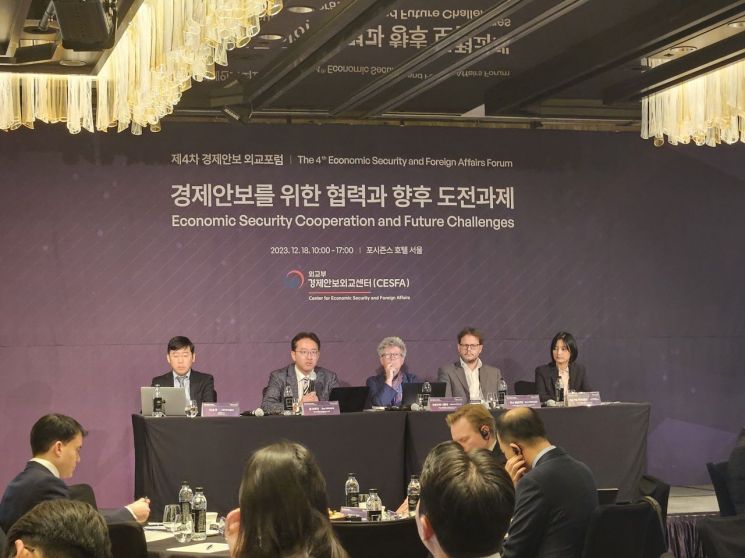 Chair and panelists of Session 1 at the '4th Economic Security Diplomacy Forum' hosted by the Ministry of Foreign Affairs Economic Security Diplomacy Center. (From left) Seungju Lee, Professor of Political Science and International Relations at Chung-Ang University; Ryo Sahashi, Associate Professor at the University of Tokyo, Japan; Fran?ois Nicolas, Senior Research Fellow at the French Institute of International Relations; Max Jenglein, Senior Economic Researcher at the Mercator Institute for China Studies, Germany; Khaokamol Pitakdumrongkit, Senior Research Fellow at Nanyang Technological University, Singapore.
He said, “The second axis complementing defense is the enhancement of advanced industrial capabilities,” explaining, “In France’s case, it is difficult to implement protectionism due to EU policies and the protection of free competition, so supporting domestic industries is used as an offensive measure.” Examples of industrial promotion policies include the ‘French Technological Sovereignty Fund’ and investment review systems. Senior researcher Nicolas added, “The discourse that globalization is not the optimal concept for economic development is expanding, and behaviors that use trade interdependence as a ‘weapon’ are emerging, spreading disappointment with globalization,” and “The issue has become whether a country can protect its assets from China.”
There was also a point made about the need for a ‘coordination platform’ related to economic coercion exercised by China, the ‘world’s factory,’ within the existing trade system centered on China. Ryo Sahai, associate professor at the Institute for Future Vision at the University of Tokyo, Japan, said, “At the ‘Hiroshima Summit,’ there was discussion on how a platform to coordinate economic coercion should operate,” but added, “The United States needs to take the lead in how to apply international law and take action first.” Max Zenglein, senior economic researcher at the Mercator Institute for China Studies (MERICS) in Germany, said, “A survey of German companies shows a significant number of responses emphasizing the need to monitor geopolitical and geoeconomic relations with China,” and “From Germany’s perspective, attempts to respond to China can be made through cooperation with ASEAN, the United States, Russia, and others.”
Kang Jae-kwon, director of the Ministry of Foreign Affairs’ Economic Diplomacy Coordination Office, said in his opening remarks at the foreign affairs forum that “the geopolitics of economic security faces challenges in various areas related to supply chains,” and “there is a need to reorganize the global cooperation network and derive cooperation agendas.”
© The Asia Business Daily(www.asiae.co.kr). All rights reserved.
![Clutching a Stolen Dior Bag, Saying "I Hate Being Poor but Real"... The Grotesque Con of a "Human Knockoff" [Slate]](https://cwcontent.asiae.co.kr/asiaresize/183/2026021902243444107_1771435474.jpg)
















