[K-Construction, New Challenge]
Establishing Integrated Supply Infrastructure for Anode and Cathode Materials
Leading Eco-Friendly Future Growth Company Leap
Securing energy supply chains has emerged as a critical task for 'resource security' amid geopolitical conflicts. The key focus of securing energy supply chains is to ensure that core resources can be supplied continuously at stable prices without interruption.
In particular, with the recent expansion of electric vehicle supply, secondary battery batteries have become a core industry for many countries, intensifying the competition to secure lithium, a key raw material (mineral) for battery materials. Lithium is a material that plays the role of the ‘rice’ of future industries, as it accounts for a very high proportion of the cost of cathode materials, which determine battery capacity, lifespan, and safety.
Among Korean companies, POSCO Holdings has rolled up its sleeves to secure a stable lithium supply chain. Since 2018, it has proactively invested about 300 billion KRW to acquire the HombreMuerto lithium salt lake in Argentina. Through this, POSCO Group plans to secure a lithium production capacity of 423,000 tons and high-purity nickel of 240,000 tons by 2030. Subsequently, it will produce 70,000 tons of lithium, nickel, and cobalt through its material recycling business. Through this, POSCO Group aims to establish a vertically integrated supply chain capable of producing 1 million tons of secondary battery cathode materials and 370,000 tons of anode materials. This is the world’s only secondary battery material supply value chain and is expected to significantly contribute to reducing Korea’s dependence on overseas resources.
Leading the Establishment of Secondary Battery Supply Chain Based on EPC Capabilities

POSCO E&C plays a key role in building POSCO Group’s secondary battery supply chain, leveraging its technical expertise and construction know-how from successfully building the largest integrated steel mills and energy plants domestically and internationally.
Specifically, it is engaged in engineering, procurement, and construction (EPC) projects covering raw material input, production processes, product automated warehouses, and auxiliary facilities for the secondary battery business. POSCO E&C has expanded phases 2, 3, and 4 of the world’s largest cathode material plant in Gwangyang, capable of producing 90,000 tons annually, and successfully built phase 2-1 of the anode material plant producing 20,000 tons annually in the Sejong City advanced industrial complex. Currently, it is carrying out expansion work for phase 2-2, which will produce 25,000 tons.
In particular, POSCO E&C is pouring its capabilities into building anode material production plants, the future growth engine, in cooperation with several group companies such as POSCO Future M and POSCO A&C. To respond to the rapid increase in cathode material demand, it utilizes pre-construction (Pre-con) and Building Information Modeling (BIM) for swift plant expansion. It minimizes losses by simulating interference between work types in advance with POSCO Future M. It also enhances plant safety and quality by applying fire-resistant panels jointly developed with POSCO.
POSCO E&C stated, "POSCO Group is the first domestic company to establish a supply chain covering the entire process from acquiring mining rights for lithium hydroxide production for secondary batteries, exploration, to plant construction and operation." It added, "By establishing an integrated supply infrastructure for lithium extraction and key secondary battery materials such as cathode and anode materials, we are leading the realization of future eco-friendly values."
Pioneering Secondary Battery Lithium Production Base in Argentina
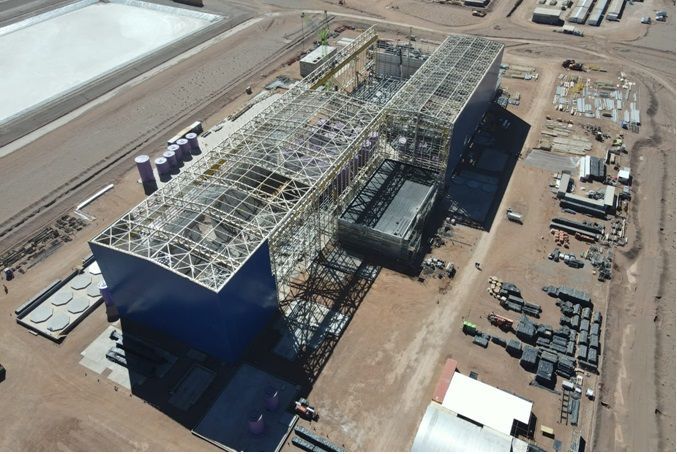 Site view of the first phase of the lithium upstream process at the Argentine salt lake / Photo by POSCO E&C
In August 2020, POSCO E&C successfully completed a demo plant for lithium mining and refining in Argentina, becoming the first Korean company to do so. The demo plant is a facility to verify production performance in advance, capable of producing 2,500 tons of lithium phosphate annually.
Currently, it is constructing the phase 1 upper process commercial plant in Salta Province, Argentina, at an altitude of 4,000 meters, which will produce 25,000 tons of lithium phosphate annually, and a lower process plant in the nearby Guemes industrial complex to convert and produce lithium phosphate into lithium hydroxide. POSCO E&C explained that it minimized business risks by thoroughly investigating local construction infrastructure, partners, logistics, and local regulations in Argentina based on extensive project experience in Latin American countries such as Chile, Peru, Panama, and Brazil.
POSCO E&C plans to expand its business scope continuously by securing early self-capabilities not only in construction but also in strengthening technology roadmap execution and basic equipment design for the secondary battery business to create a cluster that grows alongside group companies. It aims to establish a commercial lithium process design model, localize lithium unit equipment, develop new lithium extraction methods, and build standard models for new business products (raw materials and materials) by 2025.
A POSCO E&C official said, "In line with POSCO Group’s vision, we will focus our capabilities to realize real value and leap forward as the global number one in the secondary battery EPC field."
Realizing an Eco-Friendly Future Growth Leading Company
Additionally, POSCO E&C is making various efforts to leap forward as an eco-friendly future growth leading company. In September, ahead of its 30th anniversary next year, it announced a new vision as an "innovative company challenging the limits of its business to build an eco-friendly future society." Through this, it aims to achieve 25 trillion KRW in sales and 2 trillion KRW in operating profit by 2035, increasing its corporate value tenfold from the current level.
It is innovating not only its fundamental organizational structure but also its corporate culture. The company pursues a work style centered on execution based on autonomy and creativity by communicating openly with employees about the company’s direction, maximizing empathy and motivation.
Han Seong-hee, CEO of POSCO E&C, said, "Starting from the vision announcement, all employees will unite their hearts to continuously challenge the limits of our business as an eco-friendly company. We will do our best to realize the company’s real value through restructuring focused on eco-friendly businesses, expanding the value chain, increasing profitability, and gradually expanding overseas operations."
© The Asia Business Daily(www.asiae.co.kr). All rights reserved.
![Clutching a Stolen Dior Bag, Saying "I Hate Being Poor but Real"... The Grotesque Con of a "Human Knockoff" [Slate]](https://cwcontent.asiae.co.kr/asiaresize/183/2026021902243444107_1771435474.jpg)
















