If Gyeonggi Buk-do is Established, Gyeonggi Nambu Becomes Wealthier
Consent from Other Local Governments Required if Ordinary Local Allocation Tax Area
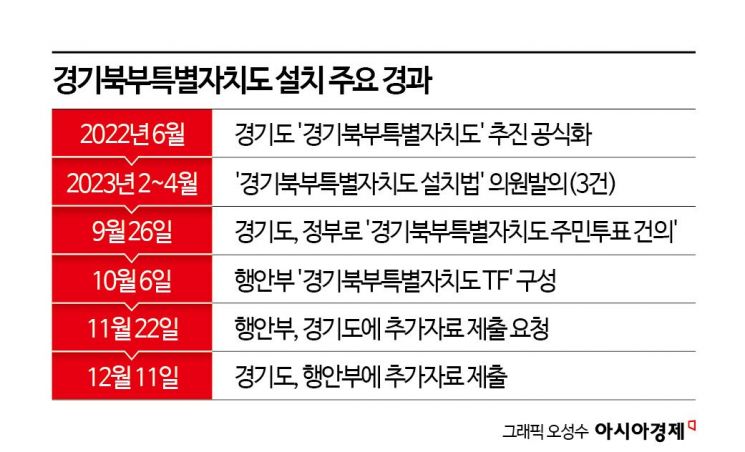
The Ministry of the Interior and Safety and Gyeonggi Province are currently in conflict over the holding of a resident referendum on the establishment of a special autonomous province in northern Gyeonggi. Previously, the Ministry of the Interior and Safety disclosed the additional data requested from Gyeonggi Province. The requested data covers 9 items across 3 areas, with the core issues being in the financial sector and balanced development sector. All the contentious points related to the establishment of Gyeonggi Bukdo are included here.
If Gyeonggi Bukdo is established, 'Gyeonggi Namdo' will become wealthier
The biggest issue is the adjustment grant, which is key to the financial independence of Gyeonggi Bukdo. The adjustment grant is a certain amount of provincial tax collected by cities and counties and local consumption tax of the province that is redistributed back to the cities and counties. It is intended to adjust the financial disparities between jurisdictions, and the governor distributes it based on population, collection performance, the financial situation of the relevant cities and counties, and other criteria prescribed by presidential decree.
The problem is that there is a large tax revenue gap between the northern and southern parts of Gyeonggi Province. The southern part of Gyeonggi, which belongs to the semiconductor belt, has relatively sufficient tax revenue capacity, but the northern part is financially relatively poor. The additional data requested by the Ministry of the Interior and Safety from Gyeonggi Province is also to verify measures for this issue.
Looking at the provincial tax collection performance in Gyeonggi Province as of 2019, the southern part accounted for 82% and the northern part 18%. On the other hand, the adjustment grant was distributed with Gyeonggi Nambu receiving 68.2% and Gyeonggi Bukbu 31.8%, creating a structure where more is allocated to the north. If the relatively 'less paying and more receiving' Gyeonggi Bukbu region becomes independent without any special measures, the wealthy existing 'Gyeonggi Namdo' will become even wealthier.
Allocation of ordinary grants expected to be controversial
The allocation of ordinary grants is also expected to be controversial. Ordinary grants refer to general funds provided by the central government to cover the financial shortfall that local governments cannot cover with their own revenues after calculating the standard level of basic administrative expenses necessary for all local governments to maintain a certain level of administration.
Ordinary grants are allocated to 174 out of 243 local governments, excluding autonomous districts. Among these, four local governments that are relatively financially affluent and thus excluded from the grant recipients this year are Seoul City, Gyeonggi Province, Seongnam City in Gyeonggi, and Hwaseong City in Gyeonggi.
Gyeonggi Province and the Ministry of the Interior and Safety anticipate that if Gyeonggi Bukdo is established, it will become a grant recipient. In this case, since the limited ordinary grant resources will be additionally shared with Gyeonggi Bukdo, other local governments may oppose this.
The plan to establish Gyeonggi Bukdo as a 'special autonomous province' is also expected to be controversial. Gyeonggi Province cites economic revitalization of this relatively underdeveloped area due to metropolitan area regulations as the reason for making northern Gyeonggi a special autonomous province. They intend to largely lift regulations imposed because it is part of the metropolitan area, such as the Capital Region Readjustment Act.
This is essentially a policy to exclude Gyeonggi Bukdo from the metropolitan area, and other metropolitan local governments focusing on attracting businesses for economic revitalization may not readily accept this.
© The Asia Business Daily(www.asiae.co.kr). All rights reserved.
![Clutching a Stolen Dior Bag, Saying "I Hate Being Poor but Real"... The Grotesque Con of a "Human Knockoff" [Slate]](https://cwcontent.asiae.co.kr/asiaresize/183/2026021902243444107_1771435474.jpg)
















