October Seoul Apartment Actual Transaction Price Index Down 0.08%
Nationwide Declines for the First Time in 9 Months
As the Seoul apartment real transaction price index turned downward for the first time this year, there is an analysis that the housing market has entered a second adjustment phase. Thanks to the government's deregulation, apartment prices rebounded in the first half of the year, but due to loan regulations and the continuation of a high-interest rate trend, prices have turned downward after six months, leading to a drought in transactions and declining sales across Seoul.
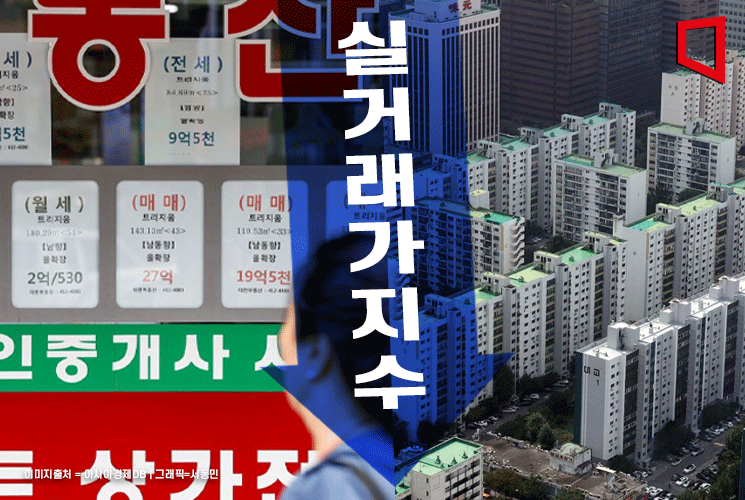
According to the Korea Real Estate Board on the 18th, the Seoul apartment real transaction price index in October fell by 0.08% compared to the previous month, marking the first decline this year. Unlike price trend surveys centered on asking prices, the real transaction price index quantifies the fluctuation by comparing actual transaction prices with previous transaction prices, and is evaluated to reflect recent market conditions relatively accurately.
By region, the southeastern area, which includes the Gangnam 4 districts, led the index decline with the largest drop (-0.65%). The Gangnam area, where many complexes are near their previous peak prices, experienced a significant decline in real transaction prices.
The nationwide apartment real transaction price index also fell by 0.20%, showing a decline for the first time since January (-0.74%). The real transaction price indices in Gyeonggi Province and Incheon dropped by 0.35% and 0.29% respectively compared to the previous month, showing a larger decline than Seoul.
The Seoul apartment real transaction price index fell by 22.07% on a cumulative basis last year when the housing price uptrend broke, but after turning upward in January this year, it rose by 13.42% until September. In some popular areas, flagship apartments recovered 80-90% of their previous peak prices, significantly regaining last year's losses, which led to the spread of a rebound theory in the housing market. This was thanks to the government's deregulation measures earlier this year, such as lifting regulation zones and launching special BoGeumJaRi loans, which revived buying demand.
However, after the government ended the special BoGeumJaRi loan general type (600 million to 900 million KRW) at the end of September and the high-interest rate trend continued, buying demand sharply contracted starting from the outskirts of Seoul.
The expectation that housing prices would fall also caused buyers to adopt a wait-and-see stance. According to the ‘Monthly KB Housing Market Trend’ released by KB Kookmin Bank, the Seoul housing sales price outlook index for October was 98.2, down 8.3 points from last month (106.5). This index is based on a survey of over 6,000 real estate agencies nationwide by KB Kookmin Bank regarding price expectations 2-3 months ahead; a value below 100 indicates a prevailing expectation of price decline in the next 2-3 months.
As housing prices entered an adjustment phase, the transaction volume, which had shown signs of gradual recovery, also fell again. According to the Seoul Real Estate Information Plaza, the number of apartment transactions in Seoul in October (based on reports) was 2,313, the lowest in nine months since January this year (1,412 transactions). The transaction volume in November is expected to be even lower than in October. Although the reporting deadline has not yet passed by the end of this month, as of the 16th, the November transaction volume stands at only 1,672, and if the current trend continues, the transaction volume is likely to fall below 2,000.
© The Asia Business Daily(www.asiae.co.kr). All rights reserved.
![Clutching a Stolen Dior Bag, Saying "I Hate Being Poor but Real"... The Grotesque Con of a "Human Knockoff" [Slate]](https://cwcontent.asiae.co.kr/asiaresize/183/2026021902243444107_1771435474.jpg)
















