South Korea's 50-Year Average Annual Growth of 6.4%
Growth Rate to Decline from 2% to 0% Over Next 30 Years
Negative Growth Expected from 2040 Without Productivity Gains
Need to Find New Growth Industries Like Semiconductors and Green Energy
Comprehensive Measures Required to Curb Population Decline
An analysis has emerged suggesting that if South Korea fails to improve productivity, its economic growth rate will turn negative starting in the 2040s. Over the next 30 years, due to a decline in the working-age population and reduced labor and capital inputs, South Korea's growth rate is expected to fall to the 2% range in the 2020s and to the 0% range in the 2030s. If productivity also fails to improve, the onset of negative growth could be accelerated.
On the 17th, Cho Tae-hyung, Deputy Director of the Economic Research Institute at the Bank of Korea, revealed this in a BOK Economic Research report titled "80 Years of the Korean Economy (1970-2050) and Future Growth Strategies." In the report, Deputy Director Cho decomposed economic growth over the past 50 years using growth accounting methods and projected the next 30 years. He also examined the importance of productivity improvement to mitigate the slowdown in economic growth.
Average Annual Growth of 6.4% Over the Past 50 Years... Led by 'Capital'
According to the report, South Korea's Gross Domestic Product (GDP) grew at an average annual rate of 6.4% from 1971 to 2022. After growing 8.7% annually in the 1970s and reaching a peak of 9.5% in the 1980s, the growth rate declined by 2 to 2.5 percentage points every decade, slowing to 2.9% annually in the 2010s. During the COVID-19 pandemic crisis from 2020 to 2022, the growth rate further dropped to 2.1%.
Generally, economic growth is driven by increases in inputs of production factors such as labor and capital, as well as improvements in total factor productivity (TFP) through technological progress. Analyzing South Korea's average annual growth rate of 6.4% over the past 50 years by these factors, capital input contributed 3.4 percentage points, accounting for 53.1% of total growth. Labor input contributed 1.4 percentage points (22.6%), and total factor productivity contributed 1.6 percentage points (24.3%). Thus, South Korea's economic growth over the past 50 years was primarily led by capital input.
Examining the reasons for the steady decline in growth rates since the 1980s, labor input slowdown was the main driver of growth rate decline during the high-growth 1990s. In the 2000s, following the Asian financial crisis, sluggish capital investment was the main factor, while from the 2010s onward, after the global financial crisis, productivity stagnation became the primary cause of growth rate decline. The reasons for lower productivity included sluggish manufacturing growth, aging population, and weakening corporate dynamism.
If Productivity is Low, Negative Growth of -0.1% Begins in the 2040s
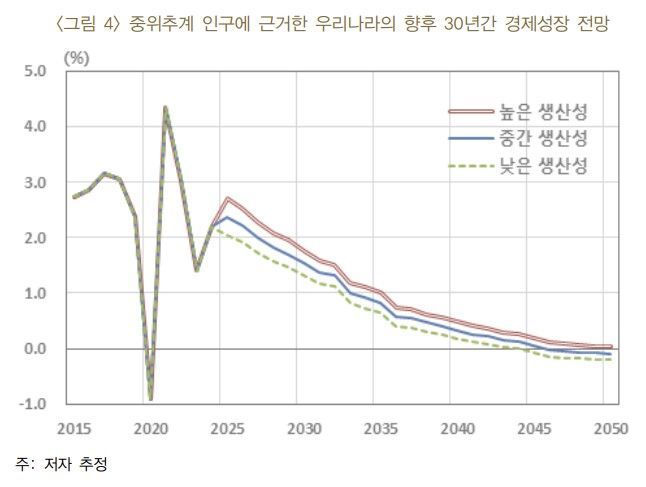
The problem is that growth rate prospects for the next 30 years are not optimistic either. Deputy Director Cho projected that the growth rate will be 2.2-2.3% from 2022 to 2025, 1.6-2.1% from 2026 to 2030, and will fall below 1% in the early or late 2030s. This is because South Korea faces a declining population due to low birth rates, average working hours shrinking to levels similar to Japan, and a gradual decline in capital input growth rates.
He anticipated that the speed of South Korea's growth rate slowdown will be determined by the extent to which total factor productivity plays a role in this environment.
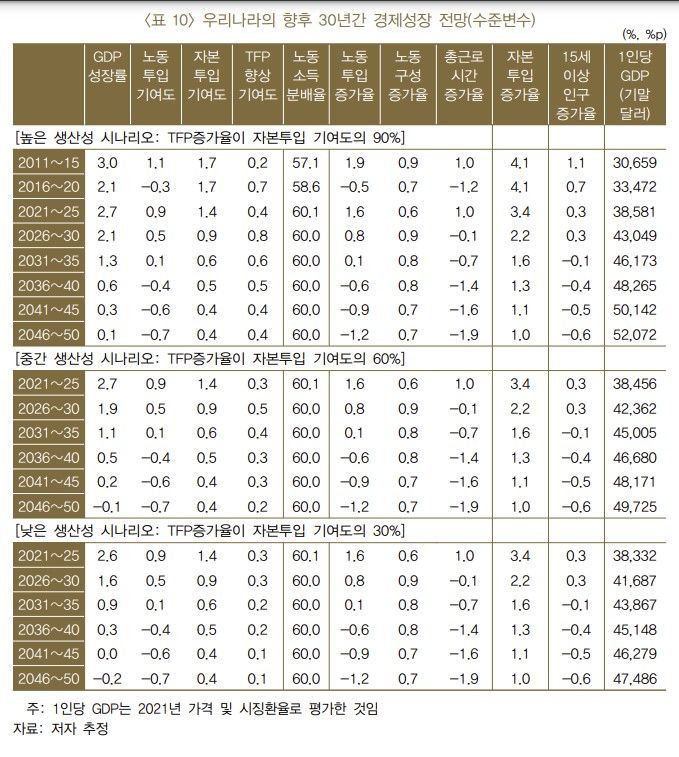
Under a "high productivity scenario," where total factor productivity contributes 90% of the capital input contribution, South Korea's economic growth rate is projected to be 2.4% in the 2020s, 0.9% in the 2030s, and 0.2% in the 2040s. However, under a "low productivity scenario," where total factor productivity contributes only 30% of the capital input contribution, growth rates are expected to be 2.1% in the 2020s, 0.6% in the 2030s, and -0.1% in the 2040s.
In the "medium productivity scenario," where total factor productivity contributes 60% of the capital input contribution, growth rates are calculated at 2.3% in the 2020s, 0.8% in the 2030s, and 0.1% in the 2040s.
If total factor productivity growth remains high amid declining labor and capital input growth rates, South Korea could maintain positive growth even in the 2050s. However, if total factor productivity growth remains low, negative growth will be inevitable from the mid-2040s.
Nonetheless, the report expects that even with growth slowing and population declining, GDP per capita will rise from $33,472 in 2020 to between $47,000 and $52,000 by 2050.
Maintaining Productivity is Key... Need to Find New Growth Industries
The report emphasized that the key to slowing the decline in South Korea's economic growth rate is whether high productivity can be maintained.
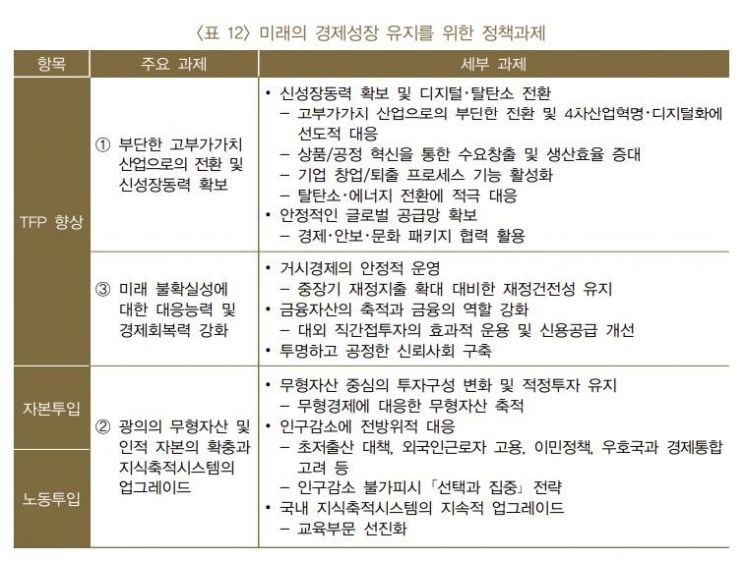
To this end, it explained that strategies to maintain high productivity through transitioning to high value-added industries, securing new growth engines, enhancing capabilities to respond to future uncertainties, and strengthening economic resilience are necessary. It also stressed the need to improve the qualitative level of labor and capital inputs by expanding broad intangible assets and human capital, and upgrading knowledge accumulation systems.
Specifically, it highlighted the importance of new growth industries. Since semiconductors and displays are the physical foundations enabling digital transformation, they will continue to develop in areas such as system semiconductors, packaging, and mobility. It also noted the growing importance of the defense industry due to the Russia-Ukraine war, eco-friendly mobility responding to the climate crisis, and the development of new power sources.
Furthermore, to secure stable supply chains, it advised exploring "package cooperation" measures encompassing not only the economy but also diplomacy, security, and culture. Developing economic cooperation into security and cultural cooperation amid rising international tensions would help secure stable partner countries. As part of this, it recommended actively supporting the success of Official Development Assistance (ODA) recipient countries and pursuing mutually beneficial cooperation with these nations.
If Population Decline is Not Prevented, Current Industrial Structure Cannot be Maintained
The report particularly emphasized the need for comprehensive measures covering youth values, employment, marriage, childbirth, education, and housing to curb population decline. South Korea's population is projected to decrease by 8.6%, from 51.84 million in 2020 to 47.36 million in 2050. Failure to prevent this decline could make it difficult to maintain even the current industrial structure.
The report stated, "It is time for bold and serious discussions on attracting foreign workers, repatriation of overseas Koreans, immigration policies, and economic integration with friendly countries." It warned, "If these policies fail, our economy will face a crossroads of 'selection and concentration' in terms of industry."
Additionally, the report recommended expanding research capabilities in the service sector, small and medium enterprises, and universities to enhance innovation capacity. It also suggested managing macroeconomics stably to ensure the economy maintains a normal growth path amid various challenges. Furthermore, it emphasized the need to promote financial innovation to facilitate the transition to an intangible asset-centered economy and to establish rational, fair, and transparent dispute resolution procedures to build a trustworthy society.
© The Asia Business Daily(www.asiae.co.kr). All rights reserved.
![Clutching a Stolen Dior Bag, Saying "I Hate Being Poor but Real"... The Grotesque Con of a "Human Knockoff" [Slate]](https://cwcontent.asiae.co.kr/asiaresize/183/2026021902243444107_1771435474.jpg)

















