"Focus on Institutional CBDC over General-Purpose"
"The Bank of Korea is focusing more on institutional CBDC rather than general-purpose CBDC. As the asset tokenization industry develops, there is a need for a stable token-based payment system. We aim to present a digital alternative tool to maintain the sovereignty of monetary policy."
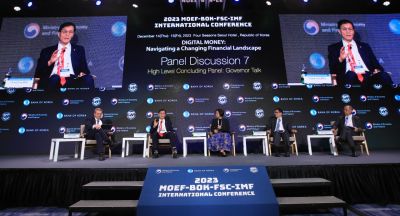
Lee Chang-yong, Governor of the Bank of Korea, stated this on the 15th at the 'Joint Conference of the Ministry of Economy and Finance, Bank of Korea, Financial Services Commission, and International Monetary Fund (IMF)' held at the Four Seasons Hotel in Jongno-gu, Seoul.
During a discussion on the future of digital currency with central bank governors from Hong Kong and Cambodia, as well as the former governor of the Bank of Thailand, Governor Lee mentioned the institutional CBDC pilot experiment that the Bank of Korea has been preparing since October this year. He explained, "Tokenized assets and tokenized payment methods can be integrated, but the regulation of tokenized assets will be overseen by financial supervisory authorities, not the central bank," adding, "This is a point that needs practical consideration and review."
Comprehensive Review of Non-Bank Participation... "Real Transaction Testing for the General Public Holds Great Significance"
Regarding the participation of non-banks in the payment system, he said that payment risk management aspects will be comprehensively reviewed. In his keynote speech that morning, Governor Lee stated, "When a new payment infrastructure is established, there is the issue of how much participation by non-banks should be allowed. While non-bank participation has the positive aspect of enhancing competition, there are also opinions that payment risk management must be strengthened accordingly. We will review these aspects and decide on policies."
As a starting point for the second phase pilot (institutional CBDC experiment), he explained, "From 2021, for two years, we implemented and experimented with a general-purpose CBDC simulation system using distributed ledger technology. Given that transactions are already conveniently conducted using credit cards and open banking, and considering additional benefits such as airline mileage accumulation that CBDC cannot easily provide, it was difficult to definitively answer whether a general-purpose CBDC is truly necessary in Korea and whether the private sector would actively use it if introduced."
He continued, "In the second phase pilot, it will be possible to issue deposit tokens that digitalize deposits based on institutional CBDC. We also designed a system that allows banks to issue e-money tokens fully backed 100% by institutional CBDC."
He said, "Both deposit tokens and e-money tokens will be issued and circulated on a monetary ledger jointly operated by the central bank and banks, and there will be a separate ledger (satellite ledger) for trading digital assets apart from the monetary ledger. We plan to experiment on whether special payment tokens issued based on e-money tokens from the monetary ledger on this separate ledger can be used as payment for assets."
Governor Lee evaluated the significance of this experiment, noting that it plans to conduct real transaction testing involving the general public.
He also cited the expected benefits of this experiment as ▲ verifying the pros and cons of programmable functions ▲ maintaining banks' financial intermediation and credit creation functions ▲ preventing side effects such as the proliferation of speculative virtual assets or private stablecoins ▲ preparing for scenarios where new payment infrastructures like deposit tokens are linked across countries.
He also diagnosed that there is a need for review due to concerns that digital currencies endorsed by the central bank might be used like private stablecoins through the separate ledger. Governor Lee said, "In the second phase pilot, we will also conduct technical experiments linking the monetary ledger and the separate ledger. To actually connect the monetary platform, the monetary ledger, and the asset platform, the separate ledger, extensive review of related regulations, systems, and governance is necessary."
© The Asia Business Daily(www.asiae.co.kr). All rights reserved.
![Clutching a Stolen Dior Bag, Saying "I Hate Being Poor but Real"... The Grotesque Con of a "Human Knockoff" [Slate]](https://cwcontent.asiae.co.kr/asiaresize/183/2026021902243444107_1771435474.jpg)















