Statistics Korea 'Social Trends in Korea 2023' Report
Positive attitudes toward marriage among young adults in their 20s and 30s have been steadily declining since 2008. Attitudes toward cohabitation and childlessness have become more positive than negative over the past five years. Since the COVID-19 pandemic, the proportion of leisure time spent using smart devices has decreased since 2020, but the viewership of online video streaming services (OTT) has shown a continuous upward trend.
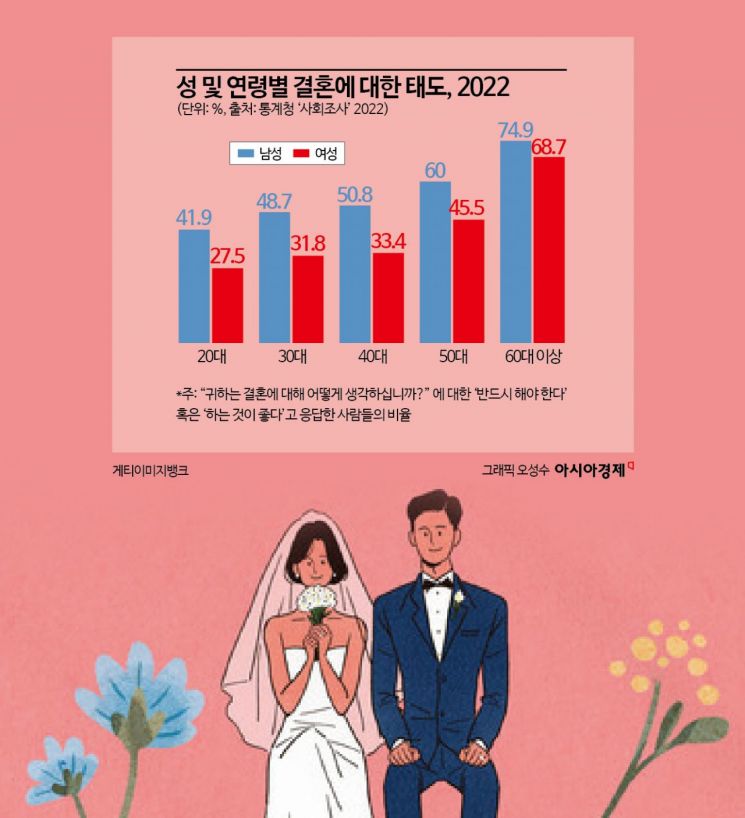
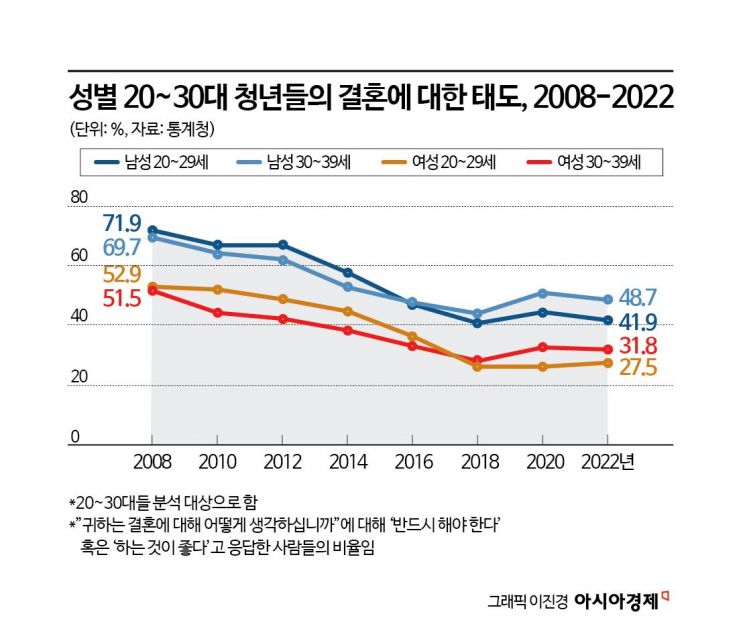
According to the "Social Trends in Korea 2023" report released by Statistics Korea on the 15th, positive attitudes toward marriage among young adults in their 20s and 30s have shown a continuous downward trend since 2008.
Between 2008 and 2022, positive attitudes toward marriage decreased by 30.0 percentage points among men in their 20s and by 25.4 percentage points among women in their 20s. The decline in positive attitudes toward marriage was greater among those in their 20s than those in their 30s for both men and women. In particular, only 27.5% of women in their 20s expressed the attitude that "marriage is a must" or "it is better to get married." Last year, positive attitudes toward marriage increased with age, especially among those aged 60 and over, with 74.9% of men and 68.7% of women expressing positive attitudes, higher than those in their 50s (men 60.0%, women 45.5%).
Positive perceptions of being single, cohabitation, childlessness, and non-marital childbirth among people in their 20s and 30s have shown an increasing trend. Over the past five years (2015?2020), positive perceptions increased by 8.6 percentage points for being single, 14.7 percentage points for cohabitation, 16.4 percentage points for childlessness, and 9.5 percentage points for non-marital childbirth. In 2020, negative perceptions of being single, cohabitation, and childlessness were below 30%, whereas negative perceptions of non-marital childbirth without marriage were high at 54.4%.
The proportion of those who "cannot accept" sexual minorities has decreased (62.1% in 2013 → 55.9% in 2022), while the proportion who can accept them as colleagues at work increased (7.9% in 2013 → 14.0% in 2022). The proportion of those who "cannot accept" foreign immigrants and workers increased from 7.1% in 2016 to 10.0% in 2022.
The proportion of residents living in semi-basements, basements, and rooftops was highest among young single-person households living in the Seoul metropolitan area at 3.24%, and young married couples and households living with parents in the metropolitan area also exceeded 1%.
While the average household income increased from 45.67 million KRW in 2018 to 50.22 million KRW in 2021, the income for those aged 20 and under decreased by 7.4% during the same period, from 33.63 million KRW to 31.14 million KRW. Debt levels showed a notable increase in debt holdings among those aged 20 and under and those in their 30s compared to 2018, with the debt holding increase rate for those aged 20 and under reaching 93.5% during this period.
In 2020, the number of general hospitals and hospitals was higher in non-metropolitan areas than in the Seoul metropolitan area, while clinics were more numerous in the metropolitan area. However, medical personnel such as doctors and nurses were significantly more concentrated in the metropolitan area. The number of pediatricians was higher in the metropolitan area compared to non-metropolitan areas, and the regional gap widened. The number of pediatricians per one million people was 224.6 in the metropolitan area in 2011, increasing to 293.9 in 2020, while in non-metropolitan areas it was 161.8 in 2011 and 198.6 in 2020.
The level of digital informatization by age group exceeded the general population level for those under 40, but decreased with age from the 50s onward, with particularly low competency levels. The 'access' level of informatization was relatively high at 88% for those aged 70 and over compared to the general population, but the 'competency' level, which reflects usage ability, was low at 56.7% for those aged 60?69 and 34.6% for those aged 70 and over.
The industrial accident fatality rate (per 10,000 workers) decreased from 2.6 in 2001 to 1.1 in 2022. Fatalities from accidents sharply declined among those aged 40 and under but showed an increasing trend among those aged 60 and over. Deaths from diseases have been increasing since 2017, while deaths from accidents have maintained a downward trend since 2001.
Since the COVID-19 pandemic, leisure time spent using smart devices decreased from 54.1% in 2020 to 37.8% in 2022, but attendance at cultural and artistic events via OTT has steadily increased, rising from 38.8% to 52.6% during the same period. Life satisfaction during the COVID-19 period was 6.23 points in 2021, down from 6.29 points in 2019, but began to recover to pre-pandemic levels at 6.28 points in 2022.
© The Asia Business Daily(www.asiae.co.kr). All rights reserved.
![Clutching a Stolen Dior Bag, Saying "I Hate Being Poor but Real"... The Grotesque Con of a "Human Knockoff" [Slate]](https://cwcontent.asiae.co.kr/asiaresize/183/2026021902243444107_1771435474.jpg)
















