The three major indices of the U.S. New York stock market showed a unified upward trend in the early session on the 14th (local time) as they digested the December Federal Open Market Committee (FOMC) results, which suggested the possibility of three interest rate cuts next year. The 10-year U.S. Treasury yield fell below the 4% level.
At around 10:45 a.m. at the New York Stock Exchange (NYSE), the Dow Jones Industrial Average was trading at 37,171, up 0.22% from the previous close. The S&P 500, which is centered on large-cap stocks, was up 0.32% at 4,722, and the tech-heavy Nasdaq was up 0.26% at 14,771.
Currently, all sectors in the S&P 500 except for consumer staples, telecommunications, and healthcare are rising. In particular, real estate and energy-related stocks are showing notable gains. Solar-related stocks such as Sunrun and Sunnova are showing double-digit increases compared to the previous close. Foot Locker jumped more than 7% after investment bank Piper Sandler upgraded its rating to overweight. Moderna rose over 11% as the mid-stage clinical trial results of its vaccine, announced that day, came out positive. On the other hand, Adobe fell nearly 6% due to a below-expectation earnings guidance for 2024.
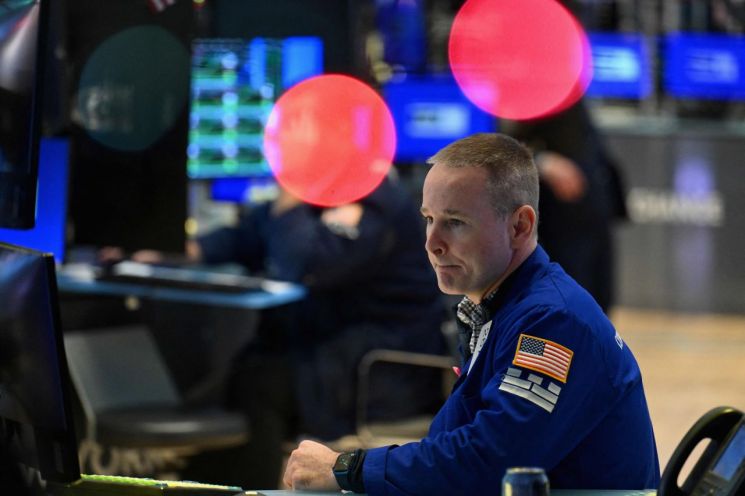
Investors are digesting the results of the December FOMC regular meeting and the press conference by Federal Reserve (Fed) Chair Jerome Powell, which were announced the previous afternoon, while also keeping an eye on economic indicators released that day.
As expected, the Fed held interest rates steady at 5.25-5.5% at this FOMC meeting, while signaling rate cuts next year through the dot plot. The median forecast for the year-end rate is 4.6%, which implies a total of 0.75 percentage points, or three rate cuts, over the year. Chair Powell also made more dovish remarks than expected, stating that "discussions about rate cuts have become visible," which lifted the market. The Dow Jones hit an all-time high the previous day. Gina Volbin, chair of Volbin Wealth Management Group, said, "The Fed gave the market an early (Christmas) holiday gift," adding, "The Santa rally could continue."
The market is currently pricing in a stronger likelihood of rate cuts in the first half of next year. According to the CME FedWatch tool from the Chicago Mercantile Exchange (CME), federal funds futures currently reflect more than an 80% chance that the Fed will cut rates by at least 0.25 percentage points at the March meeting. The probability of a rate cut by May next year exceeds 98%.
The decline in Treasury yields is continuing. In the New York bond market, the 10-year U.S. Treasury yield fell below 4.0%. The 2-year yield, which is sensitive to monetary policy, dropped to around 4.35%. The dollar index, which measures the value of the U.S. dollar against the currencies of six major countries, fell nearly 1% to 101.9.
Following the Fed, the European Central Bank (ECB) and the Bank of England (BOE) also held rates steady that day. However, unlike the Fed, which signaled rate cuts next year, the ECB and BOE did not send any signals of rate cuts. ECB President Christine Lagarde dismissed rate cuts, saying, "We did not discuss rate cuts at all."
The U.S. retail sales data for November, released that day, exceeded expectations thanks to the Black Friday effect. According to the U.S. Department of Commerce, November retail sales totaled $705.7 billion, up 0.3% from the previous month. This was stronger than the Wall Street Journal (WSJ) consensus forecast of a 0.1% decline and an improvement from the previous month's revised decline of 0.2%.
Contrary to expectations that consumer spending would slow significantly starting in the fourth quarter due to accumulated tightening and depletion of additional savings, consumer spending rebounded during the holiday discount period including Black Friday. This has further raised hopes for a so-called soft landing, where inflation falls without a recession. Andrew Hunter of Capital Economics said, "The November retail sales rebound shows that a sharp slowdown in inflation does not lead to an economic growth slowdown."
The unemployment data released on the same day showed a slowdown. According to the Department of Labor, initial jobless claims for the week of December 3-9 decreased by 19,000 from the previous week to 202,000. This was slightly below the expert forecast of 222,000. However, continuing claims, which count those claiming unemployment benefits for at least two weeks, rose by 24,000 to 1,876,000 from the previous week.
European stock markets showed mixed results. Germany's DAX index fell 0.1%. The UK's FTSE index rose more than 1%. France's CAC index was up 0.66%.
© The Asia Business Daily(www.asiae.co.kr). All rights reserved.
![Clutching a Stolen Dior Bag, Saying "I Hate Being Poor but Real"... The Grotesque Con of a "Human Knockoff" [Slate]](https://cwcontent.asiae.co.kr/asiaresize/183/2026021902243444107_1771435474.jpg)















