Insurance Companies' 3Q Household Loans Reach 134.7 Trillion
Urgent Cash Demand Drives 3.9 Trillion Increase in 'Insurance Policy Loans'
Delinquency Rate Also a Concern... Excluding Mortgage Loans, It Exceeds 1%

The balance of household loans held by insurance companies increased by more than 4 trillion won over the past year in the third quarter of this year. Most of the loan increase was from insurance policy loans, which are mainly used when 'urgent cash' is needed. With delinquency rates on various loans nearly doubling and domestic and international economic uncertainties persisting, there are calls to strengthen soundness management.
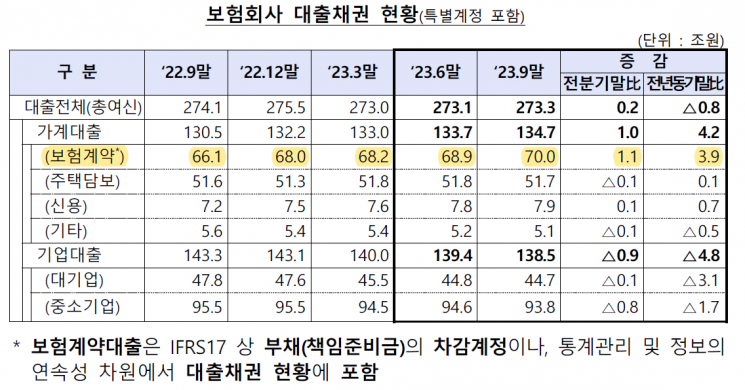
According to the Financial Supervisory Service on the 15th, as of the end of the third quarter this year, the balance of loan receivables held by insurance companies was recorded at 273.3 trillion won. It increased by about 300 billion won this year but decreased by 800 billion won compared to the same period last year.
The problem lies in household loans. The size of household loans reached 134.7 trillion won, an increase of 4.2 trillion won compared to the same period last year. In contrast, corporate loans decreased by about 4.8 trillion won during the same period.
In particular, insurance policy loans, which meet the demand for 'urgent cash' among household loans, increased significantly. Insurance policy loans are loan products where borrowers can borrow 79-95% of the surrender value without canceling the subscribed insurance. There is no screening process such as credit rating checks, and repayment can be made at any time without early repayment fees. Typically, those with low credit scores who find it difficult to use bank loans or have unstable cash flow mainly use these loans.
According to the Financial Supervisory Service's data, as of the end of the third quarter this year, the balance of insurance policy loans held by insurance companies was 70 trillion won, an increase of about 3.9 trillion won compared to the same period last year. This accounts for 92.9% of the total increase in household loans. This scale surpasses the increase in mortgage loans of 100 billion won and credit loans of 700 billion won during the same period.
Delinquency rates are also a concerning point. As of the end of the third quarter this year, the delinquency rate on insurance company loan receivables (based on principal and interest overdue by one month or more) was 0.47%. This is more than double the 0.23% recorded in the third quarter of last year. Delinquency rates for both household and corporate loans are on the rise.
For household loans, the delinquency rate was 0.48%, up 0.19 percentage points from the same period last year. The mortgage loan delinquency rate was 0.31%, an increase of 0.13 percentage points compared to the same period last year. The delinquency rate for loans other than mortgages rose even more sharply. During the same period, it jumped 0.43 percentage points to 1.16%, exceeding 1%.
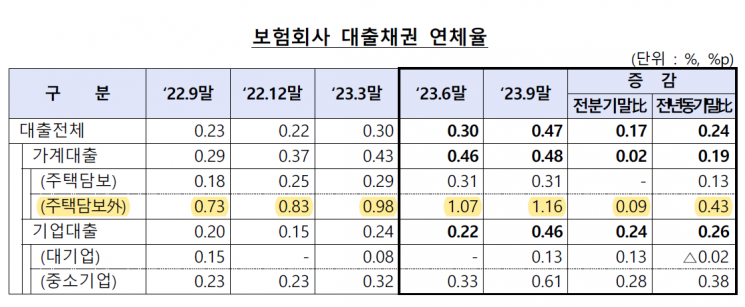
Corporate loan delinquency rates also surged. As of the end of the third quarter, it was 0.46%, a 2.3-fold increase over one year. The impact varied depending on the size of the company. The delinquency rate for large corporations fell from 0.15% in the third quarter of last year to 0.13% this year, but during the same period, the delinquency rate for small and medium-sized enterprises rose nearly threefold from 0.23% to 0.61%.
The ratio of non-performing loans (fixed or below credit loans) is also rising. For all loans, it was 0.42%, up 0.15 percentage points from 0.27% at the end of the third quarter last year. Household loans rose 0.12 percentage points to 0.39% compared to the same period last year, and corporate loans increased 0.17 percentage points to 0.44% during the same period. Among household loans, the non-performing loan ratio for loans other than mortgages nearly doubled over one year to 0.97%, approaching 1%.
An official from the Financial Supervisory Service stated, "We plan to continuously monitor soundness indicators in preparation for concerns about deteriorating soundness due to increased domestic and international economic volatility," adding, "We will secure sufficient loan loss reserves to enhance loss absorption capacity and encourage early normalization of non-performing assets."
© The Asia Business Daily(www.asiae.co.kr). All rights reserved.
![Clutching a Stolen Dior Bag, Saying "I Hate Being Poor but Real"... The Grotesque Con of a "Human Knockoff" [Slate]](https://cwcontent.asiae.co.kr/asiaresize/183/2026021902243444107_1771435474.jpg)

















