Didimdol Loans and Group Loans Increased
But Individual Bank Mortgages and Policy Mortgages Decreased
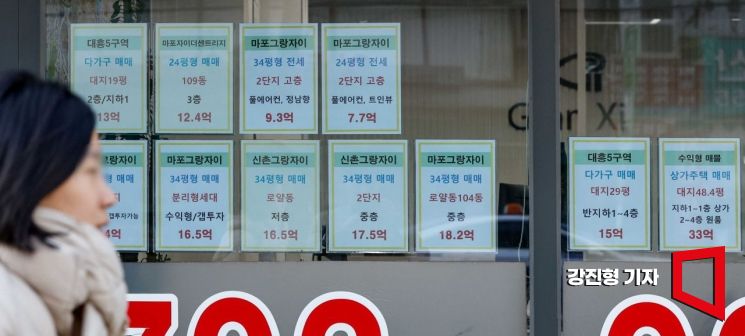
The increase in household loans in November (2.6 trillion KRW) significantly decreased compared to the previous month (6.2 trillion KRW) due to a decline in non-bank sector loans and other factors.
According to the Financial Services Commission on the 16th, the increase in household loans in the banking sector decreased compared to the previous month (6.7 trillion KRW → 5.4 trillion KRW). Demand for bank-funded Didimdol loans remained steady (1.8 trillion KRW → 1.8 trillion KRW), and group loans rose compared to the previous month (300 billion KRW → 1.3 trillion KRW).
Due to a decrease in housing transactions and regulatory measures by financial authorities, the growth rate of individual mortgage loans by banks (2.3 trillion KRW → 1.7 trillion KRW) and policy mortgages (1.3 trillion KRW → 900 billion KRW) significantly slowed compared to the previous month.
The volume of housing sales transactions in Seoul has been declining from 6,700 units in August to 6,300 units in September, 5,100 units in October, and 3,900 units in November.
Non-bank household loans also showed an increased decrease compared to the previous month (-500 billion KRW → -2.8 trillion KRW), mainly in mutual finance sectors (-2.2 trillion KRW), due to high market interest rates and repayments of non-housing collateral loans.
The financial authorities positively evaluated that "the increase in bank mortgage loans, which had somewhat risen since July and August, has gradually slowed down following regulatory measures."
At the same time, they stated, "We will promptly conclude ongoing discussions with the financial sector regarding the variable interest rate Stress Debt Service Ratio (DSR) and announce detailed plans within December. Based on the Financial Supervisory Service’s on-site inspections of bank household loans, we plan to correct improper loan handling practices found in banks and swiftly identify and implement necessary institutional improvements."
The Stress DSR is a method of calculating the DSR for loan limits by preemptively adding an additional 1 percentage point to the interest rate to reflect future interest rate fluctuation risks. This effectively reduces the household loan limit.
The Financial Supervisory Service pointed out that despite banks expanding the DSR by extending maturities through 50-year mortgage loans, they inadequately conducted prior reviews of important changes to loan products. Additionally, household loan expansion was included in employee evaluation scores.
The Financial Supervisory Service said, "We will immediately guide banks to correct major issues, inspect the adequacy of improvements during future on-site examinations, and establish institutional safeguards to prevent recurrence of similar cases."
© The Asia Business Daily(www.asiae.co.kr). All rights reserved.
![Clutching a Stolen Dior Bag, Saying "I Hate Being Poor but Real"... The Grotesque Con of a "Human Knockoff" [Slate]](https://cwcontent.asiae.co.kr/asiaresize/183/2026021902243444107_1771435474.jpg)















