Financial Services Commission Announces 'Guidelines on Basic Asset Requirements for Trust Beneficiary Certificates'
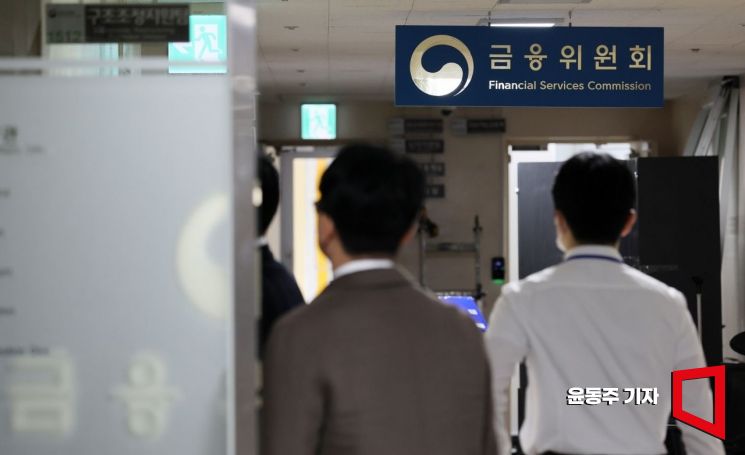 On the 9th, officials were busy moving in the corridor of the Financial Services Commission at the Government Seoul Office in Jongno-gu, Seoul, where financial authorities decided to include mortgage loans (Judaemae) in the 'debt refinancing' infrastructure scheduled to be launched in May by the end of the year. Financial authorities explained that they aim to reduce the interest burden on mortgage loans by building a debt refinancing platform that allows users to compare financial sector loan interest rates at a glance and switch loans easily. Photo by Dongju Yoon doso7@
Standards have been presented stating that real estate project financing (PF) or bridge loans for development projects cannot be used as underlying assets for fractional investment.
On the 14th, the Financial Services Commission (FSC) announced guidelines outlining the requirements for underlying assets when issuing trust beneficiary certificates for fractional investment. Fractional investment uses underlying assets such as artworks, copyrights, and real estate, which are generally difficult for ordinary investors to access.
According to the guidelines, the underlying assets must be objectively measurable and evaluable in terms of value. The issuer of the trust beneficiary certificates must determine the issuance conditions (such as issue price and quantity) based on an appraisal of the trust property’s value, and investors must be able to know the results of the underlying asset valuation.
Additionally, it is recommended that assets already obtainable in existing secondary markets should not merely be converted into trust beneficiary certificates without changing the investment form. For underlying assets like securities that can be traded in small amounts, differentiation and innovation must be demonstrated.
The guidelines also include provisions that the assets must be easily transferable and that the transfer process must be subject to domestic law. The FSC explained that if foreign law applies during disposal or acquisition, it could hinder principal recovery, so this rule is set to protect investors.
It is also stipulated that the underlying asset must be a single asset rather than a collection of multiple assets, and must not be related to uncertain events such as PF loans or bridge loans.
Furthermore, attempts to securitize residential housing linked to loan-to-value ratio (LTV) or debt service ratio (DSR), as well as underlying assets related to gambling industries, are not permitted.
For fractional investment operators, the principle of subsidiarity applies, whereby institutionalized investment vehicles such as securitization, crowdfunding, and securities should be prioritized, and trust beneficiary certificates should be issued only when these are difficult to utilize. This is to prevent indiscriminate issuance of trust beneficiary certificates before the legal revision for institutionalizing trust beneficiary certificates is completed.
© The Asia Business Daily(www.asiae.co.kr). All rights reserved.
![Clutching a Stolen Dior Bag, Saying "I Hate Being Poor but Real"... The Grotesque Con of a "Human Knockoff" [Slate]](https://cwcontent.asiae.co.kr/asiaresize/183/2026021902243444107_1771435474.jpg)















