Possibility of Bank of Korea Rate Cut Spreading in Q2
The U.S. Federal Reserve (Fed) has hinted at the end of its rate hike cycle and forecasted three rate cuts next year, sparking debates over the timing of South Korea's benchmark interest rate cuts. Jerome Powell's more dovish-than-expected remarks have further fueled expectations for rate cuts, leading to rapid speculation that South Korea's rate cut timing could be brought forward.
On the morning of the 14th, the Bank of Korea stated at the 'Market Situation Review Meeting' that "since the November Federal Open Market Committee (FOMC), expectations of a policy stance shift have formed in the market, as evidenced by a significant drop in U.S. Treasury yields due to slowing U.S. inflation indicators and dovish remarks from Fed officials. The December FOMC results are expected to further strengthen these market expectations."
Yoo Sang-dae, Deputy Governor of the Bank of Korea, said, "Going forward, attention to the Fed's monetary policy operations will likely focus on the timing of rate cuts, during which volatility in financial and foreign exchange markets may frequently increase. We will closely monitor U.S. inflation and economic trends and changes in monetary policy stance to carefully assess their impact on the domestic economy and financial and foreign exchange markets."
Experts note that the market sentiment, which had predicted high interest rates and a prolonged period, has changed over the past month, and Powell's remarks have instilled optimism in this atmosphere, prompting close attention to the potential impact on South Korea's monetary policy. Initially, the U.S. rate cut timing was expected in the second to third quarter of next year, but growing market expectations suggest it could happen as early as the first quarter, leading to opinions that South Korea's rate cut timing will also be advanced.
Jo Yong-gu, a researcher at Shin Young Securities, said, "The downward revision of core inflation forecasts in the U.S. economic outlook by 50 basis points (1bp = 0.01 percentage point) by the end of this year and 20 basis points by the end of next year means that the timing of rate cuts will be brought forward and the magnitude of cuts will increase. We are revising our forecast to reflect that the U.S. will start cutting rates in June next year."
The view that South Korea could cut rates before the U.S. due to an earlier-than-expected shift in U.S. monetary policy has largely disappeared. Kwon Hyo-sung, an economist at Bloomberg Korea, said, "While the pace of inflation slowdown in the U.S. is rapid, South Korea's inflation rate is expected to remain in the high 2% range until the second quarter of next year, delaying the slowdown. The U.S. is expected to begin rate cuts in the second quarter, and South Korea will likely be able to do so only in the third quarter."
From the Bank of Korea's perspective, there is some relief as the Fed is expected to hold policy rates steady at the December FOMC and signal rate cuts next year, thereby broadening the scope for monetary policy maneuvering. However, concerns about the timing and frequency of future rate cuts have increased. Kim Jung-sik, Emeritus Professor of Economics at Yonsei University, pointed out, "Given the significant concerns about household loan growth and the possibility of additional rate hikes if inflation is not controlled due to accumulated cost pressures, it is not easy for the Bank of Korea to hastily follow the U.S. in cutting rates. A situation where rates neither rise nor fall may persist for some time, and differentiated monetary policies depending on inflation and economic conditions cannot be ruled out."
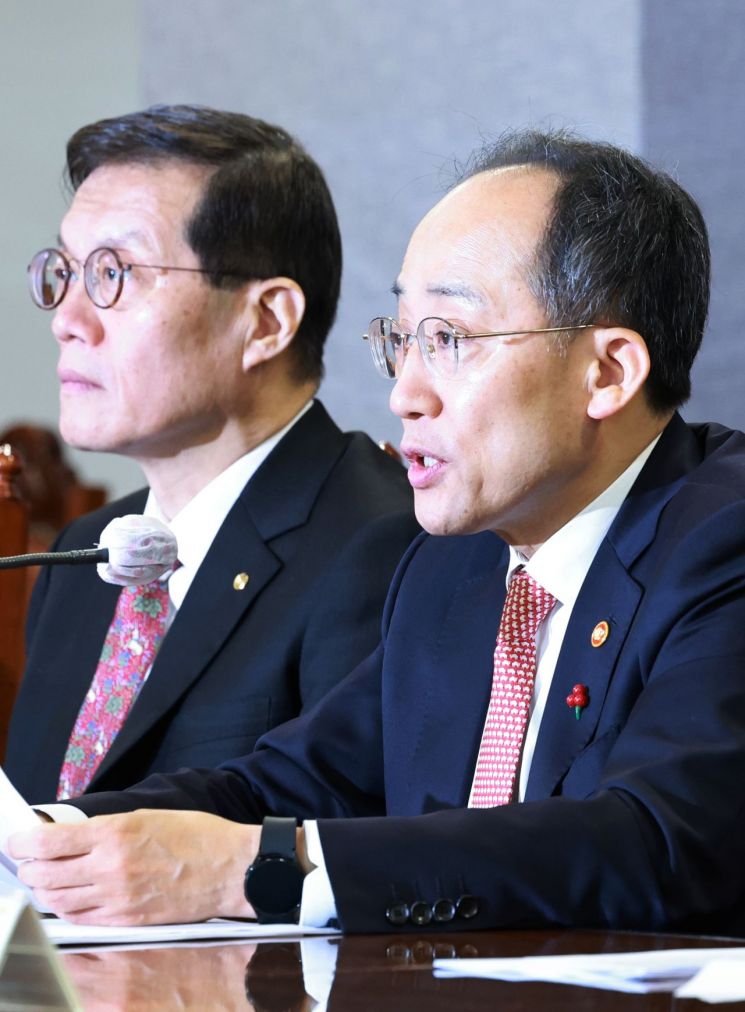
On the same day, Choo Kyung-ho, Deputy Prime Minister and Minister of Economy and Finance, emphasized at the emergency macroeconomic and financial meeting held jointly with related agencies, "While the burden of high interest rates continues, the possibility of increased global economic uncertainties such as the Middle East situation remains, and some vulnerabilities such as real estate project financing (PF) are latent. Therefore, the government and the Bank of Korea will remain vigilant and make every effort to manage vulnerable sectors to prevent increased market volatility during the year-end and New Year period."
© The Asia Business Daily(www.asiae.co.kr). All rights reserved.
![Clutching a Stolen Dior Bag, Saying "I Hate Being Poor but Real"... The Grotesque Con of a "Human Knockoff" [Slate]](https://cwcontent.asiae.co.kr/asiaresize/183/2026021902243444107_1771435474.jpg)















