Word of the Year "hallucinate"
"Best Reflects AI's Impact on the Future"
Many AI-Related Terms Selected as 'Word of the Year'
Every year, major English-language dictionaries and publishers select the 'Word of the Year,' and this year, AI-related vocabulary is dominating the list.
On the 12th (local time), the American online dictionary site Dictionary.com announced that it had chosen 'hallucinate,' meaning 'to experience hallucinations,' as the 2023 Word of the Year. Earlier last month, the Cambridge Dictionary in the UK also selected the same word as its Word of the Year.
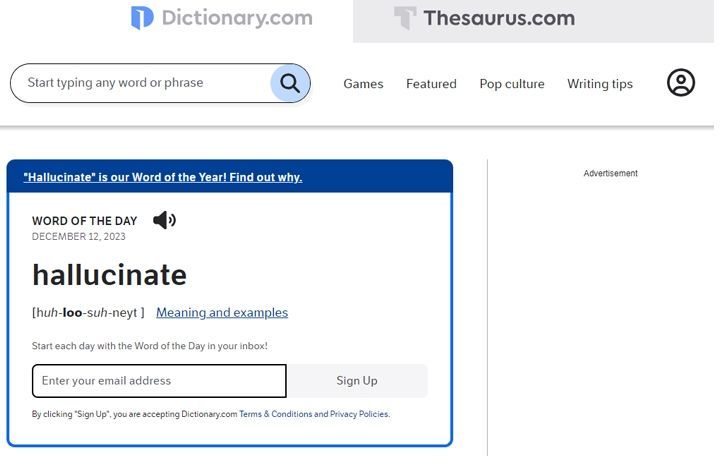
Dictionary.com explained that in the AI era, this word has acquired a new meaning: 'the act of generating false information contrary to the user's intent and presenting it as if it were true.' They added, "After reviewing which word best represents the profound impact AI has on language and the future of life, we selected this word."
Originally, hallucination refers to the phenomenon of seeing, hearing, or feeling things that do not exist due to health conditions or drug use, but recently, the industry has been using the term to describe cases where AI, such as Chat GPT, generates incorrect information. For example, it is used when AI presents incorrect statistical figures as plausible answers or describes completely unfounded stories as facts.
Dictionary.com reported that searches for 'hallucinate' and other AI-related words have significantly increased over the past year. The site's search volume rose by 46% compared to last year, and media usage of the word increased by 85%. Additionally, searches for AI-related terms such as 'chatbot,' 'GPT,' and 'generative AI' increased by 62% compared to the previous year, according to Dictionary.com.
Meanwhile, AI-related vocabulary continues to rank high among the 'Words of the Year' selected by leading dictionaries worldwide.
Last month, the Cambridge Dictionary in the UK also selected 'hallucinate' as the Word of the Year, stating that it added the meaning 'AI generating false information' to the existing definition of 'seeing or hearing things that do not exist.'
The American Merriam-Webster Dictionary also chose 'authentic' as its Word of the Year last month, explaining that "the development of AI reflects the increasingly blurred line between real and fake." The publisher also reported that 'deepfake' was among the final candidates.
Additionally, on the 4th, the British Oxford Dictionary selected 'rizz' (meaning 'charisma that attracts the opposite sex') as the Word of the Year, with the AI-related term 'prompt' competing closely for first place until the end. Originally meaning 'to trigger or induce' as a verb, this word was not commonly used in the English-speaking world but has seen a significant increase in usage as a command input for AI models like Chat GPT.
© The Asia Business Daily(www.asiae.co.kr). All rights reserved.
![Clutching a Stolen Dior Bag, Saying "I Hate Being Poor but Real"... The Grotesque Con of a "Human Knockoff" [Slate]](https://cwcontent.asiae.co.kr/asiaresize/183/2026021902243444107_1771435474.jpg)















