Economic Emergency Measures Two Days After Inauguration
Massive Cuts to Government Subsidies
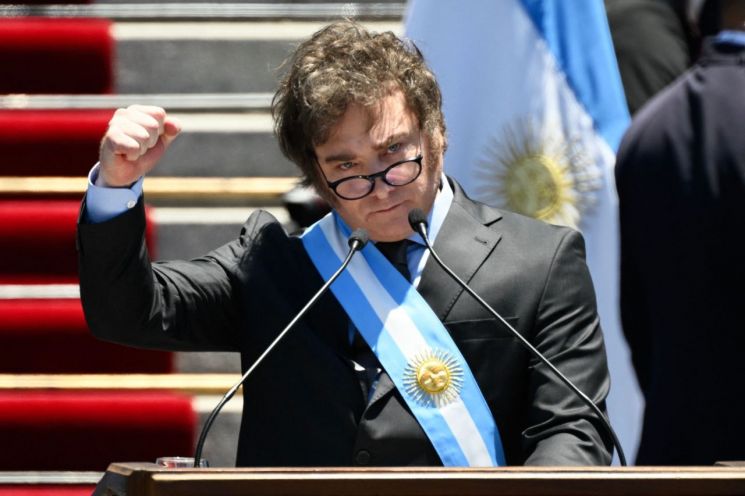
To overcome hyperinflation reaching an annual rate of over 140% and economic difficulties, Argentine President Javier Milei took drastic measures just two days after taking office by devaluing the peso by more than 50%. He also announced large-scale fiscal spending cuts, including reducing various government subsidies and halving the number of government ministries.
On the 12th (local time), Luis Caputo, Argentina's Minister of Economy, announced 10 emergency economic measures, including a 54% devaluation of the Argentine peso, during a TV address.
He stated that the fixed exchange rate of 366.5 pesos per dollar, which was maintained to defend the exchange rate, would be adjusted to 800 pesos per dollar. This effectively halved the value of the peso. As a result, the gap between the official exchange rate set by the government and the unofficial dollar exchange rate (Blue Dollar) prevalent in the black market significantly narrowed. The Blue Dollar rate was 1,070 pesos as of that day.
The Central Bank of Argentina plans to continue devaluing the peso by 2% each month going forward.
The Argentine government also implemented major fiscal spending cuts. It plans to further reduce expenditures equivalent to 0.5% of GDP in energy subsidies, 0.2% of GDP in transportation subsidies, and 0.4% of GDP in social security and pensions. The number of government ministries will be cut in half. The government will reduce transfers to local governments and halt public works projects. The total scale of Argentina’s fiscal spending cuts is expected to reach 2.9% of GDP.
Minister Caputo emphasized, "There is no more money," and stated, "Argentina must solve its addiction to fiscal deficits."
Argentina’s radical move to devalue the peso by more than 50% is part of a drastic remedy to normalize the collapsed Argentine economy. Argentina is suffering from severe economic difficulties, including a brutal inflation rate exceeding 140% annually and a poverty rate in the 40% range. In response, President Milei had previously announced strong policies to overcome the economic crisis, including fiscal spending cuts. Notably, during the presidential campaign, he proposed bold pledges such as adopting the US dollar and closing the central bank.
The International Monetary Fund (IMF) immediately welcomed the Milei administration’s measures as a "bold initial step." The IMF stated, "Their resolute implementation will help stabilize the economy and lay the foundation for more sustainable, private sector-led growth."
Additionally, President Milei reportedly sent a letter to Chinese President Xi Jinping requesting the renewal of a $5 billion currency swap. The dollar currency swap between the two countries was renewed for a three-year term in June, but the Chinese government had maintained a principle of remitting funds only after the Argentine presidential election. During the election period, President Milei had declared, "I will never deal with the Communist Party," expressing anti-communist and anti-China sentiments. However, to overcome the severe economic crisis caused by rising inflation and depletion of foreign exchange reserves, he changed his stance after winning the presidency and reached out to China for assistance.
© The Asia Business Daily(www.asiae.co.kr). All rights reserved.
![Clutching a Stolen Dior Bag, Saying "I Hate Being Poor but Real"... The Grotesque Con of a "Human Knockoff" [Slate]](https://cwcontent.asiae.co.kr/asiaresize/183/2026021902243444107_1771435474.jpg)















