Real Estate and Other Adverse Factors "Respond and Eliminate"
Prioritizing 'Economic Stability' Through Industrial Policy and Consistent Response
Next Year's Growth Rate Target Expected Around 5%
The Chinese government has set 'economic stability' and 'reasonable quantitative growth' as the top priorities for next year's policy direction. Regarding exposed negative factors such as the real estate slump, local government debt, and the insolvency of small and medium financial institutions, it expressed a determination to "respond and eliminate" them. However, specific policy directions, including the large-scale stimulus measures expected by the market, were not mentioned.
According to China's state-run Xinhua News Agency on the 13th, the Chinese Communist Party and government held the Central Economic Work Conference in Beijing from the 11th to 12th, attended by President Xi Jinping and other leaders, to decide the macroeconomic policy direction for next year. The Central Economic Work Conference, held annually in mid-December, is a closed-door meeting where hundreds of top policymakers including President Xi, senior local government officials, and representatives of state-owned enterprises gather in the capital Beijing to determine the economic policy direction for the following year.
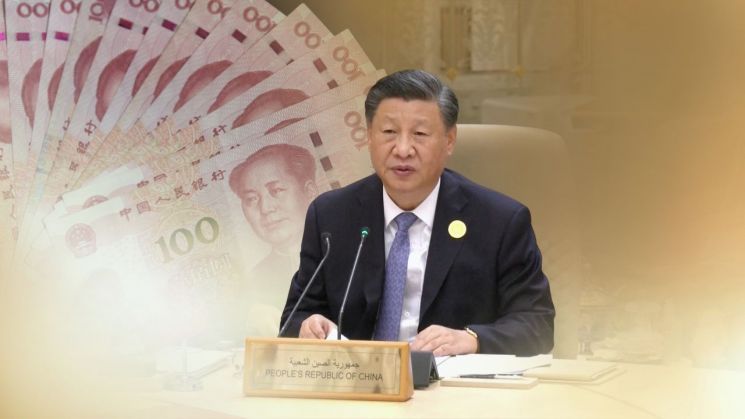
At the meeting, the economic tone for next year was set with the slogan 'Onzhongqujin·Yijinchuo'on·Xianliuhoupa,' meaning 'pursuing growth amid stability, promoting stability through growth, and establishing first then breaking through.' 'Onzhongqujin,' which means pursuing growth amid stability, appeared in the economic work conferences of 2021 and last year, but 'Yijinchuo'on' (promoting stability through growth) and 'Xianliuhoupa' (establishing first then breaking through) appeared for the first time this year.
Regarding this, Won Bin, chief economist at China Minsheng Bank, explained to Pengpai News, "The tone has somewhat shifted from prioritizing stability to emphasizing 'progress' and 'establishment,' which is a more positive policy signal." Wang Qing, chief macroeconomic analyst at Dongfang Jinsung International Credit Rating, interpreted 'Xianliuhoupa' as "meaning that new momentum, represented by advanced technology, replaces and transitions from existing momentum."
Additionally, the Party and government expressed their determination at this meeting to enhance consistency in macroeconomic policy direction, prioritize scientific and technological innovation and industrial development, and actively develop the digital economy and artificial intelligence (AI) technology. They also identified major risks such as the real estate slump, local government debt, and insolvency of small and medium financial institutions, emphasizing the intention to "respond and eliminate" these risks. In particular, they explained that "funding will be reasonably raised regardless of whether it is from the private or state-owned sectors."
Furthermore, while emphasizing reform of state-owned enterprises and expanding support for the private sector, they called for removing obstacles to visits to China by foreigners for business, study, and tourism, and strengthening the foundation for foreign trade and foreign investment.
It is believed that the meeting also discussed next year's economic growth target, but it was not disclosed. Typically, a clear growth target is presented at the Two Sessions (National People's Congress and Chinese People's Political Consultative Conference) held in March. The market expects the target for next year to be around 5%. Professor Kao Heping of Peking University explained, "If the policy intensity is appropriate, a solid foundation will be laid to achieve 5% growth next year," adding, "Considering the scale of our economy, that is very impressive."
Western media predicted that the results of this meeting would disappoint the market. Ding Xiang, chief economist for Greater China at Standard Chartered, told Bloomberg News, "It showed that technological self-reliance is more important than in previous years," but also evaluated, "There are no signs of large-scale economic stimulus." Eric Zhu, economist at Bloomberg News, said, "Chinese policymakers at the meeting acknowledged sluggish domestic demand, weak consumption, and risks from real estate and local government debt, but did not propose new relief measures or quick solutions." Jack Cleanlong, chief China economist at BNP Paribas, stated, "These measures are classic content," adding, "There is nothing particularly creative about them."
© The Asia Business Daily(www.asiae.co.kr). All rights reserved.
![Clutching a Stolen Dior Bag, Saying "I Hate Being Poor but Real"... The Grotesque Con of a "Human Knockoff" [Slate]](https://cwcontent.asiae.co.kr/asiaresize/183/2026021902243444107_1771435474.jpg)















