Acute Myeloid Leukemia Treatment 'PHI-101'
Overall Complete Remission Rate (CCR) 60%
Pharos iBio announced on the 12th that it disclosed the results of the Phase 1a/b clinical trial of the acute myeloid leukemia (AML) treatment 'PHI-101' at the American Society of Hematology (ASH).
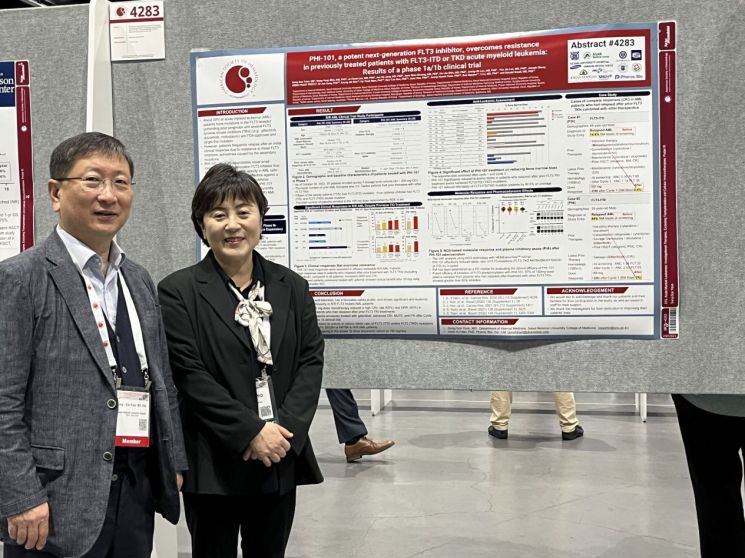 Han Hye-jung, CEO of Pharos iBio USA (right), and Yoon Sung-soo, professor of Hematology and Oncology at Seoul National University Hospital, participated in the American Society of Hematology and took a photo after presenting the clinical phase 1a and 1b study results of 'PHI-101'.
 [Photo by Pharos iBio]
The American Society of Hematology is the world's largest academic event in the field of hematologic cancers, held from the 9th to the 12th (local time) in San Diego, USA.
The Phase 1 clinical trial of PHI-101 is being conducted on patients with acute myeloid leukemia (AML) who relapsed or were refractory after using other treatments. The trial results showed excellent tolerability at all doses, with no dose-limiting toxicities (DLT) observed.
The Phase 1b trial is proceeding with a single-agent regimen at the recommended dose for expansion (RDE) of 160 mg. So far, 60% of evaluable patients have shown composite complete remission. Composite complete remission includes complete remission (CR), CR with incomplete hematologic recovery (CRi), and morphologic leukemia-free state (MLFS).
In particular, Pharos iBio revealed a case of a 68-year-old male patient who relapsed after treatment with Novartis' midostaurin. This patient continuously received PHI-101 and was ultimately diagnosed with complete remission (CR), followed by allogeneic hematopoietic stem cell transplantation (HSCT) about three weeks later. Hematopoietic stem cell transplantation, known as 'bone marrow transplantation,' is an active AML treatment method that restores healthy blood function by transplanting healthy hematopoietic stem cells from oneself or a donor after cancer cells have been eliminated.
Additionally, the objective response rate (ORR), which indicates tumor size reduction or disappearance, was 80%. The ORR for patients with FLT3 mutations was 60%.
Pharos iBio plans to complete the Phase 1 clinical trial of PHI-101 in the first half of next year and enter Phase 2 trials in the United States, Australia, and Korea in the second half. The goal is to complete the Phase 2 trial of PHI-101 around 2025 and apply for conditional marketing approval through the 'Rare Drug Development Program' to achieve early commercialization.
PHI-101 has been designated as a rare drug by the U.S. Food and Drug Administration (FDA). In Korea, it received approval for compassionate use twice in August this year for patients with acute myeloid leukemia. Compassionate use approval is a system where the Ministry of Food and Drug Safety permits the use of drugs for patients in life-threatening or serious conditions who have no appropriate treatment options.
Han Hye-jung, CEO of Pharos iBio's U.S. branch, said, "We are honored that PHI-101 has demonstrated the potential as a next-generation acute myeloid leukemia treatment and received high evaluations on the global stage and in academia," adding, "We are seeking ways to commercialize it promptly for rare hematologic cancer patients who urgently need treatment alternatives."
© The Asia Business Daily(www.asiae.co.kr). All rights reserved.
![Clutching a Stolen Dior Bag, Saying "I Hate Being Poor but Real"... The Grotesque Con of a "Human Knockoff" [Slate]](https://cwcontent.asiae.co.kr/asiaresize/183/2026021902243444107_1771435474.jpg)
















