Director Kim Ji-woon and Producer Jo Eun-seong Also Investigated for Violating Inter-Korean Exchange Cooperation Act
Criticism Over Blocking and Shrinking Civilian Exchanges
Actors including Kwon Hae-hyo and other filmmakers are under investigation by the Ministry of Unification for contacting officials of the General Association of Korean Residents in Japan (Chongryon) while producing a documentary film about Korean schools in Japan.

The Ministry of Unification stated that this is a "process of verifying facts" and that they do not intend to fundamentally block exchanges and cooperation or impose fines, but concerns have been raised that this could stifle creative activities of the Korean diaspora in Japan.
According to the Ministry of Unification on the 12th, a formal letter was sent to documentary director Kim Ji-woon, who produced the documentary film "Discrimination" about discrimination against Koreans in Japan. The letter requests an explanation for failing to submit a report after contacting personnel from Korean schools operated by Chongryon in Japan. The same letter was also sent to producer Cho Eun-sung, who made the film "I Am a Korean," and to Kwon Hae-hyo, who runs "People with Korean Schools, Mongdangyeonpil" (Mongdangyeonpil).
According to the Inter-Korean Exchange and Cooperation Act (hereinafter the Inter-Korean Exchange Act), contact with Chongryon officials requires prior notification of the plan to the Ministry of Unification, and if contact occurs unexpectedly, a report must be submitted afterward. Furthermore, the Yoon Suk-yeol administration is strictly applying the Inter-Korean Exchange Act under the policy of establishing an order and system for exchanges and cooperation based on law and principles, and is also pushing for amendments to strengthen sanctions in case of violations.
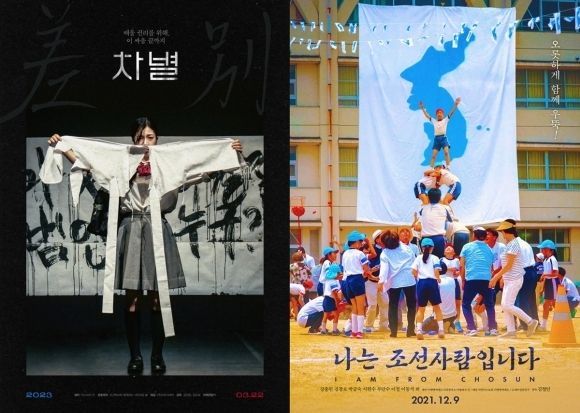 Posters of the documentary films about Zainichi Korean schools, "Discrimination" (2023) and "I Am a Korean" (2021).
An official from the Ministry of Unification said, "Considering the poor inter-Korean relations and the fact that North Korea publicly announced in July that it would not allow our citizens to visit, the government’s position is to accept reports of contact with the North only restrictively unless it is an essential matter." The official added, "In the past, the application of the Exchange Act regarding contact with North Korean residents was somewhat loosely enforced," and explained, "This is to enhance legal trust in exchanges and cooperation and to create sustainable conditions for exchanges and cooperation that the public can sympathize with."
On the other hand, the filmmakers who were asked to submit an explanation letter protested, saying this had never happened under any previous government. Producer Cho Eun-sung told Yonhap News in a phone interview, "I have made several documentaries related to the Korean diaspora in Japan for over 10 years, but this is the first time something like this has happened," adding, "(The Ministry of Unification’s action) will suppress creative activities related to the Korean diaspora in Japan, and I am concerned that the cultural blacklist from the Park Geun-hye administration might be revived."
© The Asia Business Daily(www.asiae.co.kr). All rights reserved.


















