Draft Bill Expected on 12th
Discussion on Interest Income and Separate Account Management
Some Member States Concerned About Legal Issues
The European Union (EU) is expected to announce a bill this week to utilize interest income generated from Russia's frozen assets for the reconstruction of Ukraine. Although discussions had stalled due to opposition from member states, the issue has returned to the negotiation table as Russia began to obstruct the EU's plans.
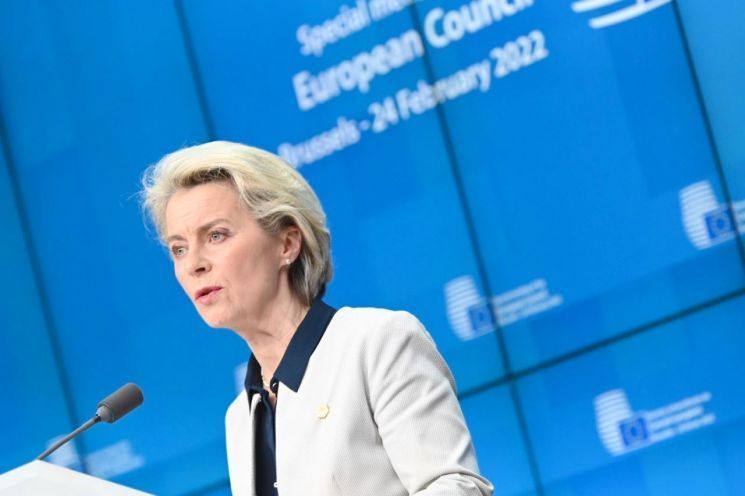
On the 11th (local time), major foreign media reported that the European Commission plans to release a draft bill on the 12th outlining measures to utilize Russian assets. The bill is expected to include detailed plans to use interest income from Russia's frozen assets for Ukraine's reconstruction.
Specifically, the EU intends to require depositary institutions to hold the interest income earned from assets deposited by Russia in a separate account dedicated to supporting Ukraine.
Currently, the EU estimates that approximately 235 billion euros (about 333 trillion KRW) of Russian assets are frozen within the EU. Of this, 207 billion euros belong to the Russian central bank. Last year, the EU froze funds held in Europe by the Russian central bank and others as sanctions against Russia's invasion of Ukraine.
Most of these assets are believed to be in Belgium, and the depositary institutions holding Russian assets have invested them in bonds and other instruments, generating substantial interest income. Euroclear, the world's largest international central securities depository, estimates that financial firms earn up to 3 billion euros annually in interest income from Russia's frozen assets. Accordingly, the EU expects to raise up to 15 billion euros in support funds for Ukraine by 2027 from interest income alone.
Initially, the EU had discussed using not only the interest income but also the frozen Russian assets themselves to support Ukraine. However, concerns arose over potential issues under international law regarding the confiscation of a nation's assets, leading to a narrowing of the scope to using only the interest income for funding. U.S. Treasury Secretary Janet Yellen also emphasized in April that the issue of Russia's state-owned assets should not be taken lightly and highlighted the need for cooperation with allies.
Although the agenda had reached a deadlock, discussions resumed after Russia strongly opposed the EU's plans in October. Russia condemned the EU's plan to use frozen Russian assets as "stealing our country's frozen assets to militarize Kyiv (Ukraine)."
Even securing funds solely from interest income is expected to face difficulties. Germany and France currently demand various safeguards, stating that it must be confirmed whether using only the interest income from Russia's frozen assets poses any issues under international law.
Bloomberg, citing anonymous EU sources, reported, "The European Commission aims to conclude discussions by the end of the year, but some member states such as France and Germany are urging a cautious approach," adding, "They want to prepare various documents to eliminate financial security and legal risks for the EU."
© The Asia Business Daily(www.asiae.co.kr). All rights reserved.
![Clutching a Stolen Dior Bag, Saying "I Hate Being Poor but Real"... The Grotesque Con of a "Human Knockoff" [Slate]](https://cwcontent.asiae.co.kr/asiaresize/183/2026021902243444107_1771435474.jpg)















