Due to Election Law Amendments, General Voters Also Allowed to Wear 'Eokkaetti'
Registration for preliminary candidates in the '22nd National Assembly General Election' scheduled for April 10 next year has begun. As the competition to enter the National Assembly officially starts, this election is expected to present a somewhat different landscape due to the revised Public Official Election Act amended last August.
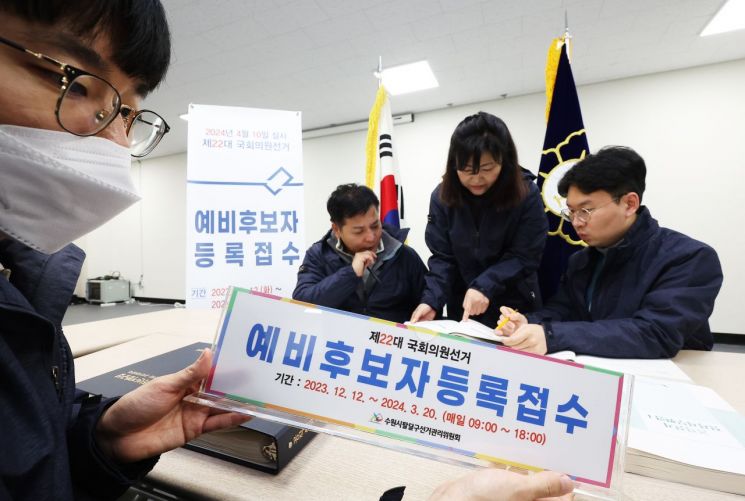
According to the Central Election Commission on the 12th, preliminary candidate registration is open from 120 days before the election day, starting today, until the day before the official candidate registration period (March 21-22, 2024), which is March 20 next year. This system was introduced in 2004 to allow political newcomers to compete fairly with incumbent politicians by permitting election campaigning even before the official campaign period. Even if one does not register as a preliminary candidate, they can still run in the election by registering during the official candidate registration period.
Preliminary candidates must submit documents such as a family relation certificate to the Election Commission and pay a deposit of 3 million KRW. They can also establish a support committee to raise up to 150 million KRW.
Public officials, including Minister of Justice Han Dong-hoon, who are subject to candidacy restrictions and rumored to run in the general election, must resign before applying to register as preliminary candidates. Even if they do not register as preliminary candidates, they must resign by January 11 next year to run in the election.
With preliminary candidate registrations expected to surge starting today, especially among political newcomers, attention is focused on declarations of candidacy by major figures. Kim In-gyu, former presidential office administrator and grandson of former President Kim Young-sam, and lawyer Kwak Sang-eon, son-in-law of former President Roh Moo-hyun, have declared their intention to run as candidates for the People Power Party and the Democratic Party, respectively.
This election also draws attention to changes such as restrictions on election campaigning by ordinary voters and the period for installing banners due to the election law revision. First, ordinary voters can now engage in election campaigning by wearing or carrying items like 'sashes.' Previously, only candidates, their spouses, and campaign workers were allowed to wear sashes. The banner installation period, which had reached a 'pollution' level during elections, has also been shortened. Whereas banners used to be displayed from 180 days before the election day, this has been changed to 120 days before the election day. Regulations on private gatherings during the election period have also been relaxed. Previously, gatherings such as hometown associations, clan meetings, alumni meetings, unity rallies, or outings were prohibited, but now only private gatherings with more than 25 people intended to influence the election are restricted. Additionally, the 'Internet Bulletin Board Real-Name Verification System,' which required real-name authentication when posting on internet news sites' bulletin boards, has been removed.
However, due to the incomplete redistricting, some preliminary candidates inevitably face disadvantages. Political newcomers with lower name recognition than incumbent lawmakers cannot know in which electoral district they should campaign, limiting their opportunities to communicate their platforms and pledges.
After candidate registration ends, the official election period will begin on March 28 next year, followed by shipboard voting from April 2 to 5, early voting from April 5 to 6, and the main voting and counting on April 10.
© The Asia Business Daily(www.asiae.co.kr). All rights reserved.
![Clutching a Stolen Dior Bag, Saying "I Hate Being Poor but Real"... The Grotesque Con of a "Human Knockoff" [Slate]](https://cwcontent.asiae.co.kr/asiaresize/183/2026021902243444107_1771435474.jpg)
















