Increase in Long-term Care Insurance Copayment Rate
Criticism of Manipulating Intergenerational Conflict
The Japanese government is pushing forward with a low birthrate policy that includes making university entrance and tuition fees free for families with multiple children. Although this policy has been criticized as populism within Japan, the government is focusing on addressing the low birthrate issue. However, concerns have been raised that the decision to increase the medical insurance copayment rate for the elderly to fund this policy may fuel generational conflict.
On the 12th, Asahi Shimbun reported that the government’s low birthrate policy body, the Children’s Future Strategy Council, announced the ‘Children’s Future Strategy’ measures with these contents at a meeting held the previous day.
The core of this policy is to provide free university tuition for families with multiple children and to significantly increase child allowances. From 2025, the government will support entrance fees and tuition for families with three or more children. There will be no household income restrictions, and universities will include junior colleges and vocational schools. However, families where the first and second children are employed will be excluded from eligibility.
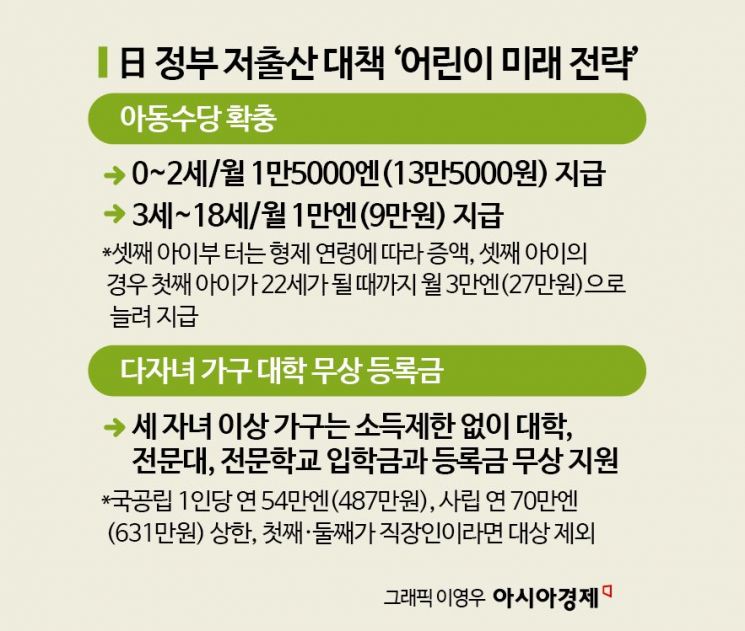
Child allowances will also be available to any household with children, with income restrictions removed. The payment age limit has been extended from middle school students to 18 years old. This measure will be applied starting December next year. Regarding the ‘placement standards’ that limit the number of 4- to 5-year-old children per childcare worker, a review will be conducted to improve the quality of care.
However, this policy is expected to increase the tax burden on the elderly. To implement these measures, the government will need to allocate a new budget of 3.6 trillion yen (approximately 32.476 trillion won) annually for three years starting next year. The Japanese government’s proposed methods to secure funding include △ reforming social insurance expenditures such as medical and nursing care △ utilizing existing budgets like employment insurance premiums △ and various support grant systems. According to this plan, elderly individuals with certain income levels will see their nursing care insurance copayment rate increase from 10% to 20%.
Local media have criticized the low birthrate policy for pushing the elderly into a difficult situation. Asahi cited an interview with an elderly person struggling with hospital costs, stating, "When medical expenses increase for the elderly, they have no choice but to refrain from outpatient visits," and added, "While childcare support is understandable, isn’t it strange to cover the insufficient funding by increasing the burden on the elderly?"
The Nihon Keizai Shimbun (Nikkei) criticized, "The government is creating a structure where the low birthrate policy is supported across all generations, thereby pressuring the elderly," and added, "It is now necessary to find other options. Discussions to accelerate securing funding in line with strengthening low birthrate measures are needed."
© The Asia Business Daily(www.asiae.co.kr). All rights reserved.
![Clutching a Stolen Dior Bag, Saying "I Hate Being Poor but Real"... The Grotesque Con of a "Human Knockoff" [Slate]](https://cwcontent.asiae.co.kr/asiaresize/183/2026021902243444107_1771435474.jpg)















