Financial Supervisory Service Reports to National Assembly's Political Affairs Committee
"Early Start of On-Site Inspections... Investment Scale Very Large, Significant Proportion of Elderly"
January 0.8 trillion → February 1.4 trillion → March 1.6 trillion → April 2.6 trillion
Five Banks, Total Sales of Hong Kong H Index ELS Amount to 15.9 Trillion Won
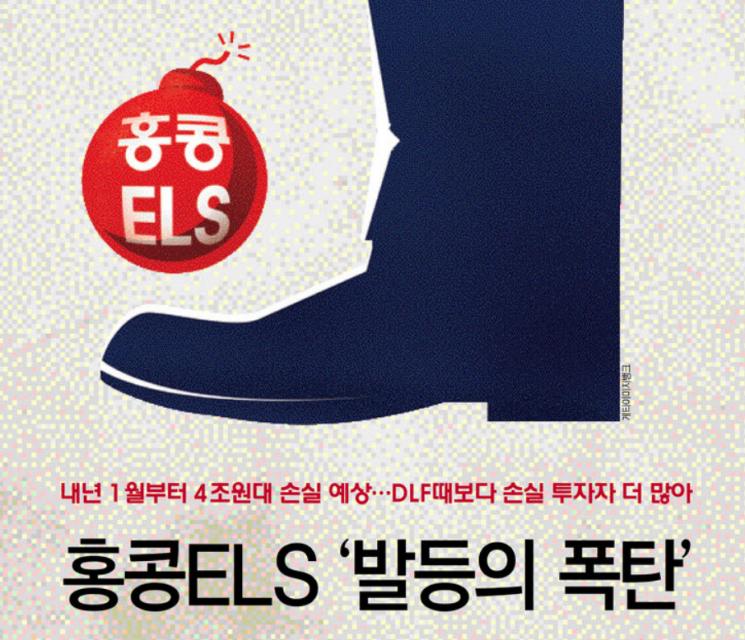
Starting January next year, concerns over massive losses among investors in Hong Kong H Index equity-linked securities (ELS) have emerged. The Financial Supervisory Service (FSS) explained the situation to the National Assembly's Political Affairs Committee and announced plans to "initiate on-site inspections early." If the H Index fails to rebound, losses are expected to concentrate in April next year.
According to data received on the 11th from the FSS by the office of Kim Seong-ju, a member of the National Assembly's Political Affairs Committee from the Democratic Party, the monthly maturity amount of Hong Kong H Index ELS products in the banking sector (including Kookmin, Shinhan, Nonghyup, Hana, SC, etc.) is largest in April. Starting from 800 billion KRW in January, it gradually rises to 1.4 trillion KRW in February, 1.6 trillion KRW in March, and peaks at 2.6 trillion KRW in April. It then maintains 1.3 trillion KRW in May and 1.5 trillion KRW in June.
The maturity amount in the second half of next year (July to December) is 4.2 trillion KRW. On this day, the FSS explained the current status of Hong Kong H Index ELS to members of the National Assembly's Political Affairs Committee. The FSS stated, "The maturity amount will continuously increase from January to April next year, peaking in April, and then gradually decrease."
3.8 Trillion KRW Maturing in Q1 Next Year, 5.4 Trillion KRW in Q2
Looking at the quarterly maturity distribution, 3.8 trillion KRW matures in the first quarter and 5.4 trillion KRW in the second quarter. By bank, in the first quarter, Kookmin Bank has 2 trillion KRW, Nonghyup Bank 900 billion KRW, Shinhan Bank 600 billion KRW, SC First Bank 200 billion KRW, and Hana Bank 100 billion KRW maturing. In the second quarter, Kookmin Bank has 2.8 trillion KRW, Shinhan Bank 900 billion KRW, Nonghyup Bank 700 billion KRW, Hana Bank 600 billion KRW, and SC First Bank 400 billion KRW maturing, in that order.
As of the end of June this year, the total sales volume of Hong Kong H Index ELS in the banking sector was 15.9 trillion KRW, sold across 247,000 accounts. Kookmin Bank sold 8 trillion KRW, Shinhan Bank 2.4 trillion KRW, Nonghyup Bank 2.2 trillion KRW, Hana Bank 2 trillion KRW, and SC First Bank 1.2 trillion KRW.
The FSS explained, "The five banks accounted for 99.2% of the total," adding, "Including 3.5 trillion KRW sold by securities firms, the total sales volume across the financial sector reaches 19.4 trillion KRW."
Trust-type products (ELT) accounted for an overwhelming 96.8% (15.4 trillion KRW). By product structure, knock-in type products (8 trillion KRW) made up 50.5%, and no knock-in type products (7.9 trillion KRW) accounted for 49.5%, showing similar proportions.
The FSS expressed concern, stating, "Due to the spread of economic crisis theories in China caused by US-China conflicts, the H Index has been declining since early 2021, resulting in losses in linked financial products. The investment scale itself is very large, and a significant portion of investors are elderly customers in the banking sector, raising the possibility of large-scale complaints such as mis-selling."
Banks Account for Over 90% of Offline Sales
It continued, "Based on the number of accounts, banks have a high offline channel sales ratio of 91.7%, whereas securities firms have an 87.6% non-face-to-face channel sales ratio, suggesting that issues of mis-selling by securities firms are expected to be limited."
Furthermore, "The key issue is whether sellers, including banks, complied with sales principles such as suitability and adhered to sales regulations under the Financial Consumer Protection Act," adding, "It is crucial whether they accurately understood the customer's situation and recommended products suitable for their investment purpose, and whether explanations were provided in a way that consumers could understand during the sales process."
Accordingly, the FSS stated, "Since investor losses are expected from next year, we are currently investigating the status with major sellers," adding, "For Kookmin Bank, which sold more than half of the banking sector's sales, on-site inspections are underway to check the product selection process, KPI policies, and customer response systems, while written investigations are being conducted for major financial companies."
The FSS also said, "From January next year, when maturities begin, we will focus on monitoring investor loss status and complaint situations by seller," and "We plan to analyze suspected violations by sellers identified during the dispute resolution process for complaints received by the FSS and, depending on the situation, initiate on-site inspections early."
Assemblyman Kim Seong-ju said, "Since last week, the decline in the Hong Kong H Index has become pronounced, dropping to 5,500 points," urging, "The FSS must thoroughly inspect the banking sector, including whether there was any mis-selling."
© The Asia Business Daily(www.asiae.co.kr). All rights reserved.
![Clutching a Stolen Dior Bag, Saying "I Hate Being Poor but Real"... The Grotesque Con of a "Human Knockoff" [Slate]](https://cwcontent.asiae.co.kr/asiaresize/183/2026021902243444107_1771435474.jpg)
















