As the digital healthcare industry, including digital therapeutics (DTx) and artificial intelligence (AI) medical devices, continues to grow, there is a suggestion that efforts encompassing various stakeholders within the medical ecosystem are necessary to achieve growth that truly reaches patients.
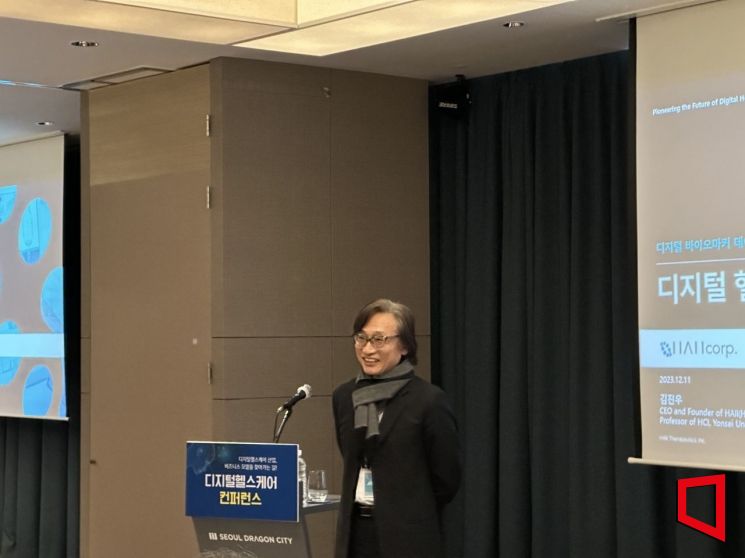 On the afternoon of the 11th, Kim Jin-woo, CEO of Hi, is giving a lecture at the "Digital Healthcare Conference" hosted by the Korea Electronics and Telecommunications Industry Promotion Association (KEA) in Yongsan-gu, Seoul.
 [Photo by Lee Chun-hee]
On the afternoon of the 11th, at the 'Digital Healthcare Conference' hosted by the Korea Electronics and Telecommunications Industry Association (KEA) in Yongsan-gu, Seoul, three representatives of digital healthcare companies?Hwang Hee, CEO of Kakao Healthcare; Kim Jin-woo, CEO of Hi; and Kang Sung-ji, CEO of Welt?unanimously emphasized that for the digital healthcare industry to truly succeed, it is essential to understand the dynamics among various players in the ecosystem and to attempt diverse collaborations.
Kim Jin-woo, CEO of Hi, said, "At the beginning of the year, I encountered two unfortunate news items: the bankruptcy of Pear Therapeutics and the management difficulties of Akili Interactive," and concluded that "it is absolutely impossible to succeed alone."
The basis for Kim's argument lies in the unique industrial structure of the healthcare market, including digital health. In a typical product market, consumers pay sellers directly to purchase products. However, the healthcare market is different. Not only the end consumer, the patient, but also caregivers, doctors, and hospitals function as a kind of consumer. Moreover, payors such as the National Health Insurance and private insurance companies pay more money than the patients themselves. He explained, "To succeed in the healthcare business, it is necessary to closely understand the interests of hospitals and insurance companies as healthcare service providers, as well as patients and caregivers, and the utility that can be provided to them," adding, "It is important to talk with other players and discuss how meaningful business can be created through connections."
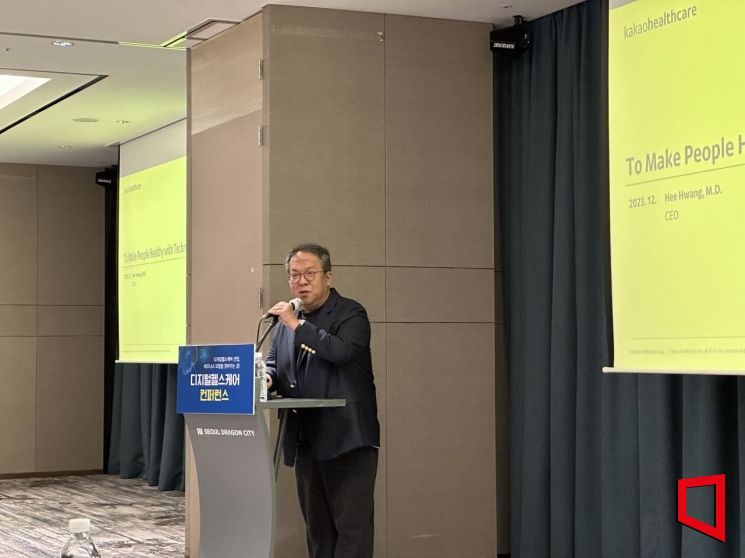 On the afternoon of the 11th, Hwang Hee, CEO of Kakao Healthcare, is speaking at the 'Digital Healthcare Conference' hosted by the Korea Electronics and Telecommunications Industry Promotion Association (KEA) in Yongsan-gu, Seoul.
 [Photo by Lee Chunhee]
Hwang Hee, CEO of Kakao Healthcare, also mentioned that Korea is a society optimized for digital healthcare but pointed out the lack of important payment systems. Hwang said, "Korea has good manpower, networks, infrastructure, and technology, and although digital literacy among the public is often criticized, it is better compared to other countries," emphasizing, "If we cannot succeed in Korea, we should assume we cannot succeed elsewhere."
Expressing regret that "it is ultimately a market without payors," Hwang added, "Although insurance fees for DTx are being discussed, there are many concerns about whether the fees are sufficiently set and whether costs can be covered," and warned, "If sufficient value is proven in Korea, global growth is necessary; otherwise, it may be meaningful only for research institutes and schools but difficult for corporate sustainability."
This is also why Hwang emphasized global expansion. He said, "If the service does not end in Korea, the key is whether we can find major players without conflicts in markets such as the U.S., Europe, and Japan as partners," noting that Kakao Healthcare has formed partnerships with global companies such as Google Cloud, Dexcom, L'Or?al, and Novo Nordisk.
Kim Jin-woo's Hi is also exploring overseas expansion. Hi's solution is digital biomarkers. Kim explained, "By monitoring patients' physiological, psychological, and behavioral data through commercial devices like smartphones and organizing it well, services can be provided much more easily," adding, "We are conducting validation work to see if this is technically feasible and clinically possible." While developing various proprietary services such as 'Alzguard,' 'LipiChe,' and 'Maumjeongwon' using digital biomarkers, they also created 'Biomarker.it,' a service that provides actual digital biomarkers. Kim said, "There has been a response in the U.S., and actual exports have taken place," and added, "Since using digital biomarkers for remote patient monitoring (RPM) simplifies the process, we are currently conducting exploratory clinical trials."
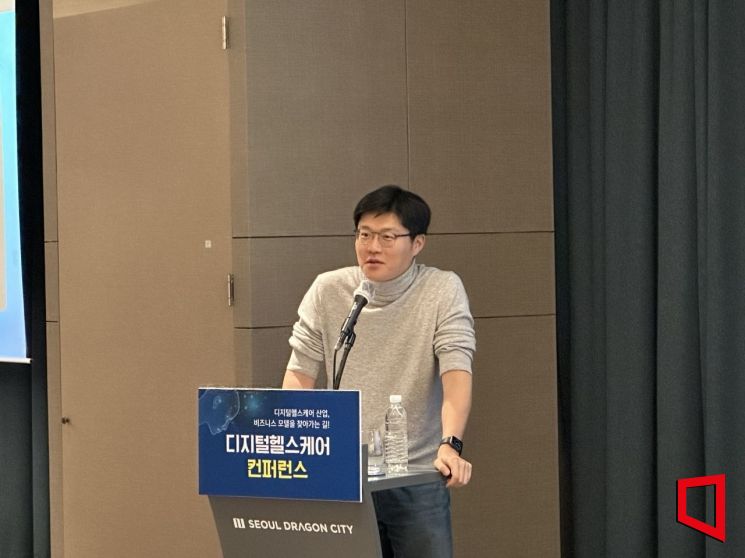 On the afternoon of the 11th, Kang Sung-ji, CEO of Welt, is giving a presentation at the 'Digital Healthcare Conference' hosted by the Korea Electronics and Telecommunications Industry Promotion Association (KEA) in Yongsan-gu, Seoul.
 [Photo by Lee Chun-hee]
Kang Sung-ji, CEO of Welt, emphasized the role of regulatory agencies among various stakeholders. Kang stressed reliability, saying, "For digital healthcare to have value, it must be trustworthy, just as treatments passed down by word of mouth were refined, verified, standardized, and turned into medicines," and emphasized, "The foundation for the emergence of DTx is also the role of the state, represented by regulatory agencies." In fact, the Ministry of Food and Drug Safety (MFDS) in Korea has issued guidelines for DTx approval and review since 2020, covering various indications such as insomnia and addiction disorders, while in the U.S., the Food and Drug Administration (FDA) proactively established systems, followed by efforts in insurance systems such as the 'Medicare Coverage of Innovative Technology (MCIT)' and 'Transitional Coverage for Emerging Technologies (TCET)' for innovative technologies.
Kang also suggested that, as discussions continue in the industry about applying services like large language models (LLM), various stakeholders should begin discussions on LLM. He said, "To achieve proper development speed, AI might also be used to manage this," adding, "We are trying various attempts, such as internally testing LLMs trained on MFDS guidelines."
© The Asia Business Daily(www.asiae.co.kr). All rights reserved.
![Clutching a Stolen Dior Bag, Saying "I Hate Being Poor but Real"... The Grotesque Con of a "Human Knockoff" [Slate]](https://cwcontent.asiae.co.kr/asiaresize/183/2026021902243444107_1771435474.jpg)

















