Advanced clinical data of Hanmi Pharmaceutical's innovative acute myeloid leukemia (AML) treatment drug 'TUSPETINIB (TUS)' was presented orally at the American Society of Hematology (ASH).
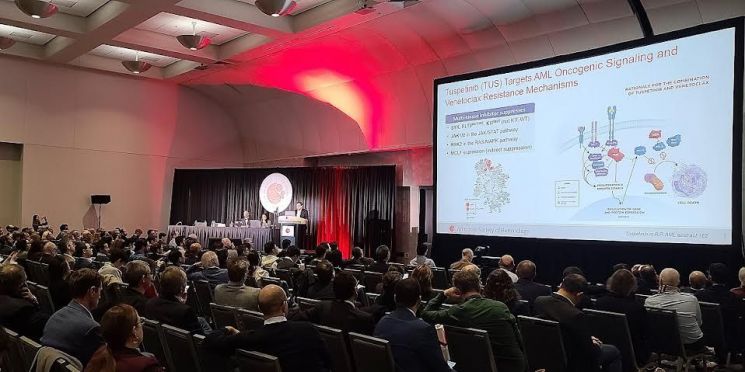
Hanmi Pharmaceutical's partner, Aptose, announced on the 9th (local time) at ASH held in San Diego, California, USA, that it presented advanced clinical data of TUS orally and disclosed detailed clinical profiles. TUS is a once-daily oral myeloid kinase inhibitor (MKI) targeting key kinases acting in myeloid malignancies. It was licensed out to Aptose in April 2021 for $420 million (approximately 544.4 billion KRW). TUS has been designated by the U.S. Food and Drug Administration (FDA) as an orphan drug (2018) and a fast-track development item (2022).
The clinical data, presented by Dr. Naval G. Daver, a professor at the MD Anderson Cancer Center in Texas, USA, showed excellent efficacy including complete remission with complete clearance (CRc) of tumors in both TUS monotherapy and combination therapy with Venetoclax (VEN).
First, in the 80?160 mg TUS monotherapy conducted on 68 patients, CRc was observed in 8 out of 28 patients (29%) who had no prior VEN treatment experience. By mutation classification, CRc was observed in 5 out of 12 patients (42%) with FLT3 mutations and in 3 out of 16 patients (19%) with wild-type or unmutated FLT3.
Many patients showed positive drug responses, leading to hematopoietic stem cell transplantation (HSCT) treatment in some cases. Additionally, sustained therapeutic effects were observed in patients who did not proceed to HSCT. The safety profile was favorable without notable adverse events or dose-limiting toxicities (DLT) up to the maximum daily dose, and there were no treatment discontinuations due to drug-related toxicity. Accordingly, 80 mg was selected as the recommended dose for the upcoming phase 2 trial.
In the TUS·VEN (80 mg·200 mg) combination therapy group, 49 patients were treated, with 36 patients evaluated. The combination therapy group mainly consisted of patients with prior VEN or FLT3 inhibitor treatment history.
In the combination therapy, CRc was observed in 9 out of 36 patients (25%) including those without prior VEN treatment and those with VEN relapsed/refractory (R/R) AML. Among patients without prior VEN treatment, 3 out of 7 (43%) showed CRc, and among those with prior treatment, 6 out of 29 (21%) showed CRc. In the FLT3 wild-type group, 5 out of 25 patients (20%) showed CRc, and in the FLT3 mutant group, 4 out of 11 patients (36%) showed CRc.
Dr. Daver stated, “TUS demonstrates clear therapeutic effects in relapsed/refractory AML, a very challenging and difficult disease in oncology, and exhibits remarkably excellent tolerability. TUS shows efficacy across a broad patient population including FLT3 wild-type patients, who account for over 70% of AML patients, as well as patients with FLT3 and NPM1 mutations.”
He continued, “From a broader perspective, the expanding range of anti-leukemic activity and the continuously disclosed safety profile of TUS provide important evidence supporting the potential use of TUS·VEN·hypomethylating agent (HMA) triple therapy as a first-line treatment for newly diagnosed AML patients. Although patients receiving TUS·VEN combination therapy are currently in the early stages of treatment, most responders continue therapy, and it is expected that better responses will be achieved with ongoing administration.”
© The Asia Business Daily(www.asiae.co.kr). All rights reserved.
![Clutching a Stolen Dior Bag, Saying "I Hate Being Poor but Real"... The Grotesque Con of a "Human Knockoff" [Slate]](https://cwcontent.asiae.co.kr/asiaresize/183/2026021902243444107_1771435474.jpg)
















