Mayor Yujeongbok: "Right to a speedy trial violated by Seoul High Court remote trial"
Incheon City and a pan-citizen organization are making every effort to attract a High Court to Incheon. Currently, among metropolitan cities, only Incheon and Ulsan lack a High Court, but considering that Incheon’s population (2.97 million) is about three times that of Ulsan (1.1 million), Incheon is effectively the only major metropolitan city without a High Court.
Incheon City announced on the 12th that it is continuously requesting cooperation from related institutions such as the National Assembly, the Court Administration Office, and the Ministry of Economy and Finance, together with the 'Pan-Citizen Promotion Committee for Attracting the Incheon High Court,' to ensure that the bill related to attracting the Incheon High Court is processed within the 21st National Assembly’s term. The city is also actively providing administrative support, including hosting policy forums at the National Assembly.
On the 8th, Mayor Yoo Jeong-bok met with Kim Do-eup, Chairman of the National Assembly’s Legislation and Judiciary Committee, and delivered a petition requesting cooperation to expedite the passage of the pending bill related to attracting the Incheon High Court. Mayor Yoo said, “Despite being the second most populous metropolitan city, Incheon lacks a High Court, forcing residents to travel to Seoul for appellate trials. Incheon citizens’ constitutional rights to a speedy trial and the right to file lawsuits are being infringed upon, and especially given the region’s many islands, judicial accessibility for island residents must be guaranteed.”
He continued, “The fact that 1.1 million people, one-third of Incheon’s population, participated in the signature campaign to attract the Incheon High Court sufficiently demonstrates the justification and necessity for establishing the High Court,” and urged Chairman Kim to resolve this long-standing issue for Incheon citizens. Regarding the establishment of the Incheon High Court, the 'Partial Amendment to the Act on the Establishment and Jurisdiction of Courts,' proposed in 2020 by Democratic Party lawmakers Shin Dong-geun (Incheon Seo-gu Eul) and Kim Gyo-heung (Incheon Seo-gu Gap), is currently pending in the National Assembly’s Legislation and Judiciary Committee.
In this context, the Pan-Citizen Promotion Committee for Attracting the Incheon High Court held a 'National Assembly Policy Forum on the Establishment of the Incheon High Court' at the National Assembly Library on the 28th of last month, stating, “The bill related to the Incheon High Court is a vital bill concerning people’s livelihoods and a core piece of legislation,” and urged, “This bill must be passed during the 21st National Assembly, which ends its term in late May next year.” Lawmaker Kim said, “We are actively persuading the bipartisan secretaries of the Legislation and Judiciary Committee and will do our best to ensure the bill passes within the term.”
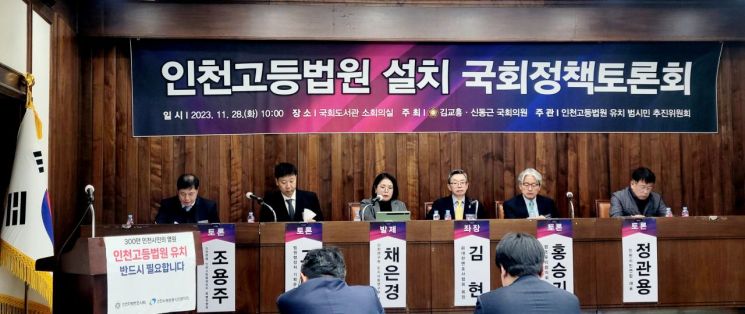 The "National Assembly Policy Forum on the Establishment of the Incheon High Court," hosted by Democratic Party lawmakers Kim Gyo-heung and Shin Dong-geun and organized by the "Incheon High Court Attraction Citizens' Promotion Committee," was held on the 28th of last month in the small conference room of the National Assembly Library.
 [Photo provided by Incheon City]
In Incheon, the Seoul High Court’s Incheon Branch Court opened in March 2019, but it operates only two collegiate panels handling appeals for civil and family cases. Appeals for criminal and administrative collegiate panel cases are still conducted at the Seoul High Court, causing inconvenience for Incheon citizens who must travel about 50 km to Seocho-dong, Seoul, to attend trials.
Moreover, as of 2020, the Seoul High Court has the largest jurisdictional area among all High Courts and a jurisdictional population of 18.94 million, more than twice that of the second largest, the Suwon High Court. With 20,659 cases, 60% of the 30,412 main lawsuits nationwide are concentrated at the Seoul High Court, resulting in an overloaded workload. This has been pointed out as causing delays or inefficiencies in trials, highlighting the need to decentralize judicial services from the Seoul High Court.
If a High Court is established in Incheon, citizens of neighboring areas such as Gimpo and Bucheon in Gyeonggi Province can also expect qualitative improvements in judicial services. Currently, High Courts are established in Seoul, Daejeon, Daegu, Busan, Gwangju, and Suwon.
© The Asia Business Daily(www.asiae.co.kr). All rights reserved.
![Clutching a Stolen Dior Bag, Saying "I Hate Being Poor but Real"... The Grotesque Con of a "Human Knockoff" [Slate]](https://cwcontent.asiae.co.kr/asiaresize/183/2026021902243444107_1771435474.jpg)
















