North Korea's Shift in Foreign Currency Earning Methods: 'Hacking and Cryptocurrency Laundering'
Comprehensive and Strategic Response Covering Security, Economy, and Technology
South Korea, the United States, and Japan have agreed to block North Korea's foreign currency earnings through hacking and the dispatch of IT workers. In addition to existing economic sanctions, they plan to actively prevent North Korea from acquiring foreign currency in the cyber domain to curb its nuclear and missile development.
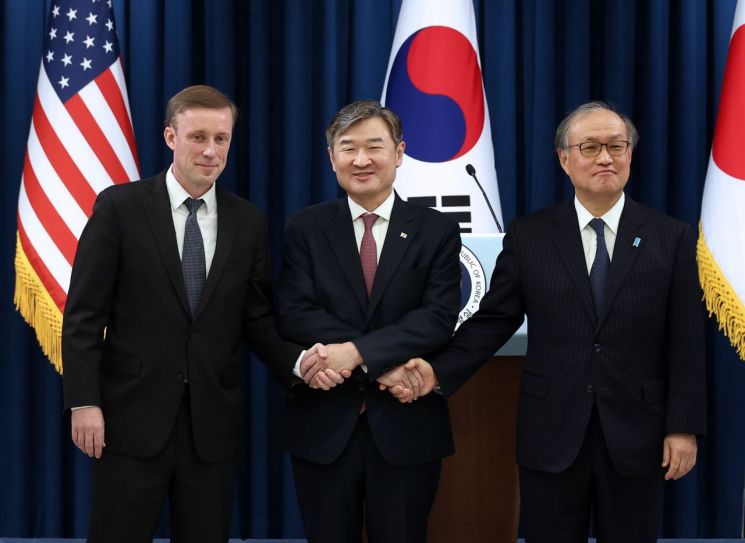
According to the Presidential Office on the 11th, the national security chiefs of South Korea, the United States, and Japan held a two-day meeting on the 9th and 10th to promote a new trilateral initiative that includes joint responses to illegal cyber activities such as cryptocurrency laundering and hacking aimed at funding North Korea's nuclear development.
The three countries intend to evolve their response methods based on the cyber working group newly established this year under the Camp David agreement reached last August.
So far, the United Nations Security Council and the international community have imposed sanctions on financial transactions of institutions and individuals within North Korea, as well as third-country entities dealing with North Korea, to sanction North Korea's nuclear and missile development and launches, strictly controlling exports and imports.
In addition, South Korea, the United States, and Japan have adopted resolutions and independent sanctions to block North Korea's funding sources as much as possible. The South Korean National Assembly also adopted a resolution on the 8th urging the cessation of arms transactions between North Korea and Russia.
However, North Korea is changing its illegal foreign currency earning methods from existing counterfeit currency, mineral exports, overseas restaurant operations, and labor dispatch to cryptocurrency theft and laundering, malware attacks, and overseas IT project contracts.
According to a report submitted to the Security Council by the expert panel of the UN Security Council's North Korea Sanctions Committee, the amount of virtual assets stolen by North Korea's Reconnaissance General Bureau last year was estimated at $1.7 billion (about 2.3 trillion won), three times the amount in 2021. The Financial Action Task Force (FATF) also designated North Korea as a high-risk country for money laundering for the 13th consecutive year at its general meeting held from October 23 to 27.
Jake Sullivan, U.S. National Security Advisor, stated at a briefing after the trilateral security chiefs meeting on the 9th, "We have launched a new trilateral initiative to respond to North Korea's threats ranging from cybercrime and cryptocurrency money laundering to reckless space and ballistic missile tests."
Through trilateral cooperation, it is expected that not only simple financial sanctions and cyber responses but also comprehensive responses will become possible.
At this security chiefs meeting, the three countries agreed to undertake comprehensive and strategic responses covering security, economy, and advanced technology in line with the spirit and principles of trilateral cooperation presented at the Camp David summit.
They also agreed to steadily promote trilateral security cooperation, including real-time sharing of North Korean missile warning information and the establishment of multi-year trilateral training plans.
The three national security chiefs clearly stated their intention to check the close relationship among North Korea, China, and Russia and to implement value-based diplomacy centered on the Indo-Pacific region.
While safeguarding "freedom of navigation" in the Taiwan Strait amid ongoing maritime provocations by China, they plan to continue anti-Russian solidarity with more than 50 countries regarding Russia's invasion of Ukraine, calling it a "fight for freedom."
Kim Soo-kyung, spokesperson for the Presidential Office, said at a briefing the day before, "As the nature of security crises diversifies and intensifies, trilateral cooperation will become even closer and more thorough."
© The Asia Business Daily(www.asiae.co.kr). All rights reserved.