The U.S. Federal Reserve (Fed) is widely expected to maintain its interest rates for the third consecutive time at the December Federal Open Market Committee (FOMC) meeting this week. Meanwhile, market attention is focused not on the benchmark rate decision but on the 'Dot Plot,' as it provides insight into the timing and scale of rate cuts anticipated by Fed officials next year. However, the new Dot Plot is unlikely to align with market expectations for rate cuts. The previously released employment report, which showed stronger-than-expected figures, has already dampened market hopes for a 'pivot' (a shift in monetary policy direction).
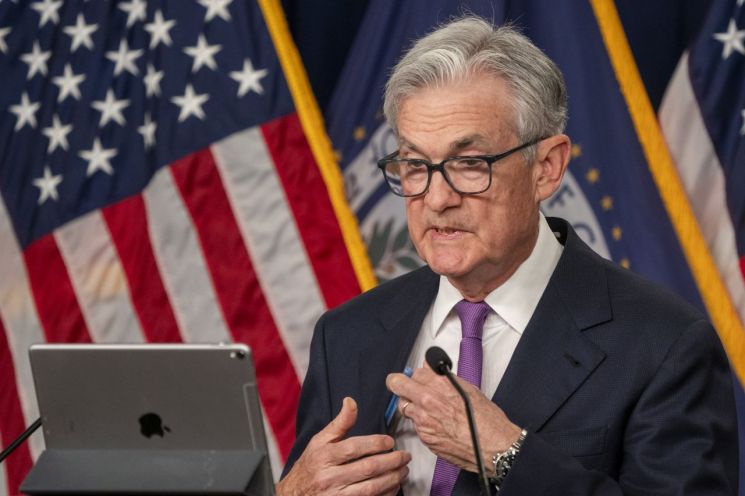
The Fed will release the December Summary of Economic Projections (SEP), which includes the Dot Plot, growth, inflation, and unemployment forecasts, alongside the rate decision at the final FOMC meeting of the year on December 12-13 (local time). The Fed is expected to keep rates steady while revising the Dot Plot and economic outlook downward.
The key issue is the hint the Dot Plot will provide regarding the timing and magnitude of rate cuts next year. The Wall Street Journal (WSJ) reported, "The biggest question now is when the Fed will start cutting rates and by how much," adding, "The answer will be crucial not only for households and markets but also for the 2024 presidential election."
Markets have increasingly speculated that rate cuts could begin as early as March next year, citing the recent trend of slowing inflation. According to the Chicago Mercantile Exchange (CME) FedWatch tool, federal funds futures currently price in about a 45% chance of a rate cut of at least 0.25 percentage points in March 2024 and about a 76% chance in May 2024. Joseph LaVorgna, Chief Economist at SMBC Nikko Securities America, noted, "Historically, the average time between the last rate hike and the first rate cut in five previous Fed tightening cycles was about eight months." Since the Fed last raised rates in July and has since held steady, March next year corresponds to that timeframe.
Some analysts even predict as many as five rate cuts throughout the year. In that scenario, the current U.S. rate range of 5.25-5.50% would fall to around 3.25-3.50% by December 2024. This is significantly lower than the median rate projections of 5.6% for this year and 5.1% for the end of next year presented in the Fed's September Dot Plot.
The Dot Plot to be released this week is likely to signal rate cuts next year while simultaneously tempering market expectations, reflecting a 'hawkish' (monetary tightening preference) stance. Bloomberg News analyzed, "The Fed is expected to forecast rate cuts in 2024 through the Dot Plot this week, but it will fall short of the expectations held by investors and economists."
The November employment report released on December 8, ahead of the FOMC, reaffirmed a robust labor market and suggested that the battle against inflation is far from over. Nonfarm payrolls increased by 199,000, exceeding expectations, and the unemployment rate dropped from 3.9% to 3.7%. This partly explains why expectations for a rate cut in March next year fell below 50% in the rate futures market immediately afterward.
A Bloomberg survey conducted earlier this month among economists found that the most common forecast was that the first rate cut would not occur until as late as June next year. The Fed's new Dot Plot is also expected to be more conservative than economists' predictions. Respondents estimated a total rate cut of 1.0 percentage point over the course of next year, but the December Dot Plot may only reflect about 0.5 percentage points. Brett Ryan, Senior Economist at Deutsche Bank, analyzed, "The Dot Plot will likely not include rate cut projections for the first half of the year."
Having previously faced heavy criticism for misjudging soaring inflation as 'transitory,' the Fed is expected to remain cautious until it confirms clear signals that inflation is moving toward the 2% target. If the Fed were to pivot to rate cuts too quickly, there is a risk of inflation rebounding, similar to what happened in the late 1960s. Fed Chair Jerome Powell also reiterated at a university event earlier this month that discussing rate cuts is "premature" and confirmed that the Fed remains open to additional rate hikes if necessary.
Former Reserve Bank of India Governor Raghuram Rajan stated, "The Fed cannot declare mission accomplished until the labor market weakens further." Lindsey Piegza, Chief Economist at Stifel Financial, also pointed out, "There are many headwinds and uncertainties on the inflation path," adding, "The Fed has not yet taken its foot off the brake."
© The Asia Business Daily(www.asiae.co.kr). All rights reserved.
![Clutching a Stolen Dior Bag, Saying "I Hate Being Poor but Real"... The Grotesque Con of a "Human Knockoff" [Slate]](https://cwcontent.asiae.co.kr/asiaresize/183/2026021902243444107_1771435474.jpg)
















