Survey of 1,315 University Professors... 2nd Place 'Jeokbanhajang'
'Gyeonri Mangui (見利忘義)'
The four-character idiom 'Gyeonri Mangui,' meaning 'seeing profit and forgetting righteousness,' was selected as this year's idiom by university professors nationwide.
On the 10th, Professor Newspaper announced that in a survey of 1,315 university professors across the country, 30.1% (396 votes) of respondents chose 'Gyeonri Mangui' as this year's idiom.
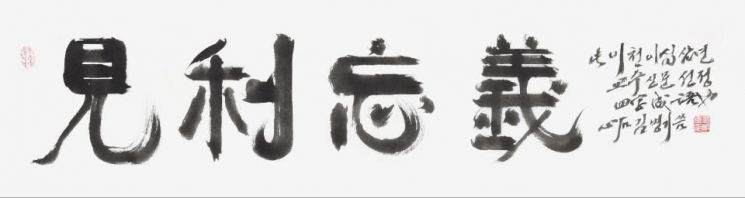 Professor Kim Byung-ki, Professor Emeritus at Jeonbuk National University, wrote the four-character idiom of the year chosen by professors, 'Gyeonri Mangui'
 [Photo by Professor Newspaper, Yonhap News]
Kim Byeong-gi, Professor Emeritus of Chinese Language and Literature at Jeonbuk National University, who recommended 'Gyeonri Mangui,' criticized, "Today’s politicians in our country seem to think more about the interests of their own faction rather than leading righteously," adding, "There are quite a few cases suspected of drafting and implementing policies beneficial to their own side to gain immediate success and power, rather than righteous politics that consider the nation's long-term future."
Other professors who chose 'Gyeonri Mangui' pointed out that the president’s relatives and politicians are not upright in the face of profit, responses to personal investments by high-ranking officials or school violence involving their children, and cases where individuals abandon family and friends under the pretext of personal gain are frequent. They noted that society as a whole has become an era where values are lost in the pursuit of profit, and stressed that social leaders should demonstrate righteousness for the community.
The second place went to 'Jeokban Hajang (賊反荷杖),' meaning 'the thief takes up the rod,' with 25.5% (335 votes).
Lee Seung-hwan, Professor Emeritus of Eastern Philosophy at Korea University, who recommended 'Jeokban Hajang,' argued, "We must reflect on the deception of using vulgar language and insults on the international diplomatic stage, blaming the press and journalists, blaming the previous government for incompetent state administration, suppressing freedom of the press while shouting for freedom whenever possible."
The third place was 'Namuchungsu (濫?充數),' which received 24.6% (323 votes). Namuchungsu means 'joining the musicians who play the flute without knowing how to play, just to fill the number,' metaphorically referring to incompetent people occupying high positions.
Professor Newspaper selects the idiom of the year reflecting Korean society through a survey of professors every year at the end of the year.
The idiom of the year selected in 2022 was 'Gwaibulgae (過而不改),' meaning 'committing mistakes but not correcting them,' and in 2021 it was 'Myoseo Dongcheo (猫鼠同處),' meaning 'cats and mice becoming allies.'
© The Asia Business Daily(www.asiae.co.kr). All rights reserved.

















