Survey on Management Status and 2024 Business Plans of Small and Medium Enterprises
Conducted with 500 SMEs
Half of domestic small and medium-sized enterprises (SMEs) evaluated this year's business environment as difficult. They also forecast that next year will not be easy.
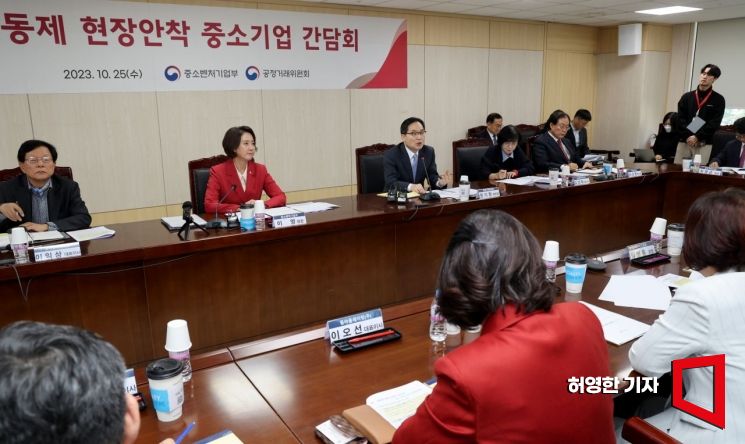 The On-Site Settlement Meeting for Small and Medium Enterprises regarding the Interlocking System, hosted by the Ministry of SMEs and Startups and the Fair Trade Commission, was held on October 25 at the Foundation for Large, Small, and Medium Enterprises and Agriculture-Fishery Cooperation. Han Ki-jung, Chairman of the Fair Trade Commission, is delivering a greeting. Photo by Heo Younghan younghan@
The Korea Federation of SMEs announced the results of the "Survey on the Business Conditions of SMEs and 2024 Business Plans," conducted from the 20th to the 24th of last month targeting 500 SMEs, on the 10th.
Half of the responding companies (49.8%) answered that "the business environment in 2023 was difficult." Only 18.4% of companies said it was "not difficult."
The main factors for this year's business difficulties (multiple responses allowed) were ranked as follows: "demand contraction" (47.4%) was first, followed by rising labor costs (31.7%) and interest rate hikes (30.9%).
To improve the business environment, SMEs mainly made efforts to "expand business partners (sales and promotion)" (46.0%). Cost reduction and restructuring (39.0%) and pursuing new businesses (33.6%) were also common.
The most useful government and local government policies this year were "tax reductions and payment deferrals" (23.2%), which accounted for the highest proportion. This was followed by loan maturity deferrals and extensions (19.2%) and business stabilization support (16.0%).
Regarding the outlook for the 2024 business environment, 57.4% of responding companies said it would be similar to this year. Companies expecting deterioration accounted for 26.8%, while 15.8% expected improvement.
For next year's core business strategies (multiple responses allowed), the most common answer was "pursuing new businesses and business diversification" at 48.6%. This was followed by cost reduction and tightening (42.4%), strengthening financial risk management (25.8%), and expanding new sales channels (25.8%).
For policies most needed to stabilize and grow SMEs next year (multiple responses allowed), "alleviating financial cost burdens" (64.6%) ranked first. Labor flexibility policies such as improving the 52-hour workweek system (35.4%) and expanding support for research and development (R&D) and facility investment (27.4%) also showed high proportions.
For the mid-to-long term, half of the responding companies (50.8%) identified "declining labor population" as the most critical factor to prepare for SME management. This was followed by regulations lagging behind industrial changes (26.6%) and widening gaps with advanced technology levels (10.2%).
Choo Moon-gap, head of the Economic Policy Division at the Korea Federation of SMEs, said, "Although positive signs such as the recovery of exports in semiconductor key items have recently appeared, economic recovery risks such as high inflation and high interest rates still remain. In particular, to help SMEs suffering from business difficulties due to increased financial costs such as rising interest expenses caused by high interest rates and rising raw material prices to achieve business stability, it is necessary to prepare measures to alleviate financial cost burdens and implement labor flexibility policies such as improving the 52-hour workweek system."
© The Asia Business Daily(www.asiae.co.kr). All rights reserved.
![Clutching a Stolen Dior Bag, Saying "I Hate Being Poor but Real"... The Grotesque Con of a "Human Knockoff" [Slate]](https://cwcontent.asiae.co.kr/asiaresize/183/2026021902243444107_1771435474.jpg)
















