Ant Investor Backlash and Year-End Stock Price Drop Prevention
Criticism That Wealth Tax Cuts Have Minimal Effect
Possible Through Income Tax Act Enforcement Decree but Requires Ruling Party and Opposition Agreement
The ruling party is considering raising the threshold for 'major shareholders' subject to capital gains tax on stock transfers from the current 1 billion KRW to 3 billion KRW.
The aim is to reduce the number of taxpayers, end the backlash from retail investors, and minimize market distortions caused by shareholders holding more than 1 billion KRW in stocks selling off their shares at the end of the year to avoid capital gains tax.
According to a ruling party official, the government is seriously considering raising the major shareholder threshold for capital gains tax on stock transfers at year-end from 1 billion KRW (or 1?4% ownership) per stock to 3 billion KRW.
Previously, when capital gains tax on stock transfers was first introduced in 2000, the major shareholder threshold was 10 billion KRW, but it has since been lowered to 5 billion KRW in 2013, 2.5 billion KRW in 2016, 1.5 billion KRW in 2018, and finally to 1 billion KRW.
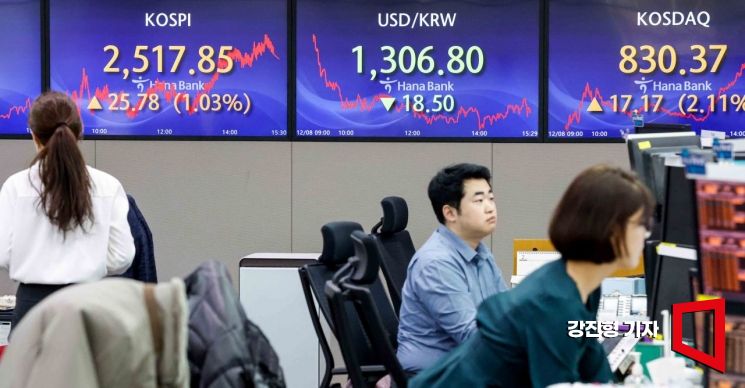 On the 8th, the KOSPI index closed at 2,517.85, up 25.78 points (1.03%) from the previous trading day, as dealers were working in the dealing room at the Hana Bank headquarters in Jung-gu, Seoul. On the same day, the KOSDAQ index closed at 830.37, up 17.17 points (2.11%) from the previous trading day. Photo by Kang Jin-hyung aymsdream@
As the number of taxpayers subject to capital gains tax on stocks increased, the tax burden grew. This led major shareholders to sell stocks at year-end to avoid taxes, causing side effects such as stock price declines. In fact, from December 1 to December 27 last year, when the list of taxpayers subject to capital gains tax was finalized, individual investors sold a net total of 2.2429 trillion KRW across the KOSPI and KOSDAQ markets.
Previously, during the Moon Jae-in administration, the government attempted to lower the major shareholder threshold from 1 billion KRW to 300 million KRW, but a public petition demanding the dismissal of then Deputy Prime Minister and Minister of Economy and Finance Hong Nam-ki surpassed 200,000 signatures, and Hong himself eventually offered his resignation.
Since its inauguration last year, the Yoon Seok-yeol administration has also been discussing measures to reduce the tax burden on major shareholders. The government abolished the family aggregation rule, which combined stocks held by children or grandchildren to calculate the total holding amount per stock, and proposed raising the major shareholder threshold from 1 billion KRW to 10 billion KRW per stock.
On the other hand, although raising the threshold for capital gains tax on stock transfers can be changed through the Enforcement Decree of the Income Tax Act alone, significant difficulties are expected due to opposition from opposition parties, who criticize it as a 'tax cut for the wealthy.' Earlier, on the 12th of last month, Deputy Prime Minister and Minister of Economy and Finance Choo Kyung-ho appeared on KBS and stated, "There was an agreement between the ruling and opposition parties to maintain the 1 billion KRW threshold for major shareholders until next year," indicating that raising the threshold requires bipartisan agreement.
There is also an opinion that raising the major shareholder threshold will not significantly affect investors, as the majority of individual investors who are not major shareholders do not pay capital gains tax. In particular, from 2025, a financial investment income tax will be imposed regardless of major shareholder status on those who earn investment income exceeding 50 million KRW from domestic listed stocks, meaning that even if the major shareholder threshold is raised, it will only be temporarily applied until 2025.
Given the opposing positions of the ruling and opposition parties, it is expected that future discussions in the National Assembly and public opinion will determine the direction of the debate on raising the major shareholder threshold. Some within the ruling party have already argued that the threshold should be raised. On the previous day, Kwon Seong-dong, a member of the People Power Party, posted on his social media (SNS) Facebook, stating, "The capital gains tax threshold on stocks is too low, causing a tax-avoidance selling spree every year at year-end, which ultimately leads to stock price declines and harms many investors," and argued, "Easing the capital gains tax threshold is not a 'tax cut for the wealthy' but a 'protection of people's livelihoods.'"
© The Asia Business Daily(www.asiae.co.kr). All rights reserved.
![Clutching a Stolen Dior Bag, Saying "I Hate Being Poor but Real"... The Grotesque Con of a "Human Knockoff" [Slate]](https://cwcontent.asiae.co.kr/asiaresize/183/2026021902243444107_1771435474.jpg)















