Children's Clothing: 4 out of 10 Buyers Spend Over 150,000 Won at Once
Active Children's Clothing Purchases Despite Shrinking Consumer Sentiment
Despite the ongoing high inflation dampening consumer sentiment, spending on infant and children's clothing appears to remain relatively active.
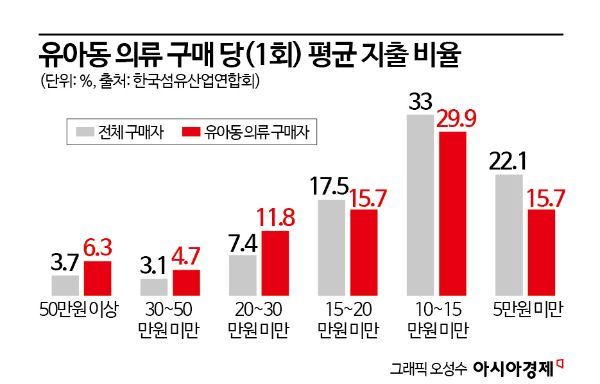
According to an online survey conducted on clothing consumers by the Korea Federation of Textile Industries on the 11th, 38.5% of all respondents said their average expenditure on infant and children's clothing was over 150,000 won. This figure is more than 10 percentage points higher than the 27.5% among all clothing purchasers. Notably, 6.3% of respondents reported spending over 500,000 won, which is higher than the 3.7% among all clothing buyers.
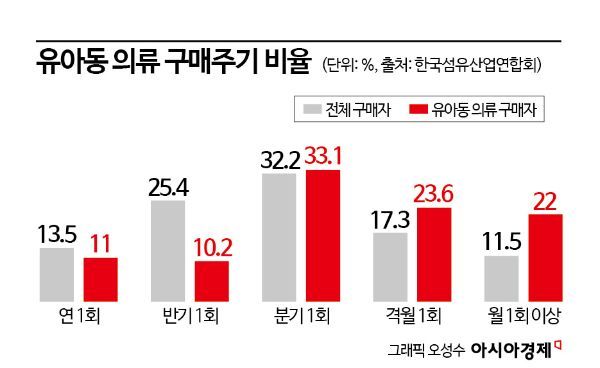
Purchases of infant and children's clothing also surpass the overall market in terms of purchase frequency and quantity. Regarding purchase frequency, about 8 out of 10 respondents (78.7%) said they buy at least once per quarter, nearly 20 percentage points higher than the 61.0% of all clothing buyers. Those who purchase at least once a month accounted for 22.0%, nearly double the 11.5% of all respondents. This likely reflects the practical reality that children’s clothes need to be replaced with appropriately sized garments as they grow.
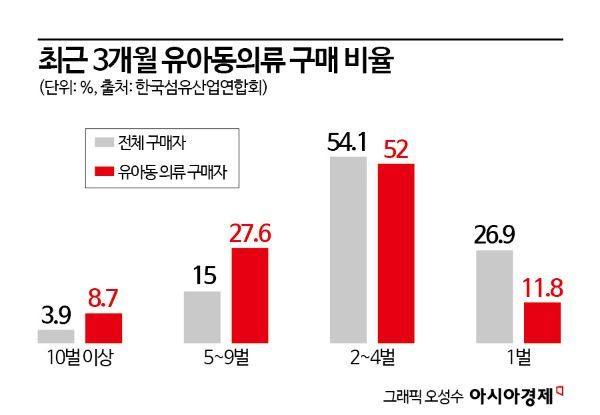
In terms of quantity, more than half (52.0%) of respondents said they purchased 2 to 4 items in the past three months, followed by 27.6% who bought 5 to 9 items. Compared to all clothing buyers, 54.1% reported buying 2 to 4 items, a similar figure, but 26.9% said they purchased only one item, ranking second, whereas among infant and children's clothing buyers, this was relatively low at 11.8%, showing a difference.
With the total fertility rate in the third quarter of this year at 0.70, solidifying the low birthrate trend and making single-child families common, it appears that parents are investing more actively and boldly in their children's clothing purchases. Additionally, the emergence of economically capable and purchasing-powerful middle-aged and senior groups, such as "active seniors" and "Hallex" (grandparents’ flex), as key consumer segments in the distribution industry also seems to be influencing this trend.
Meanwhile, the most important factor considered by infant and children's clothing buyers when making purchases was comfort, at 28.3%, followed by design (20.5%), material and finish (19.7%), price (15.0%), ease of care (9.4%), and brand (7.1%). Regarding preferred designs, about one in three (32.3%) chose comfortable designs, followed by basic designs (21.3%) and timeless designs (13.4%).
© The Asia Business Daily(www.asiae.co.kr). All rights reserved.
![Clutching a Stolen Dior Bag, Saying "I Hate Being Poor but Real"... The Grotesque Con of a "Human Knockoff" [Slate]](https://cwcontent.asiae.co.kr/asiaresize/183/2026021902243444107_1771435474.jpg)


















