55.8% of Office Workers Experience Commuting Stress
Commute Time Negatively Affects Work Performance
A study has found that the longer the commuting time, the higher the risk of developing depression. This analysis suggests that so-called 'time poverty' negatively affects mental health as well.
Professor Dongwook Lee's research team from the Department of Occupational and Environmental Medicine at Inha University Hospital recently published a paper titled "A Study on the Association Between Commuting Time and Depressive Symptoms" in the international journal Transportation and Health.
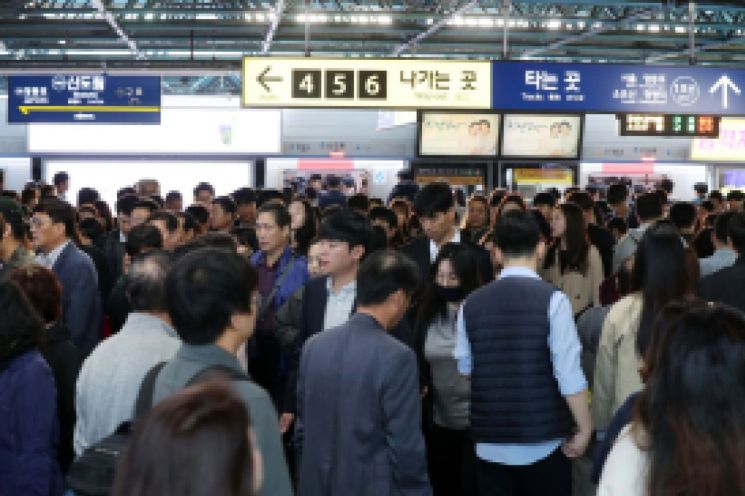 When converting the fatigue level felt by office workers during their commute into a score (out of 100 points), office workers living in the Gyeonggi area, who have the longest commute times, showed the highest fatigue level at 74 points. The fatigue scores for commuters living in Seoul and other provinces were recorded at 71 points. The photo is not related to the specific content of the article.
 [Photo by Moon Honam munonam@]
This study utilized data from the 5th Working Environment Survey, collected from 23,415 workers aged 20 to 59, and analyzed the correlation between depression and commuting time while considering various factors such as gender, age, education level, income, marital status, presence of children, occupation, weekly working hours, and shift work status.
The analysis showed that people who spend 60 minutes or more commuting daily had a 1.16 times higher risk of exhibiting depressive symptoms compared to those who commute less than 30 minutes.
The research team analyzed that commuting itself can cause psychological and physical stress and that it can negatively impact health by taking away time for personal leisure.
The factors influencing the onset of depressive symptoms varied by gender. For men, the risk of depressive symptoms was notably higher if they were ▲single, ▲childless, or ▲working long hours, whereas for women, symptoms were more commonly observed if they were ▲parents of two or more children or ▲engaged in shift work.
In particular, when time for personal leisure decreases, there is less opportunity to relieve stress and recover from fatigue through sleep or hobbies. Furthermore, time to invest in healthy lifestyle habits such as exercise also diminishes, leading to the phenomenon of 'time poverty.'
Average Commuting Time for South Korean Office Workers is 1 Hour 24 Minutes
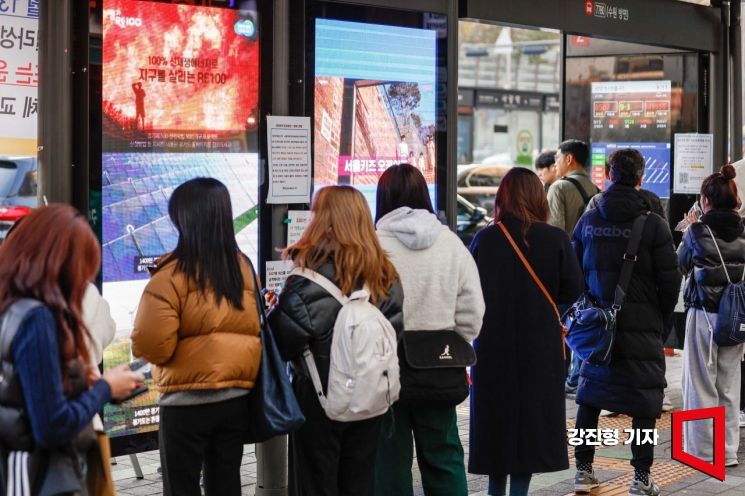 Looking at the commuting times by residential area, office workers living in the Gyeonggi region had the longest average commute time of 1 hour and 42 minutes. Office workers residing in Seoul spent an average of 1 hour and 19 minutes, while those living in provincial areas used 1 hour and 1 minute for their commute.
 [Photo by Jinhyung Kang aymsdream@]
A survey conducted by JobKorea at the end of June last year targeting 907 male and female office workers found that the average commuting time was 1 hour and 24 minutes.
By residential area, office workers living in the Gyeonggi region had the longest average commuting time of 1 hour and 42 minutes. Those living in Seoul spent an average of 1 hour and 19 minutes commuting, while office workers residing in provincial areas used about 1 hour and 1 minute for commuting.
When converting the fatigue felt during commuting into a score out of 100, office workers living in the Gyeonggi region, who had the longest commuting times, reported the highest fatigue score of 74. Both Seoul and provincial area office workers scored 71 points for commuting fatigue.
The reason office workers feel such high stress and fatigue during commuting is the reality of going to work itself.
Sixty-three percent of respondents said they felt stressed because of the reality of "going to work again today," which was the highest response.
The second most common stress factor during commuting differed by residential area. Office workers in Seoul and the Gyeonggi region cited overcrowded buses and subways (44.7%, 39.6%) as the main stressors. In contrast, those living in provincial areas pointed to the tense feeling of barely making it on time by a few minutes and the anxiety of being late (34.7%).
Especially among Gyeonggi region office workers, many expressed fatigue due to the long distance between home and workplace (39.3%). Other factors making commuting difficult included discomfort from wearing masks (27.2%), heavily congested roads (28.3%), and various nuisance passengers such as backpack attacks and wide-legged riders (11.2%).
"20% of Life is on Public Transportation" - A Common Joke
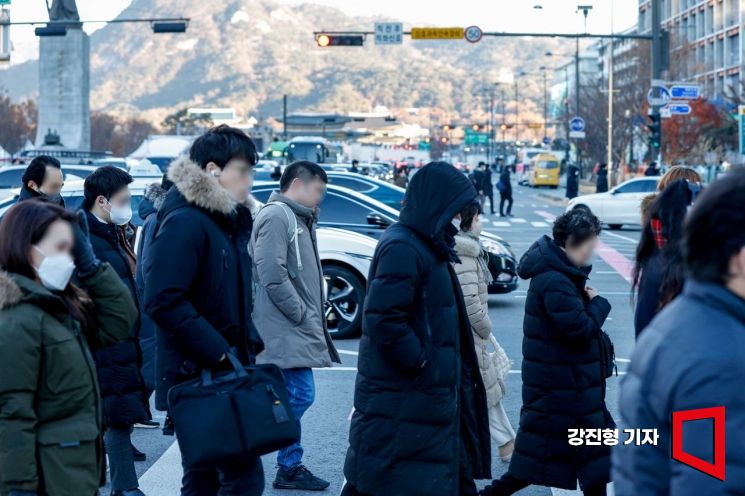 On the morning of the 30th of last month, as the temperature in Seoul dropped to minus 8 degrees Celsius, continuing the cold below freezing, office workers were seen wearing thick coats on their way to work at the Gwanghwamun intersection in Jongno-gu, Seoul.
 [Photo by Jinhyung Kang aymsdream@]
As previous research results indicate, long commuting times are lowering the quality of life for office workers. Long commuting times and severe traffic congestion increase mental and physical stress and reduce life satisfaction.
In particular, as commuting time increases, personal time to enjoy hobbies or leisure activities decreases, resulting in 'time poverty.' Additionally, commuting time has been shown to affect work and health.
A survey by the employment portal Saramin of 1,556 office workers on 'commuting distance stress and work impact' found that more than half (55.8%) felt stressed during their usual commuting time.
The most common effect was feeling lethargic before work (44.9%), followed closely by depression due to wasted personal time (44.5%). Other responses included decreased work performance due to reduced concentration before work (25.1%), physical symptoms such as heart palpitations and increased blood pressure (16.7%), and conflicts arising from reduced family time (11.1%).
Commuting stress was also found to negatively affect work. The biggest impact was decreased work concentration due to exhaustion before arriving at work (57.8%), followed by reduced work efficiency due to health deterioration such as lack of sleep (49.9%), decreased vitality due to lack of personal time (43.9%), and frequent consideration of job changes to reduce commuting distance (21.8%).
As a result, a significant number of respondents considered changing jobs (39.1%) or moving residences (11.6%). When asked about the most important factors when joining a company, job security (34.7%) and salary (21.7%) were ranked first and second, with commuting distance (18.8%) coming in third.
Regarding these issues, Professor Dongwook Lee of Inha University stated, "Although some studies suggest that long commuting times can have positive effects on health, in Korea, longer commuting times tend to negatively affect mental health. Efforts to reduce commuting time are necessary to achieve a balanced coexistence of work and family life."
© The Asia Business Daily(www.asiae.co.kr). All rights reserved.
![Clutching a Stolen Dior Bag, Saying "I Hate Being Poor but Real"... The Grotesque Con of a "Human Knockoff" [Slate]](https://cwcontent.asiae.co.kr/asiaresize/183/2026021902243444107_1771435474.jpg)

















