Hyundai Motor Group to Provide Corporate Cars to Executive Directors and Senior Managers Starting This Year
Executive Ratio Lower Than Samsung and LG Electronics
Wage Growth Gap Between Employees and Executives Widens Annually
Subsidiary Executive Salary Ranking: Hyundai Motor - Hyundai Mobis - Kia
At Hyundai Motor Company, executives receive a car upon promotion. As the largest automaker in South Korea, this is seen as a natural benefit, but it is a new regulation introduced this year. Previously, only executives at the vice president or president level were provided with company cars, while directors or executives had to purchase their own cars with discounts based on certain criteria, just like other employees. Starting this year, company cars will also be provided to directors and executive directors.
The vehicle models for directors are the sport utility vehicles (SUVs) Palisade or Genesis GV60 and GV70, while executive directors receive a higher-grade Genesis GV80 or G80. Vice presidents and above get the most expensive Genesis G90 along with a chauffeur. Executives at Kia, an affiliate company, receive cars of similar grades. Other benefits, such as business class seats for overseas business trips or enhanced health checkup benefits, are similar to those at other large corporations.
Given the high proportion of production workers, the path to becoming an executive is arithmetically more difficult compared to other large companies. As of last year, Hyundai Motor had 72,689 employees, of which only 379 (0.52%) were non-registered executives. Kia had 138 executives out of 35,847 employees, accounting for 0.38%. These ratios are lower than Samsung Electronics (0.79%, as of the end of June this year) and LG Electronics (0.85%).
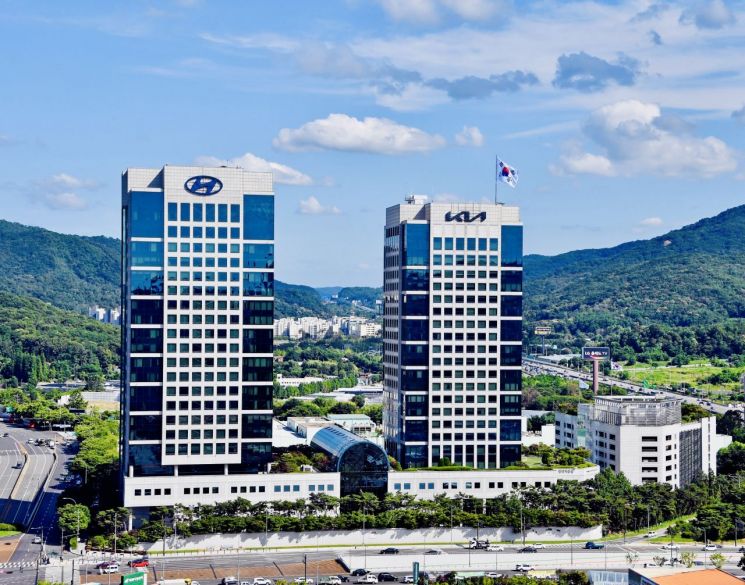
Salaries increase significantly. As of last year, the average salary for all Hyundai Motor employees was 105 million KRW, while executives earned 591 million KRW (excluding registered executives). Compared to the previous year, overall employee salaries rose by about 9.4%, but executive salaries increased by 11.7%. Executives not only earn more but also have a higher rate of increase. The civic group Consumer Sovereignty Citizens' Association recently pointed out that the wage gap between Hyundai Motor employees and executives has been widening year by year over the past five years. Until 2017, executive salaries were about 9.2 times those of employees, but last year this grew to 11.6 times.
The group stated, "While the roles of the chairman and executives are important in key company decisions and operations, and Hyundai Motor's growth into a global company was due to the entrepreneurial spirit of the executives, considering there is little evidence that employees' roles were particularly lacking compared to them, the increase in executive salaries appears excessive."
Notably, compared to other affiliates within the group, Hyundai Mobis executives earn more than those at Kia. The average salary for Hyundai Mobis executives is 448 million KRW, while Kia executives earn 382 million KRW. When considering total employee salaries, the order is Kia → Hyundai Mobis → Hyundai Motor, but for executives alone, the order is reversed: Hyundai Motor → Hyundai Mobis → Kia.
Hyundai Motor Group used to divide executive ranks into director assistant, director, managing director, executive director, vice president, and president after the department head level, but now it has been simplified to managing director, executive director, vice president, and president. When Honorary Chairman Chung Mong-koo was actively managing, each major affiliate had several vice chairmen, but under Chairman Chung Eui-sun's leadership, only Vice Chairman Chung Tae-young of Hyundai Card, who is Chairman Chung’s brother-in-law, remains. At one time, some vice chairmen wielded strong authority while closely assisting the chairman. However, under Chairman Chung Eui-sun’s regime, vice chairmen who played the role of second-in-command have disappeared.
Senior executives at the executive director level or higher receive additional monthly pay for 2-3 years after retirement while serving as advisors or consultants. Most advisors or consultants are part-time with low actual involvement in company affairs. This system is operated to prevent external technology leaks and other concerns. During Honorary Chairman Chung Mong-koo’s era, there was a joke that former executives below the president level rarely sought new jobs after stepping down because they never knew when personnel changes would occur. Even after leaving the company, if the chairman needed them, they could rejoin and work anytime. Similar occurrences occasionally happened during the era of the late founder Chung Ju-yung at Hyundai Group.
© The Asia Business Daily(www.asiae.co.kr). All rights reserved.
![Clutching a Stolen Dior Bag, Saying "I Hate Being Poor but Real"... The Grotesque Con of a "Human Knockoff" [Slate]](https://cwcontent.asiae.co.kr/asiaresize/183/2026021902243444107_1771435474.jpg)
















