Silla History Authority Joo Bodon, Kyungpook National University Emeritus Professor, Keynote Lecture
Academic Symposium Discusses Sharing, Preservation, and Maintenance Directions of Historical Value
Pohang City will hold an academic symposium to share the accumulated achievements regarding the royal temple of the Silla period, ‘Pohang Beopgwangsa Site,’ over two days on the 7th and 8th at the POSCO International Hall’s International Conference Room.
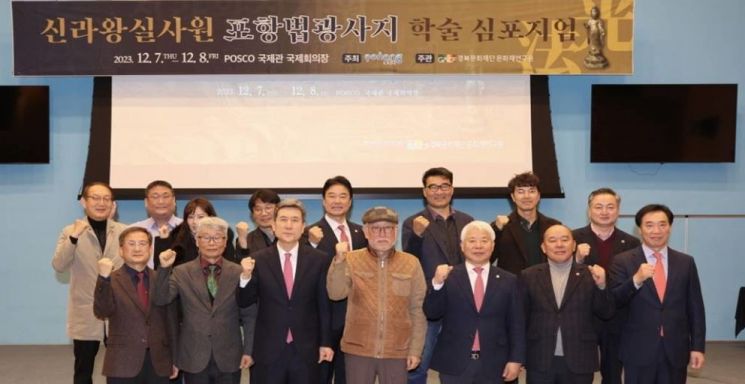
Organized by the Cultural Heritage Research Institute of the Gyeongbuk Cultural Foundation, which has been conducting excavations at Beopgwangsa Site, this event was prepared to reflect on the historical value of ‘Pohang Beopgwangsa Site’ as a royal temple of Silla based on over ten years of investigation results and to discuss directions for preservation and maintenance.
The symposium, which began with an opening ceremony on the 7th, featured a keynote lecture titled ‘The Reconstruction of Beopgwangsa and Its Significance’ by Professor Emeritus Ju Bodon of Kyungpook National University, followed by presentations from renowned cultural heritage preservation experts.
In the afternoon of the same day, participants took a field trip to the Beopgwangsa Site and nearby Silla period historical resources such as the Naengsuri Silla Stele, Naengsuri Burial Mounds, and Gyeongju Heungdeok Royal Tomb, where they enjoyed vivid explanations from experts.
On the 8th, the symposium attracted attention with a scheduled presentation by Professor Akihiro Shimizu (淸水昭博) from Tezukayama University (帝塚山), Japan, who specializes in Buddhist art history, comparing and analyzing the Beopgwangsa and ancient Japanese temple main halls.
The nationally designated heritage site (Historic Site) ‘Pohang Beopgwangsa Site’ is located in Sang-eup-ri, Singwang-myeon, Buk-gu, Pohang City. According to records, it was founded by Monk Wonhyo under the king’s command during the reign of King Jinpyeong of Silla (579?632). Today, only stone remains such as the main hall foundation, a three-story stone pagoda, twin guardian figures, and flagpole supports remain, quietly preserving the temple grounds.
Since 2010, Pohang City and the Cultural Heritage Research Institute of the Gyeongbuk Cultural Foundation have achieved significant results through 13 years of excavation at Beopgwangsa Site, uncovering the Unified Silla period main hall foundation style, a large 4-meter stone Buddha statue, and various ornate gilt-bronze ornaments.
Additionally, the ‘Pohang Beopgwangsa Site Three-story Stone Pagoda,’ located on the west side of the temple, clearly records the construction year (828, the 3rd year of King Heungdeok) and the renovation year (846, the 8th year of King Munseong) on its inscription, earning academic value and was designated as a Gyeongbuk Province heritage (tangible cultural heritage) in March this year, making it a historically rich resource.
Mayor Lee Kang-deok stated, “We are planning to upgrade the currently Gyeongsangbuk-do designated heritage ‘Pohang Beopgwangsa Site Three-story Stone Pagoda’ to a nationally designated heritage (Treasure). Based on the opinions gathered at this academic symposium, we plan to steadily take steps to prepare a comprehensive maintenance plan that can restore the authenticity of the temple as a royal Silla temple.”
© The Asia Business Daily(www.asiae.co.kr). All rights reserved.
![Clutching a Stolen Dior Bag, Saying "I Hate Being Poor but Real"... The Grotesque Con of a "Human Knockoff" [Slate]](https://cwcontent.asiae.co.kr/asiaresize/183/2026021902243444107_1771435474.jpg)















