Jusanyeon Seminar on Measures to Revitalize Housing Supply for Single-Person Households
As of September this year, the supply of officetels has decreased by 67% compared to the previous year. During the same period, permits for multi-family housing dropped by 70.5%, and permits for multi-unit housing decreased by 53.1%. With the shortage of small housing primarily occupied by single-person households, concerns are rising that housing instability among vulnerable groups such as youth may worsen in the future.
On the other hand, there are growing calls for regulatory relaxation to expand supply, such as excluding officetels from the housing count.
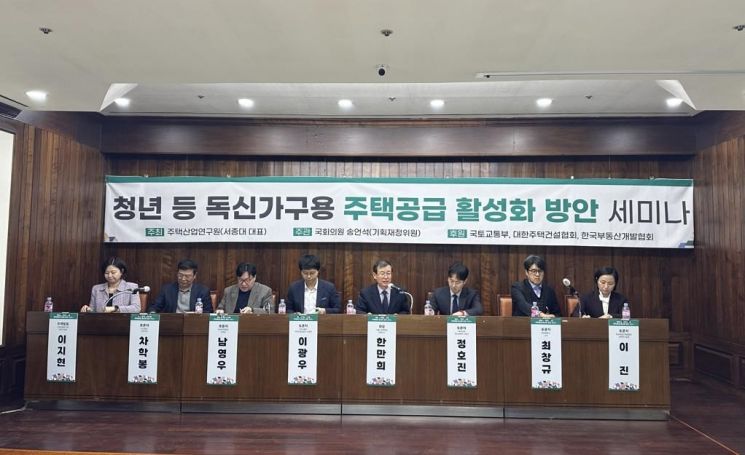
On the 6th, a seminar titled "Measures to Revitalize Housing Supply for Youth and Single-Person Households" was held at the National Assembly Library, hosted by the Korea Research Institute for Human Settlements and organized by Song Eon-seok, a member of the People Power Party. Ji-hyun Lee, a senior researcher at the Korea Research Institute for Human Settlements, stated, "Compared to the rapidly increasing number of youth and other single-person households, the supply of multi-unit housing and officetels they need is decreasing too quickly," adding, "To expand the supply of quality small rental housing, tangled tax policies and building standards must be promptly revised."
According to the Korea Research Institute for Human Settlements, last year, single-person households numbered about 7.5 million, accounting for 34.5% of all households. By 2030, the proportion of single-person households is expected to exceed 40%. However, the supply of small housing, where single-person households mainly reside, is steadily decreasing. Since 2017, single-person households have increased by an average of 6.0% annually, but the stock of small housing to support this has decreased by an average of 5.9% annually.
From January to September this year, the cumulative permits for multi-unit housing totaled 97,000 units, down 53.1% from the same period last year, and multi-family housing permits were 72,000 units, a 70.5% decrease.
According to Real Estate 114, the annual supply of officetels (based on move-in availability) peaked at 109,000 units in 2019 and has been declining for five consecutive years. From January to September this year, the supply was 12,800 units, a 67.1% decrease compared to the same period last year. The supply of urban-type residential housing during the same period was 5,800 units, down 73.6% from the previous year.
Researcher Lee explained, "Small housing is intended for rental income rather than capital gains, but because it is subject to heavy taxation such as comprehensive real estate tax, property tax, and capital gains tax for multi-homeowners, demand has decreased, leading to a decline in supply." He added, "If interest rates fall and the economy recovers around the second half of next year, housing prices and rents for small housing could surge rapidly, exacerbating housing instability for one- and two-person households."
As a measure to expand small housing supply, he proposed excluding officetels from the housing count to exempt them from multi-homeowner heavy taxation. However, to prevent individuals from acquiring dozens of units, he suggested recognizing ownership of one additional officetel under 85㎡ besides their primary residence as a single home, and for those with certain income levels or aged 60 or older, recognizing ownership of up to two officetels besides their primary residence as a single home.
He also advocated allowing balconies below a certain size to increase usable space and improve the quality of living spaces. The Korea Research Institute for Human Settlements proposed tax reductions on acquisition and capital gains for seniors aged 60 or older who downsize from single-family homes or apartments to small housing.
At the seminar, Kim Sang-hoon, chairman of the National Assembly's Planning and Finance Committee (People Power Party), and Song Eon-seok, a member of the same committee, attended, drawing attention to whether discussions on tax reforms related to officetels and other small housing will gain momentum.
Representative Song said, "The previous government strengthened holding taxes on multi-homeowners, which has led to a contraction in the supply of small-scale housing mainly occupied by single-person households."
He emphasized that officetels and urban-type residential housing have been held by elderly people as one or two units for retirement income rather than owner-occupied demand, but since all these are counted as taxable housing units, they face heavy taxation and are forced to dispose of them.
Park Sang-woo, nominee for Minister of Land, Infrastructure and Transport, also stressed the need for housing policies that reflect demographic changes, supporting a policy direction focused on non-apartment housing.
Experts at the seminar expressed concern that unprecedented supply declines are occurring due to interest rate hikes, construction cost increases, and falling real estate prices, emphasizing the importance of non-apartment housing supply.
Kim Seung-bae, president of the Korea Real Estate Development Association, said, "Currently, the focus is on supplying apartments for three- to four-person households, but if old houses are demolished and replaced with apartments, housing for one- to two-person households will disappear," adding, "The housing price surge and housing instability among vulnerable groups expected in two to three years due to the shortage of small housing will become a very serious issue for our society."
© The Asia Business Daily(www.asiae.co.kr). All rights reserved.
![Clutching a Stolen Dior Bag, Saying "I Hate Being Poor but Real"... The Grotesque Con of a "Human Knockoff" [Slate]](https://cwcontent.asiae.co.kr/asiaresize/183/2026021902243444107_1771435474.jpg)















