"Ensuring Gender, Career, Regional, and Religious Diversity in Supreme Court Justice Appointments" Advocated During Lifetime
“Law schools are training grounds for the future leaders of this country, so the path to the social elite must be wide open to talented and qualified individuals from all racial and cultural backgrounds.”
This was the opinion left by Sandra Day O’Connor, the first female U.S. Supreme Court Justice, in the 2003 ruling on the unconstitutionality of affirmative action in college admissions in the case of Grutter v. Bollinger. When the Supreme Court Justices were evenly split 4 to 4 on the University of Michigan Law School’s admissions policy that considered racial factors, O’Connor played the decisive “casting vote” role, resulting in a constitutional ruling. In this sharply divided conservative versus progressive U.S. Supreme Court, O’Connor is regarded as the “balance” that held the center.
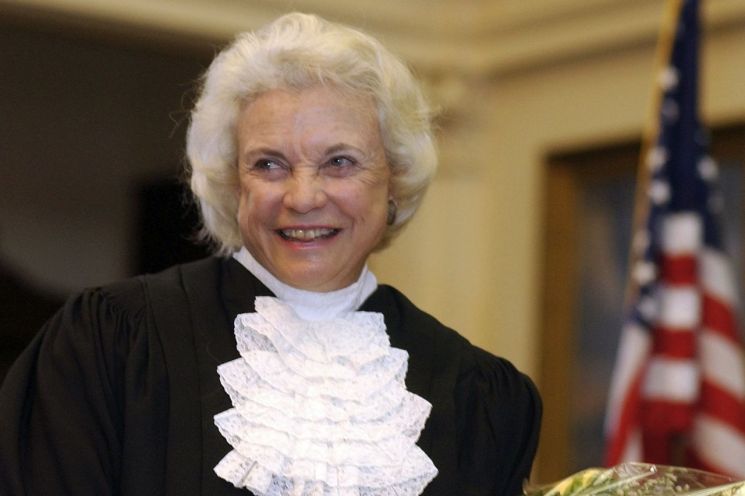 Former U.S. Supreme Court Justice Sandra Day O'Connor, the first female federal Supreme Court Justice in the United States, passed away at the age of 93 on the 1st (local time). [Image source=Yonhap News]
Rulings Protecting Minority Rights on Abortion, Same-Sex Marriage, and More
O’Connor, who passed away at the age of 93 on the 1st (local time), was nominated in 1981 by then-President Reagan as the first female U.S. Supreme Court Justice in American history. Appointed by a Republican president, O’Connor was fundamentally a moderate conservative. However, regardless of ideology, she left her name in history by issuing many landmark rulings protecting the rights of social minorities.
One representative case was in 1992, in the case of Planned Parenthood v. Casey, which challenged the constitutionality of a Pennsylvania law restricting abortion rights based on pregnancy duration and parental or spousal consent. O’Connor took the position that abortion rights should not be restricted. In the opinion she co-authored with Justices Anthony Kennedy and David Souter, O’Connor reaffirmed the core stance of the Roe v. Wade ruling (1973) that “the right to abortion is included in the constitutionally based ‘right to privacy’ and is therefore legal.”
In 2003, in a case where police arrested individuals for same-sex sexual conduct, O’Connor ruled that the Texas statute under which the arrests were made was unconstitutional because “punishing only same-sex couples for the same sexual conduct violates the Equal Protection Clause of the 14th Amendment.” This ruling laid the groundwork for the 2015 U.S. Supreme Court decision legalizing same-sex marriage.
She also left dissenting opinions that revealed her characteristic pragmatism. In March 2005, when the Supreme Court ruled that the death penalty for minors under 18 was unconstitutional, O’Connor dissented, arguing that “a blanket ruling against the death penalty for minors is misguided, and a better approach is to judge the maturity of juvenile offenders on a case-by-case basis.” She added, “It is common experience that some 17-year-old minors are more mature than the average young adult.”
“O’Connor’s Confirmation as Justice Was Evidence of Historic Progress in America”
Born in 1930 as the eldest daughter on a ranch in El Paso, Texas, O’Connor entered Stanford University at age 16, majoring in economics, and then entered the same university’s law school at 19. Although she graduated from law school at 22 with excellent grades, she rejected an offer to work as a secretary rather than a lawyer simply because she was a woman. Instead, she began her legal career as a deputy district attorney in California, where she had neither an office nor a salary. She then entered politics, serving as elected Arizona deputy attorney general and later as a Republican state senator, becoming the first female majority leader of the Arizona State Senate in 1973. She returned to the legal field and was appointed as a judge on the Arizona Court of Appeals in 1975, serving until 1979.
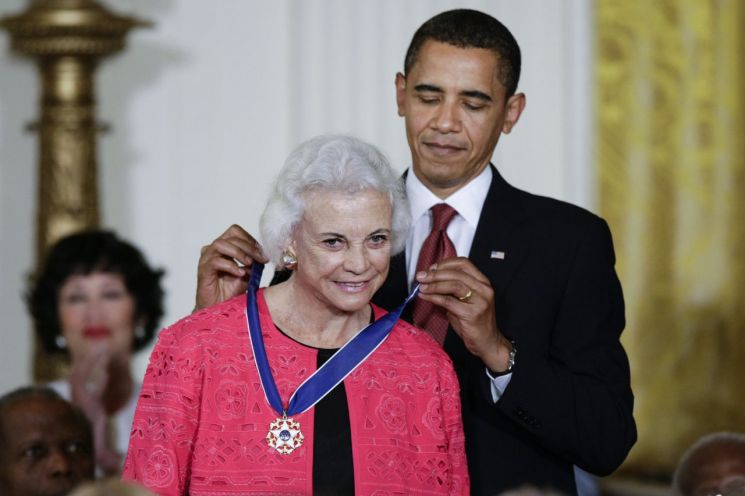 Former U.S. Supreme Court Justice Sandra Day O'Connor, who passed away on the 1st (local time), receiving the 'Medal of Freedom' from then-President Barack Obama on August 12, 2009.
 [Image source=Yonhap News]
O’Connor retired from the Supreme Court in 2006 to care for her husband, who was suffering from Alzheimer’s disease. In 2009, she was awarded the Presidential Medal of Freedom, the highest civilian honor, by the U.S. government. That same year, she participated as a panelist in a debate hosted by William & Mary College, where she served as honorary chancellor, emphasizing that “diversity must be ensured so that people with various backgrounds in gender, professional careers, regions, and religions can become Supreme Court Justices.” Under judicial rules that allow federal judges to serve for life once appointed, she occasionally served as a senior judge after retirement.
In October 2018, O’Connor announced in a letter to friends and colleagues that she was stepping down from all public offices due to her battle with Alzheimer’s disease. In the letter, she said, “My final days living with dementia will be difficult, but I remain grateful for the many blessings that have been given to me in my life.” She concluded, “Even I could not have imagined that a cowgirl from the Arizona desert would become the first female Supreme Court Justice, and I wish blessings for everyone.”
On the 2nd, when news of O’Connor’s death was announced, President Biden issued a statement saying, “I remember the hope surrounding his historic Supreme Court nomination,” and praised that the Senate’s unanimous 99-0 vote to confirm Justice O’Connor was evidence of historic progress in America.
The New York Times reported, “Justice O’Connor occupied the broad ideological center of the Supreme Court, wielded tremendous influence in American jurisprudence, and was literally the most powerful woman in America during her time.”
Yoonji Hong, Legal Times Reporter
※This article is based on content supplied by Law Times.
© The Asia Business Daily(www.asiae.co.kr). All rights reserved.
![Clutching a Stolen Dior Bag, Saying "I Hate Being Poor but Real"... The Grotesque Con of a "Human Knockoff" [Slate]](https://cwcontent.asiae.co.kr/asiaresize/183/2026021902243444107_1771435474.jpg)
















