Surpassing Hong Kong, Approaching 5th Place Worldwide
The market capitalization of the Indian stock market, which is attracting global investment funds, has surpassed $4 trillion for the first time in history. This is analyzed as a result of foreign investors' funds flowing from the Chinese stock market to the Indian stock market due to the real estate market crisis and US-China conflicts. Some predict that the market capitalization of the Indian stock market will surpass the declining Hong Kong stock market.
According to Bloomberg on the 5th (local time), the market capitalization of the Indian stock market exceeded $4 trillion (5,250 trillion won) based on the closing price that day. This is the first time since the opening of India's two major stock exchanges (Bombay Stock Exchange and National Stock Exchange of India). The market capitalization of the Indian stock market has grown threefold compared to during the 2020 pandemic.
The Indian stock market experienced a correction earlier this year due to accounting fraud allegations against the Adani Group, but it has been on a full-fledged upward trend since April. From the beginning of this year to now, the major indices representing the Indian stock market, such as the 'BSE Sensex' and 'Nifty 50,' have recorded gains of 13-15%. This marks eight consecutive years of annual growth.
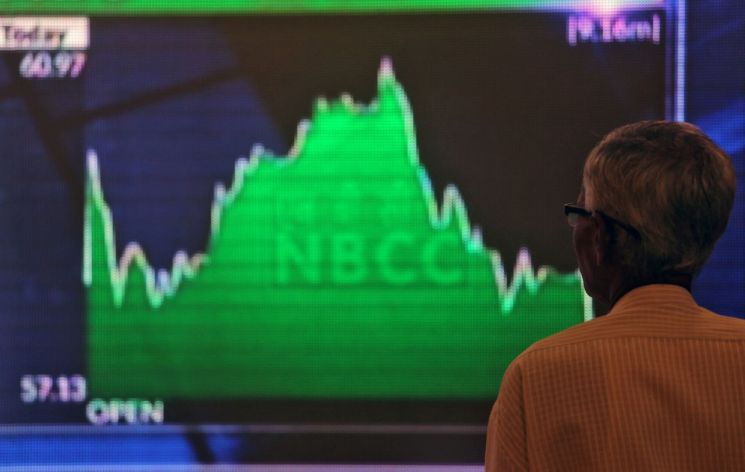
With foreign funds pouring in, the Indian stock market continues its upward trend. Since the beginning of this year, foreign investors have net purchased $15 billion in the Indian stock market. The net inflow of funds into India has exceeded $20 billion. Foreign media have evaluated that the upward trend of the Indian stock market continues as foreign funds leaving the Chinese market flock to the Indian market. Bloomberg forecasted, "If the current trend continues, the day when the market capitalization of the Indian stock market surpasses that of the Hong Kong stock market ($4.7 trillion) is not far off." During the same period, the Hong Kong stock market index has not escaped a negative trend compared to the beginning of the year.
Despite concerns about a global economic slowdown, India's third-quarter gross domestic product (GDP) showed a remarkable growth rate of 7.6%, continuing its boom. This significantly exceeds China's growth rate of 4.9%. Ashish Gupta, Chief Investment Officer (CTO) of Axis Mutual Fund, said, "India is shifting from a consumption-driven economy to an economy led by both consumption and investment," adding, "The stock market is responding positively to this structural change."
Exports, the engine of India's economic growth, are also showing strong performance. Due to the supply chain risks from China highlighted by the COVID-19 pandemic, global companies are relocating to places like India, leading to an assessment that China's status as the 'world's factory' has already shifted to India. Bloomberg noted that the fact that India's population surpassed 1.4 billion this year and is expected to overtake China as the most populous country next year, along with the high likelihood of Prime Minister Narendra Modi securing a third term, are attracting investors' attention.
Experts predict that the bull market in the Indian stock market will continue. Last month, Goldman Sachs named India as the only market in the Asia region with a long-term structural growth story and upgraded its investment rating on the Indian stock market to 'overweight.' Nomura Holdings also maintained an 'overweight' rating on India in its recent Asia-Japan strategy report. Chetan Seth, a Nomura analyst, wrote in an investor memo that "assuming the long-term policy execution capability of (Prime Minister Modi) is maintained, it is recommended to pursue buying on dips during market corrections."
© The Asia Business Daily(www.asiae.co.kr). All rights reserved.
![Clutching a Stolen Dior Bag, Saying "I Hate Being Poor but Real"... The Grotesque Con of a "Human Knockoff" [Slate]](https://cwcontent.asiae.co.kr/asiaresize/183/2026021902243444107_1771435474.jpg)















