Recently, as China has suspended customs clearance for industrial urea exports to South Korea, raising concerns about a second urea crisis, the government has decided to double the public stockpile of vehicle urea through the Public Procurement Service. Additionally, if import disruptions from China persist for a significant period, plans are in place to establish support measures to alleviate the burden on domestic companies importing from third countries. To prevent temporary shortages of urea solution, the government is also considering limiting the quantity per purchase.
On the 6th, the government held the "11th Economic Security Core Items Task Force Meeting" at the Seoul Government Complex, chaired by Kim Byung-hwan, First Vice Minister of the Ministry of Economy and Finance, and announced that it would implement these urea supply and distribution measures. Earlier, on the 30th of last month, the General Administration of Customs of China suspended exports of industrial urea by its companies to a major South Korean corporation. Urea is the main raw material of urea solution, which is added to reduce emissions from diesel vehicles. If the supply of urea is cut off, disruptions are inevitable not only in vehicle transportation but also in domestic industries such as manufacturing.
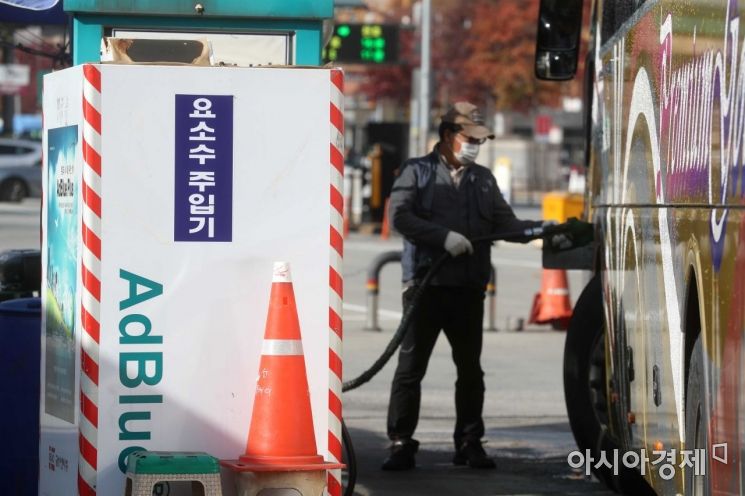 On the 7th, amid a nationwide shortage of diesel exhaust fluid, a vehicle is refueling with diesel at the Seoul Express Bus Terminal in Seocho-gu, Seoul. Photo by Mun Ho-nam munonam@
The government plans to diversify import sources to secure additional quantities of vehicle urea from regions outside China. Currently, the domestic urea stock covers 3.7 months of supply. According to government verification, some domestic companies recently confirmed contracts to import 5,000 tons of urea from countries such as Vietnam, slightly increasing the existing three-month supply. To prevent a urea solution crisis, the government intends to expand the public stockpile centered on the Public Procurement Service. The Public Procurement Service is currently negotiating with domestic urea solution manufacturers to double the public stockpile of vehicle urea from 6,000 tons (one month's usage) to 12,000 tons. For companies experiencing temporary supply difficulties, applications will be accepted to release about 2,000 tons of the currently held public stockpile of vehicle urea early, according to the situation.
Monitoring of the urea supply situation will also be significantly strengthened. Relevant ministries, including the Ministry of Trade, Industry and Energy and the Ministry of Environment, will monitor the on-site supply status of urea solution daily and strive to stabilize distribution by setting purchase quantity limits per transaction for trucking associations and gas stations to prevent supply difficulties caused by market disruptions. The government explained that if import disruptions from China persist for a considerable period, it plans to devise support measures to reduce the corporate burden for domestic companies urgently needing to import from third countries such as Vietnam. To this end, efforts will be made for the prompt passage of the 'Basic Supply Chain Act,' which includes the establishment of a Supply Chain Stabilization Committee and a Supply Chain Stabilization Fund.
Background of South Korea's Urea Instability... Due to China's Increased Exports to India
The government analyzed that the recent sudden suspension of urea imports was due to China significantly increasing its export volume to India. Choi Jae-young, Deputy Head of the Economic Security Supply Chain Planning Team at the Ministry of Economy and Finance, stated, "It was confirmed that about 860,000 tons of urea were imported from China to India in September," adding, "This is twice the amount South Korea imports annually, and we believe this export control was implemented to secure domestic supply."
The government analyzed that China did not specifically suspend exports of vehicle urea to South Korea. A government official said, "Upon confirmation, Japan was also denied urea imports from China, and it is generally judged that China is blocking all export volumes."
However, criticism is expected that the government’s fundamental measures were insufficient despite the spread of concerns about a second crisis following the 2021 urea solution incident. Deputy Head Choi emphasized, "The government is also uncomfortable and apologetic about China's refusal of customs clearance for urea. However, over the past two years, the government has established the Economic Security Supply Chain Planning Team to inspect core items and has been working on plans and legislation to diversify supply sources."
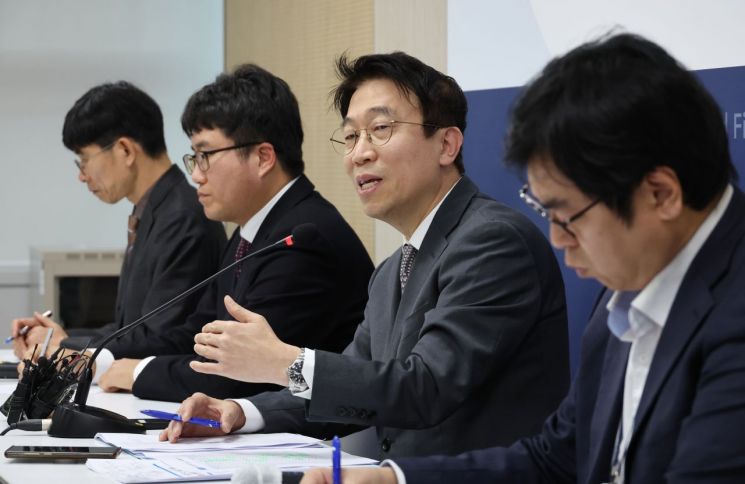 Briefing on the Results of the Interdepartmental Inspection Meeting on Vehicle Urea
(Sejong=Yonhap News) Reporter Choi Jae-gu = On the 6th, at the briefing on the results and future plans of the interdepartmental inspection meeting on vehicle urea held at the Government Complex Sejong, Choi Jae-young, Deputy Director of the Supply Chain Planning Division, is answering questions. 2023.12.6
jjaeck9@yna.co.kr
(End)
<Copyright(c) Yonhap News Agency, Unauthorized reproduction and redistribution prohibited>
In fact, after the urea solution incident, the government prepared the Special Measures Act to Strengthen Competitiveness in Materials, Parts, and Equipment and has been working to stabilize the supply chain of economic security core items, including urea. However, this is currently pending in the National Assembly's Legislation and Judiciary Committee. Although legal grounds for financial support were established in case of a recurrence of the urea solution incident, it means that considerable time is still needed before actual financial support can be provided.
The government emphasized, "To prevent social costs such as hoarding caused by excessive reactions from the private sector, the government is doing its best to accurately grasp the current domestic urea supply situation," adding, "Currently, except for some online sales, the domestic distribution of vehicle urea is mostly normal, so there is no need for excessive concern."
© The Asia Business Daily(www.asiae.co.kr). All rights reserved.
![Clutching a Stolen Dior Bag, Saying "I Hate Being Poor but Real"... The Grotesque Con of a "Human Knockoff" [Slate]](https://cwcontent.asiae.co.kr/asiaresize/183/2026021902243444107_1771435474.jpg)

















