Moody's Downgrades to 'Negative'
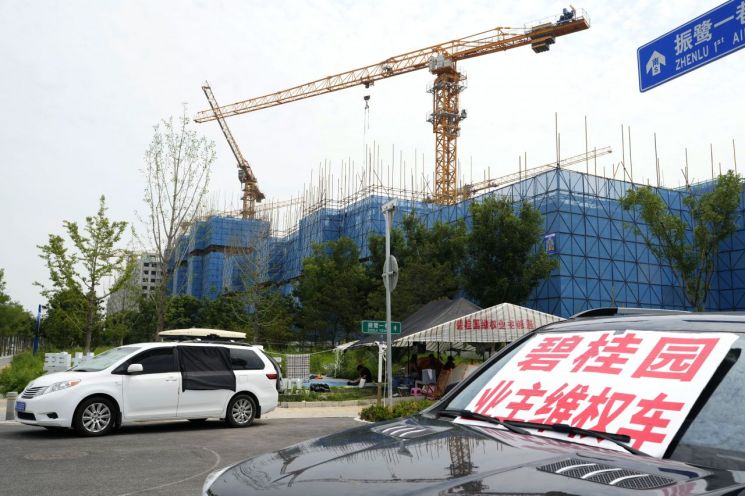 Construction site on the outskirts of Beijing by the major Chinese real estate company Biguiyuan. [Image source=Yonhap News]
While the international credit rating agency Moody's downgraded China's credit outlook, Standard & Poor's (S&P) and Fitch maintained China's sovereign credit rating outlook as 'stable.'
On the 6th, S&P stated, "We confirmed China's long-term rating at A+ with a stable outlook last June, and there has been no change yet." Fitch also maintained its A+ rating with a stable outlook for China's sovereign credit rating since August and made no changes on this day.
Earlier, Moody's, considered one of the three major credit rating agencies along with these two, maintained China's credit rating at A1 but lowered the rating outlook from 'stable' to 'negative' the day before.
A downgrade in the rating outlook means there is a higher possibility of a future downgrade in the credit rating. Moody's explained that the Chinese authorities are causing risks to the Chinese economy by using excessive fiscal stimulus to support heavily indebted local governments and state-owned enterprises.
Moody's added, "The Chinese central government is focusing its policies on preventing the debt crisis of local governments from spreading into a financial crisis," but "it is very difficult to avoid moral hazard, control fiscal costs, and maintain financial market stability."
However, Moody's assessed that China's annual gross domestic product (GDP) growth rate this year is expected to achieve around 5%, the target set by the Chinese government in March.
The Chinese government expressed "disappointment" at Moody's downgrade and rebutted, stating, "Despite the unstable global economic recovery and weakening momentum, China's macroeconomy has continuously shown a recovery trend this year, and qualitative development has steadily progressed."
Furthermore, it claimed that China's national debt at the end of last year was a total of 61 trillion yuan (approximately 1,120 trillion won), and the ratio to GDP was 50.4%, significantly lower than the internationally recognized risk threshold of 60%.
© The Asia Business Daily(www.asiae.co.kr). All rights reserved.
![Clutching a Stolen Dior Bag, Saying "I Hate Being Poor but Real"... The Grotesque Con of a "Human Knockoff" [Slate]](https://cwcontent.asiae.co.kr/asiaresize/183/2026021902243444107_1771435474.jpg)















