'Not Subject to Special Resolution Requiring Majority Attendance and Two-Thirds Presence'
The Supreme Court has ruled that matters concerning the affiliation of a labor union with a higher-level organization are subject to a general resolution, which requires "a majority attendance of registered union members and a majority approval of attending union members."
According to the legal community on the 6th, the Supreme Court's Second Division (Presiding Justice Min Yu-sook) upheld the lower court's ruling that dismissed the appeal in the case where five union members, including Mr. A, filed a lawsuit against the Busan Public Officials Labor Union to confirm the invalidity of the general meeting resolution.
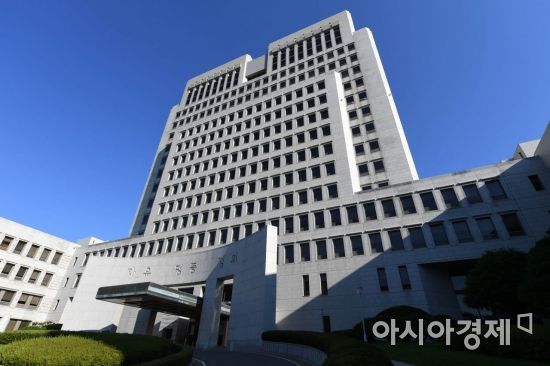
The court stated, "There is no error in the lower court's judgment that affected the ruling by misinterpreting the provisions on general meeting resolutions under the Labor Union Act, the change of bylaws, affiliation and change of federations, and the principles of union democracy," thus dismissing the appeal.
In June 2018, the Busan Public Officials Labor Union conducted a general vote among its members on the agenda of joining the higher-level organization, the Korean Government Employees' Union Federation (Gongnochoeng).
Out of 3,696 total union members, 2,849 (77%) participated in the vote, and 1,595 (56%) voted in favor, leading the union to approve the agenda. Subsequently, a delegate meeting was held, and a new provision was added to the union's bylaws stating that "Gongnochoeng shall be the federation."
Mr. A and others argued that "the decision to join a higher-level organization should be made according to a special quorum requiring 'a majority attendance of registered union members and at least two-thirds approval of attending union members,'" and filed a lawsuit requesting confirmation that the general meeting resolution was invalid.
In the trial, Mr. A and others claimed, "This resolution concerns the union joining a higher-level organization, and the name of the affiliated federation is a mandatory item in the bylaws under the Labor Union Act. Therefore, this resolution effectively constitutes a change to the bylaws, which requires a special quorum for approval under the Labor Union Act. Since the number of union members who approved did not reach two-thirds of the participating voters, the resolution quorum was not met, rendering it invalid."
Article 16 (Matters Resolved by the General Meeting) Paragraph 1, Item 6 of the Labor Union Act stipulates that "matters concerning the establishment, affiliation, and withdrawal of federations" are subject to resolution by the general meeting. Meanwhile, Paragraph 2 of the same article sets the general quorum for resolutions (majority attendance and majority approval), and the proviso lists matters requiring a special quorum (majority attendance and two-thirds approval), including "the enactment or amendment of bylaws, dismissal of officers, merger, division, dissolution, and changes in organizational form."
The first-instance court dismissed the claims of Mr. A and others.
The court explained, "Although the Labor Union Act stipulates that matters concerning the establishment, affiliation, or withdrawal of federations are subject to resolution by the general meeting, it does not explicitly list them as matters requiring special resolutions. In principle, it is consistent with a textual and systematic interpretation to regard these as general resolution matters."
Regarding the precedent cited by Mr. A and others, the court stated, "The precedent relied upon by the plaintiffs concerns resolutions about withdrawing from a federation with a specified name and joining a new federation. This case, which involves only newly joining a federation, is different."
The rulings of the appellate court and the Supreme Court were the same.
© The Asia Business Daily(www.asiae.co.kr). All rights reserved.
![Clutching a Stolen Dior Bag, Saying "I Hate Being Poor but Real"... The Grotesque Con of a "Human Knockoff" [Slate]](https://cwcontent.asiae.co.kr/asiaresize/183/2026021902243444107_1771435474.jpg)















