Korean Public Officials' Parental Leave Rate Significantly Lagging
Japanese Male Public Officials' Parental Leave Rate 72.5%
Korean Parental Leave Rate: Male 10.6%, Female 37%
The rate of paternity leave taken by male national public officials in Japan has surpassed the 70% mark for the first time.
According to reports from local Japanese media on the 5th, the National Personnel Authority, which is responsible for personnel administration of public officials in Japan, announced that 6,043 male public officials (based on full-time general positions) took paternity leave, accounting for 72.5% of those eligible for paternity leave. This represents a 9.7 percentage point increase from 62.8% the previous year.
The rate of paternity leave taken by male national public officials following the birth of a newborn has also rapidly increased, soaring from 28.0% in 2019 to 51.4% in 2020. A representative from the National Personnel Authority evaluated this as progress in creating workplaces where it is easier to take paternity leave.
The rate of paternity leave among female national public officials was recorded at 99.1%. Looking at the detailed duration, 31.2% of women took leave for '9 to 12 months,' while 48.4% of men took leave for '2 weeks to less than 1 month,' which was the most common duration.
The Japanese government aims to raise the paternity leave uptake rate, including in the private sector, to 85% by 2030 and is revising the system to make it easier to use paternity leave.
South Korean Public Officials’ Paternity Leave Rate Significantly Lags Behind Japan
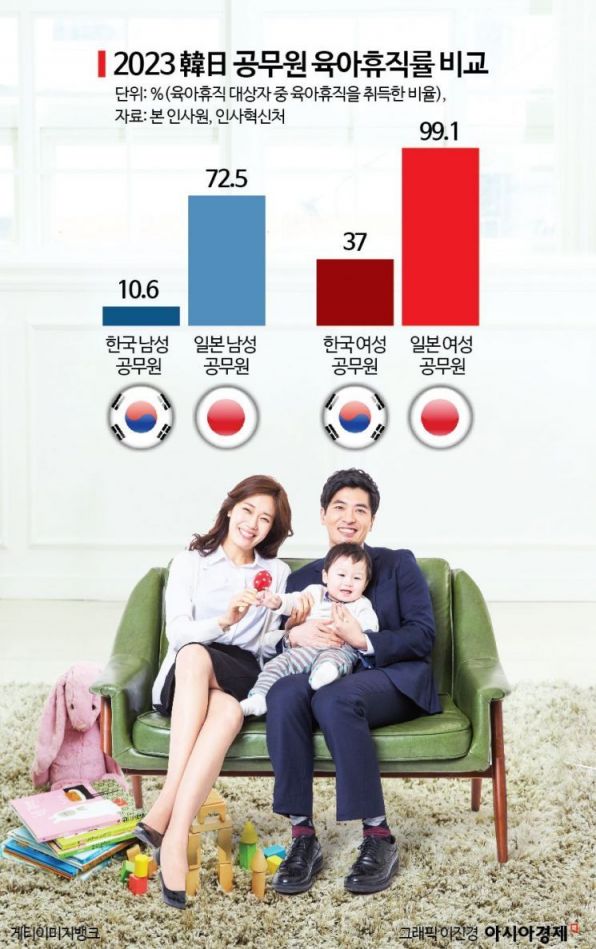
Compared to Japan, South Korea is still far behind, according to analysis. According to the 'Status of Paternity Leave Use by National Public Officials' released by the Ministry of Personnel Management, last year, among male officials eligible for paternity leave (those raising children aged 8 or younger or in the second grade of elementary school or below), only 10.6% (6,542 out of 61,485) took paternity leave, while 37% of eligible female officials (7,657 out of 26,045) took leave.
For local public officials, there are regional differences, but women use paternity leave at a rate of about 30-50%, and men at about 10-20%. The local government with the highest usage rate was Gyeonggi-do, where 37.4% of eligible officials took leave (49.7% of women and 19.3% of men). The highest female paternity leave rate was in Sejong Special Self-Governing City at 53.1%, and the lowest was in Gyeongsangbuk-do at 31.8%. For men, Gyeonggi-do had the highest rate at 19.3%, and Gyeongsangbuk-do the lowest at 11.2%.
The Ministry of Personnel Management is opening opportunities for multi-child parent officials to apply for public official career positions up to 10 years after retirement to address low birth rates. They are also considering giving additional points for promotion preference to multi-child officials at grade 8 or below. However, due to the difficult environment for raising children combined with the low birth rate problem and rapid population decline, there are calls for stronger measures such as an 'automatic paternity leave system.'
However, unlike Japan, where paternity leave can be taken until the child is 1 year old (up to 2 years), South Korea allows paternity leave until the child is 8 years old. The maximum duration of paternity leave is 52 weeks in both countries.
© The Asia Business Daily(www.asiae.co.kr). All rights reserved.
![Clutching a Stolen Dior Bag, Saying "I Hate Being Poor but Real"... The Grotesque Con of a "Human Knockoff" [Slate]](https://cwcontent.asiae.co.kr/asiaresize/183/2026021902243444107_1771435474.jpg)
















