Demand Decline Due to US-China Consumption Slowdown
Inventory Turnover Days Increase to 87.2 Days
Following the economic slowdown in China, the global manufacturing industry has entered a battle against inventory. As inventory levels have increased by about 30% compared to pre-COVID-19 times, causing cash flow to worsen and resulting in a condition akin to financial congestion, companies are engaging in individual efforts to clear out their stock.
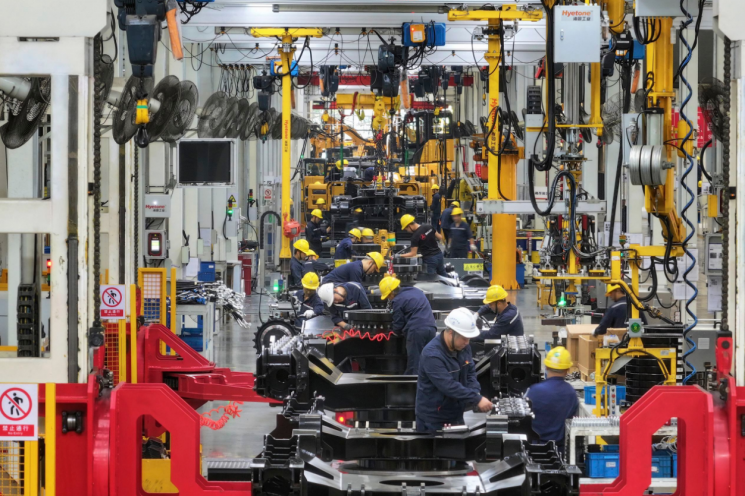
On the 5th, Nihon Keizai Shimbun reported that, according to a survey conducted through its subsidiary QUICK of 4,353 manufacturing companies worldwide, the total inventory assets as of the end of last September reached $2.1237 trillion (approximately 2,777 trillion KRW). This represents a 2% increase compared to the previous year. However, inventory assets have surged by 28% compared to December 2019 ($1.6576 trillion), before the spread of COVID-19.
As accumulated inventory increased, the inventory turnover days?the period it takes for companies to sell inventory and recover cash?also lengthened. In the third quarter of this year, the average inventory turnover days for global manufacturing companies was 87.2 days, marking the second-longest period after the second quarter of 2020 (91.6 days), when the global economy was severely impacted by COVID-19.
By industry, the inventory turnover days in the industrial machinery and measuring equipment sectors recorded 112 days and 140 days respectively, marking the longest periods since 2013. Additionally, 70% of the more than 40 industry groups showed longer inventory turnover days compared to the same period last year.
The sharp increase in inventory assets is analyzed to be due to the economic slowdown in China. Companies that experienced supply chain disruptions during COVID-19 had stockpiled inventory as a precaution against future crises. However, even with the easing of COVID-19 restrictions, demand growth in China and the United States fell short of companies’ expectations, leaving them unable to clear inventory in a timely manner.
Fanuc, a Japanese industrial robot manufacturer, stated, "Due to companies’ cautious stance on real investment in the Chinese market, it is taking more time to adjust inventory of factory automation equipment." Daikin Industries, a Japanese air conditioner manufacturer, lamented, "The real estate market slump has frozen the economy, causing distribution inventory to remain high."
Compared to China, the North American market, where consumption has been relatively steady, is also facing challenges in clearing inventory. Mitsubishi Electric of Japan saw a decline in North American sales as inventory piled up. U.S. engine developer Cummins also experienced a slowdown in product sales due to increased inventory assets.
Excess inventory acts as a negative factor blocking companies’ cash flow. Among the 4,076 manufacturing companies for which data could be aggregated, total net profit last year was $945.9 billion, a 42% increase compared to before the COVID-19 outbreak. However, operating cash flow only increased by 24% to $1.3752 trillion. This indicates a situation where companies are not generating cash proportional to their product sales. Nihon Keizai explained, "The increase in inventory assets has reduced the operating cash flow of global manufacturing companies by $250 billion."
This phenomenon is expected to continue for some time. U.S. consumption, which had been robust, has recently shown signs of slowing down, and despite economic stimulus measures by Chinese authorities, the Chinese economy has yet to rebound significantly. Nihon Keizai stated, "The manufacturing industry is struggling to deplete the inventory accumulated during the pandemic, even though supply chains have normalized since then. However, due to the economic slowdowns in the U.S. and China, it remains unclear when the excess inventory issue will be resolved."
© The Asia Business Daily(www.asiae.co.kr). All rights reserved.
![Clutching a Stolen Dior Bag, Saying "I Hate Being Poor but Real"... The Grotesque Con of a "Human Knockoff" [Slate]](https://cwcontent.asiae.co.kr/asiaresize/183/2026021902243444107_1771435474.jpg)
















