Regarding the ‘RE100’ regulation that mandates 100% use of renewable energy, two out of three Gyeonggi Province residents expressed concerns that local companies’ competitiveness might decline or that companies might relocate outside the province.
On the 5th, the Gyeonggi Research Institute published a report titled ‘How to Realize the Potential of Renewable Energy Transition’ containing these findings.
According to the report, Gyeonggi Province’s electricity consumption in 2021 was 133,445 GWh, accounting for 25% of the national total. However, renewable energy generation was only 3,281 GWh, or 2.5% of electricity consumption, falling short of the national average of 6.9%.
The capacity of renewable energy generation facilities in the province is 2.48 GW, utilizing only 3.78% of the market potential.
Meanwhile, it was analyzed that if a carbon tax is imposed under carbon neutrality regulations, production demand in key industries such as ‘computer, electronic, and optical equipment’ and ‘transportation services’ would significantly decrease.
Earlier in March, the Gyeonggi Research Institute conducted a survey of 1,000 residents via mobile, finding that 33.5% of respondents believed the RE100 regulation would negatively impact the competitiveness of local companies and the regional economy. Additionally, 31.5% worried that companies might relocate to other regions rich in renewable energy or overseas.
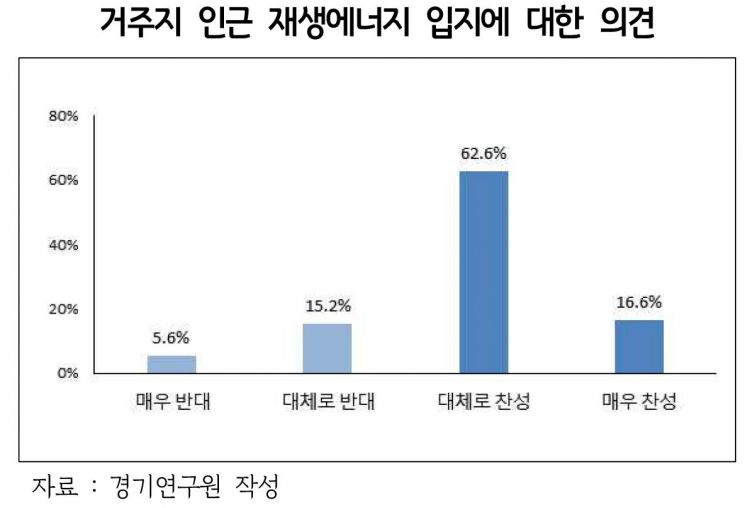
On the other hand, when asked whether green transition investments to address the climate crisis would bring new opportunities to Gyeonggi Province, 77.7% agreed. Furthermore, 79.2% responded positively to the installation of renewable energy facilities in their residential areas.
The most common feeling about the climate crisis was ‘anxiety’ at 35.2%, followed by ‘property damage from heavy rain and typhoons’ (24.4%) and ‘food issues and rising food prices’ (22.1%).
In April this year, Gyeonggi Province declared the ‘Gyeonggi RE100 Vision,’ aiming to supply 9 GW of renewable energy and actively promoting renewable energy policies to turn the climate crisis into a growth opportunity.
Meanwhile, the Gyeonggi Research Institute suggested ▲ diversifying renewable energy sources beyond solar power by establishing wind power pilot complexes and utilizing small hydropower, bioenergy, pumped storage, and tidal power ▲ resolving site constraints and increasing production efficiency ▲ recommending targets and providing incentives to local governments ▲ establishing a dedicated organization for distribution network operation and management.
Ko Jae-kyung, head of the Climate Environment Research Office at the Gyeonggi Research Institute, advised, “Currently, the market potential for renewable energy in Gyeonggi Province is only 7.65% of the technical potential, which can cover 74.7% of the province’s electricity consumption in 2021. To maximize the conversion of technical potential into market potential, efforts at the regional level must be combined with regulatory and legal system improvements by the central government.”
© The Asia Business Daily(www.asiae.co.kr). All rights reserved.
![Clutching a Stolen Dior Bag, Saying "I Hate Being Poor but Real"... The Grotesque Con of a "Human Knockoff" [Slate]](https://cwcontent.asiae.co.kr/asiaresize/183/2026021902243444107_1771435474.jpg)
















