Among 124 Representatives, 55 Support and 35 Oppose... "Caution Against Damage to Judicial Dignity"
"Need to Introduce Institutional Response at Court Level to Attacks Infringing Judicial Independence"
At the National Judges' Representative Meeting, a proposal stating that "judges should be careful not to raise doubts about their impartiality when using SNS" was passed. However, it was decided not to establish specific guidelines regarding judges' use of SNS, effectively agreeing that judges should be granted autonomy in their SNS usage. Additionally, a proposal to protect judges from excessive criticism and external attacks was approved.
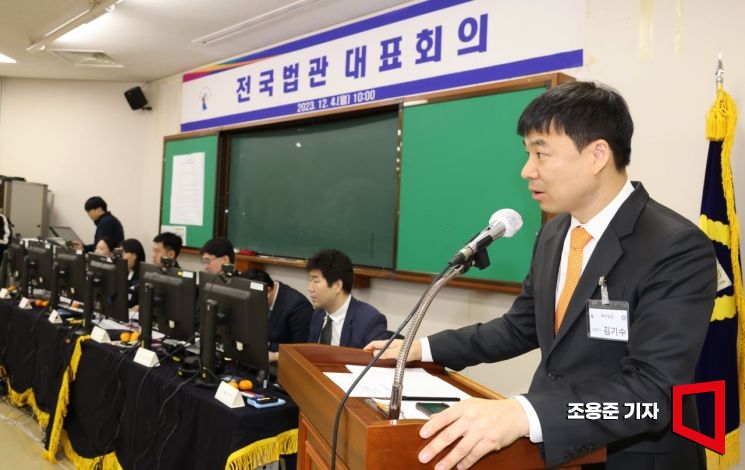 On the 4th, judges attending the National Judges' Representative Meeting held at the Judicial Research and Training Institute in Goyang-si, Gyeonggi Province, are conducting a meeting. At this meeting, agenda items regarding precautions and guidelines for judges' use of social networking services (SNS) were discussed. Photo by Jo Yongjun jun21@
On the 4th, the National Judges' Representative Meeting held its second regular meeting of the year at the Judicial Research and Training Institute in Goyang, Gyeonggi Province, where they discussed "matters judges should be cautious about when using SNS." As a result, a proposal initiated by the Judicial Trust and Judicial Ethics Subcommittee within the National Judges' Representative Meeting, stating that "judges must be careful not to create an appearance that could raise doubts about their impartiality as judges or damage the dignity of the judiciary when using SNS," was passed with 53 votes in favor, 35 against, and 11 abstentions out of 99 attendees from 124 members.
However, the existing proposal that "the Supreme Court should establish specific guidelines regarding judges' use of SNS, ensuring the participation of the National Judges' Representative Meeting so that frontline judges' opinions are sufficiently reflected" was revised and submitted as "the National Judges' Representative Meeting will prepare reference cases regarding judges' use of SNS by collecting opinions from frontline judges," and "the Supreme Court will prepare reference cases regarding judges' use of SNS by collecting opinions from frontline judges." This proposal was rejected with 46 votes in favor, 46 against, and 5 abstentions out of 97 attendees. The National Judges' Representative Meeting's regulations stipulate that decisions requiring approval must be passed by a majority of attendees.
During discussions on judges' SNS use, it was reported that there was a suggestion that the National Judges' Representative Meeting should only be involved in collecting cases rather than taking the lead in establishing guidelines, and that the formulation of guidelines based on these cases should be done later.
Regarding the proposal to establish a system to protect judicial independence from excessive attacks, a proposal stating that "the court should respond to attacks infringing on judicial independence and that a system to protect judicial independence should be promptly researched and introduced" was approved.
Recently, after the arrest warrant for Lee Jae-myung, leader of the Democratic Party of Korea, was dismissed, some civic groups have increased attacks on individual judges, such as publicly criticizing Yuchang Hoon, the chief judge in charge of warrants at the Seoul Central District Court, by name online and hanging banners with critical messages in front of the court.
In response, voices from the National Judges' Representative Meeting emphasized the need for a system that protects judicial independence through responses at the judiciary level rather than targeting individual judges.
A proposal to establish internal regulations (rules) to provide the legal basis for setting up a personnel hearing preparation team supporting candidates for the Chief Justice and Supreme Court Justices, and to regulate the composition and scope of roles of such an organization, was also approved.
A motion regarding shortening the minimum legal career period required for judicial appointments was passed with an amendment stating that "the judicial administration officer should analyze problems caused by the prolonged minimum legal career period for judicial appointments and devise countermeasures, including shortening the minimum legal career period."
Regarding the introduction of a senior judge system, the National Judges' Representative Meeting approved a proposal that senior judges should be "judges outside the quota" guaranteed to work after retirement age, and that senior judges should, in principle, be guaranteed the same status, position, and term as regular judges.
Additionally, a proposal was passed stating that judges who have served for a certain period and are about to retire should be eligible to apply, and judges selected as senior judges should be appointed and work as senior judges immediately upon retirement. The criteria, selection procedures, number of appointments, courts of service, division of duties, workload, and remuneration for senior judges should be decided by faithfully reflecting the opinions of all judges.
The National Judges' Representative Meeting is an official assembly of judges that can express opinions or make recommendations on matters related to judicial administration and judicial independence.
© The Asia Business Daily(www.asiae.co.kr). All rights reserved.
![Clutching a Stolen Dior Bag, Saying "I Hate Being Poor but Real"... The Grotesque Con of a "Human Knockoff" [Slate]](https://cwcontent.asiae.co.kr/asiaresize/183/2026021902243444107_1771435474.jpg)















